 MineArchive
Cannel Coal
| Also known as | Cannel, Parrot Coal (Scottish), Candle Coal |
|---|---|
| Category | Commodities |
| Commodity page | Cannel Coal → |
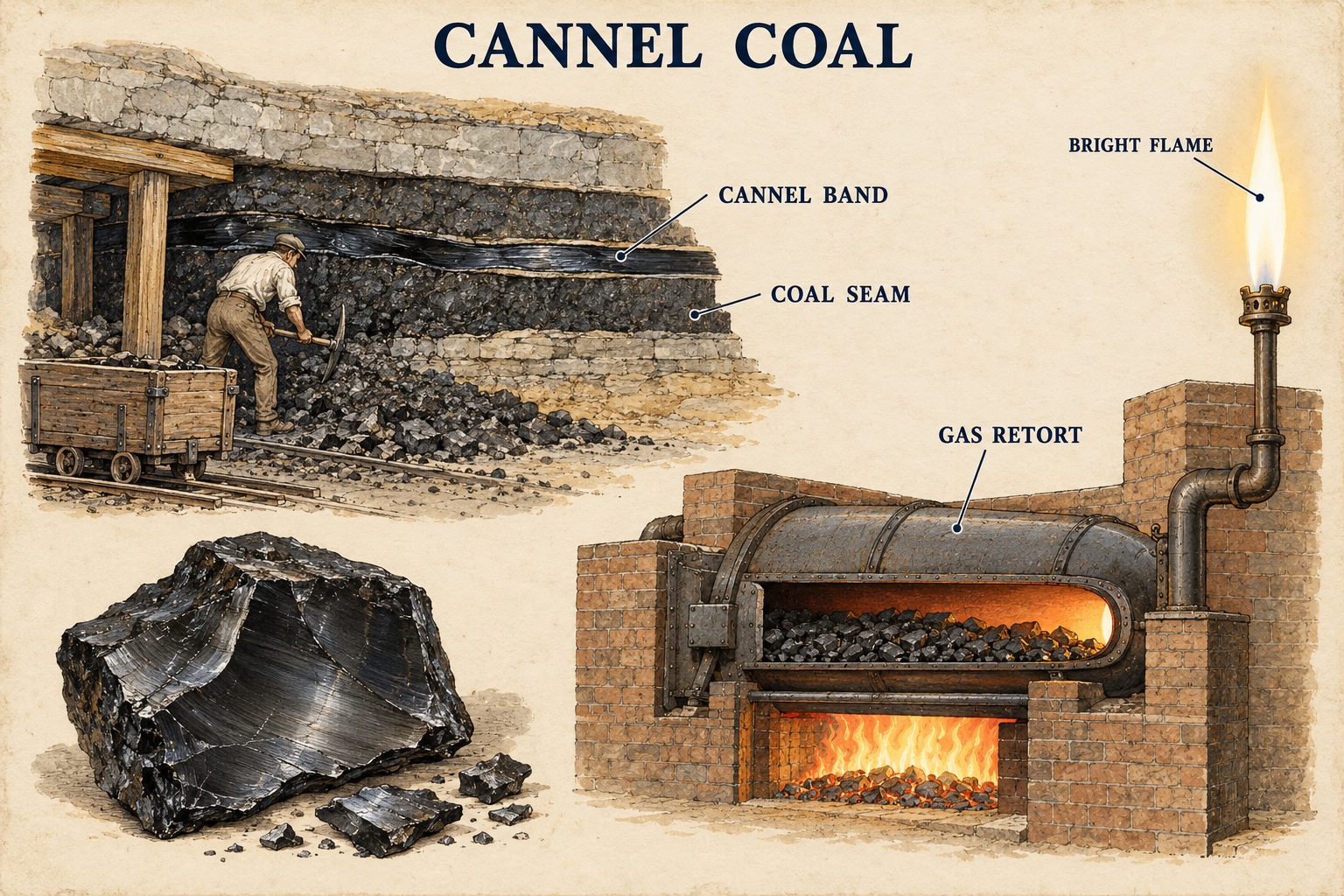
A hard, dense, dull-black coal so rich in hydrogen that it lights readily and burns with a bright, steady flame like a candle — which is where the name comes from, whether from the Welsh canwyl or the English word itself. It breaks with a smooth conchoidal fracture rather than in layers, takes a polish, and gives off far more gas and oil on heating than ordinary coal, at the cost of being a poorer plain fuel.

Historical usage
Cannel has been worked in Britain for longer than most coals have had names. Beads of it were being made in Scotland before 3500 BC, often alongside jet, and a shallow seam found on the Bradshaigh estate at Haigh near Wigan in the sixteenth century made the Wigan cannel famous enough that Gresley's 1883 glossary reaches for it as the example of a fat coal. Greenwell's Durham glossary prints Richardson's 1837 analyses: the Lancashire cannel at nearly 84 per cent carbon and under 3 per cent ash, the Edinburgh one at 67 per cent carbon and over 14 per cent ash. Its great century was the nineteenth. Town gas made from cannel burned with a luminous flame, so gasworks paid a premium for it; and in 1850 James Young of Glasgow patented the slow distillation of cannel into paraffin oil and wax, opening the first commercial oil works in the world at Bathgate in 1851 on the exceptionally rich Boghead cannel, or torbanite. In the collieries it was often a seam in its own right: the Lancashire pits at Farnworth and Kearsley worked a 'Cannel mine' at about 360 yards below their Trencherbone, and the Lothian pits sold it as parrot coal beside their household seams. Miners carved it too — a chair of parrot coal went to the Great Exhibition of 1851, and a cannel box was sealed under Locomotion No. 1 at Darlington in 1857.
How it worked
Cannel accumulated where spores, resins and waxes from the Carboniferous swamp forests settled in still ponds and shallow lakes starved of oxygen, so it is found as thin beds and lenses lying over or within ordinary coal seams rather than as thick seams of its own — a band a foot or two thick at the top of a seam is typical, though the Lancashire pits had cannel thick enough to be worked as a separate 'mine'. It was won with the pick like any coal, but its hardness and even grain meant it came out in clean blocks that could be sorted and sold by their gas yield, and the richest was kept apart for the gasworks or the oil retort. Gresley records that the richest parrot and shale yielded thirty to forty gallons of crude oil to the ton on slow distillation; torbanite gave several times that.
Why it was used
Three markets wanted it. The gas companies wanted its disposable hydrogen — the hydrogen left over after its oxygen is accounted for — because gas made from it lit rooms far better than gas from ordinary coal. The oil works wanted it as the raw material for paraffin oil, lamp oil and wax after Young's patent. And householders paid extra for it in the grate, where it lit easily, burned long, threw a bright flame and left almost no ash. None of those uses cared that it was a mediocre fuel for raising steam.
Value over time
Cannel commanded a premium over every other coal for as long as light depended on a luminous flame. Young's 1850 patent, upheld in the courts in Britain and America, put a royalty on every ton distilled and set off a rush: by 1860 fifty-five companies in the United States were making coal oil from cannel, and in Scotland the Bathgate works were followed by the whole West Lothian shale-oil industry once the Boghead cannel itself ran out in the 1860s. Speculators bored for more of it — the Boghead Gas Coal Company took a lease near Bathville in the 1870s and drove a diamond drill to 240 fathoms hoping for a cannel as rich as the Lesmahagow coal, and found nothing. Two inventions then took the premium away. Petroleum from the Drake well of 1859 undercut coal oil within a decade in America, and the incandescent gas mantle of the 1880s made the brightness of the gas flame irrelevant, since the mantle glowed whatever fed it. From then on cannel was worth little more than the coal it lay beside, and the pits that had named a seam after it stopped keeping it separate.
Hazards & challenges
The property that made cannel valuable made it dangerous underground: it is rich in volatile oils and gas. On this archive the two Lancashire cannel pits show both faces of that. At Stonehill in 1877 a hundred yards of cannel caught fire in the seam and the ventilation drove the smoke onto eighteen men who suffocated; at Unity Brook the next year the Cannel mine exploded after a roof fall released gas into workings lit by open candles. Beyond the seam's readiness to burn and to give off firedamp, the hazards were those of any coal — roof falls and dust — and no toxicity specific to the material is recorded.
Risks & limitations
Cannel was scarce and thin. It occurs in lenses and bands rather than persistent seams, so a pit could not plan on it, and a bore in search of it could fail outright as the Bathville trial did. Its value was hostage to lighting technology it did not control, and once the gas mantle and petroleum arrived the premium vanished within a generation. The material also sits on a boundary: modern classification treats it as both a bituminous coal and a terrestrial oil shale, with the lake-formed boghead coals now separated off as torbanite, so older records that call everything from parrot coal to oil shale 'cannel' need reading with care.
Regional variation
In Lancashire it was simply the Cannel, and because Lancashire miners called a seam a 'mine', the Farnworth and Kearsley collieries worked a 'Cannel mine' beneath their Trencherbone. In Scotland and the North East it was parrot coal, so called, Gresley says, because it splits and cracks on the fire with a chattering noise like a parrot talking; the Lothian collieries had a South Parrot seam. The Bathgate torbanite was called Boghead coal after the estate it was found on. Greenwell's Durham glossary treats parrot coal as nearly the same thing as cannel, and the etymology from candle is shared by every district.
Related terminology
Anthracite, Coal Measures, Jet
Mines associated with this term
5 examples chosen from 12 linked records — the term page is not an index.
- Ashton's Field Colliery — Greater Manchester (well documented example)
Named 3 times in this record, first in the summary: “…raised coking, gas, household, manufacturing and steam coal from the Cannel, Plodder, Trencherbone and Yard mines, and employed 483 people in…” - Auldhouseburn Colliery — East Ayrshire (well documented example)
Half the working section was cannel: a three-foot cannel seam lying with a four-foot ordinary coal, and the cannel was much of what the Cairntable Gas Coal Company sold for gas making. - Bamfurlong Colliery — Greater Manchester (well documented example)
Named twice in this record, first in the history: “…Ince Four and Seven Feet, the Wigan Four, Five and Nine Feet, the Cannel and the Arley. The plant described in 1896 is a good picture of a…” - Boghead Colliery — West Lothian (well documented example)
Named twice in this record, first in the history: “…centuries, and it gave its name to Boghead coal: a gas- and oil-rich cannel coal, also called torbanite or Torbanehill mineral, known there by 1837,…” - Leeswood Green Colliery — Flintshire (well documented example)
Named 5 times in this record, first in the summary: “A Flintshire cannel pit at Leeswood, four miles from Mold, whose English underground…”
See every mine that worked cannel coal →
Disasters associated with this term
Included only where MineArchive's own research gives a reasonable evidential basis, with the nature of the relationship stated — not every disaster where this term might plausibly apply.
- Stonehill Colliery fire (contributing factor)
The fire was in the cannel seam itself: cannel's high content of volatile oils and gas made a hundred yards of the working face burn in the seam and fill the ventilation with smoke. - Unity Brook Colliery explosion (hazard involved)
The explosion was in the Cannel mine, the gas-rich seam worked at about 360 yards, after a roof fall released gas into workings lit by open lights. - Auldhouseburn Colliery inundation, 1898 (contextual relationship)
The seam being worked was a three-foot cannel coal lying with a four-foot ordinary coal, the cannel being much of what the company sold for gas making. - Leeswood Main (Flue Pit) Inundation, 1864 (contextual relationship)
Named in this record’s rescue and recovery: “…engines lent from Chester, with men from the Coed Talon and Leeswood Cannel companies working alongside the brigade night and day until the…”
Sources
- (primary) G. C. Greenwell, A Glossary of Terms used in the Coal Trade of Northumberland and Durham (first published 1849; 1888 edition) — G. C. Greenwell, colliery viewer; digitised by the Internet Archive
- (primary) W. S. Gresley, A Glossary of Terms used in Coal Mining (1883) — W. S. Gresley; digitised by the Internet Archive
- (secondary) Cannel coal — Wikipedia
- (secondary) James Young (chemist) — Wikipedia
Record created: 6 September 2026 · Last researched: 6 September 2026