 MineArchive
Leeswood Main (Flue Pit) Inundation, 1864
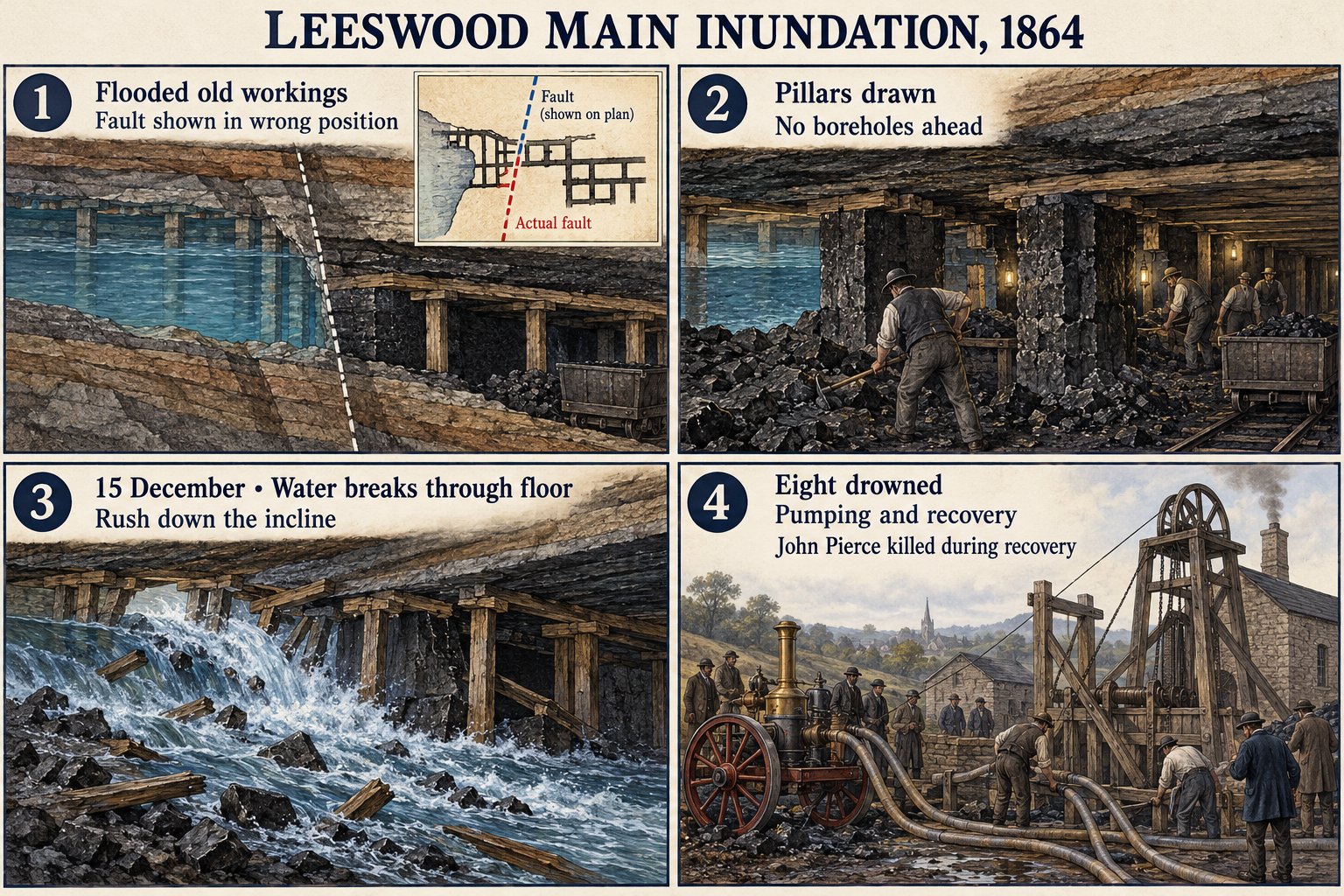
On the morning of 15 December 1864 water from the pit's own flooded old workings broke into the south side of the Flue Pit at Leeswood and drowned eight, among them Owen Jones, a boy of ten years and one month. A chartermaster, John Pierce, was killed during the recovery. The coroner's jury returned manslaughter against all three owners; the grand jury at the Flintshire Assizes found no bill, and the manager was fined five pounds for failing to bore ahead.
| Date | 15 December 1864 |
|---|---|
| Mine | Leeswood Main Colliery |
| Region | Flintshire |
| Type | Flooding / Inundation |
| Fatalities | 9 (Eight died in the inundation itself: John Jones, 19; John Smith, 22 or 23; William Jones, 23; John Roberts, 23; a second John Jones, 19 or 23; Thomas Ellis, 15 or 16, a driver; Owen Jones, 10, a water fitter; and Lewis Lloyd, 47 or 48, a daywageman. John Pierce, one of the colliery's chartermasters, was killed during the recovery of the bodies, which most accounts do not count in the total. Ages differ between the colliery list and the Pontblyddyn burial register; both are given here.) |
| Injuries | Two men working where the water came in, Edwin Harrison and Thomas Roberts, were washed some fifty yards along the incline and saved themselves; eight more escaped through a hole, and twelve in all got out. |
| Context | During active mining |
Cause
An inundation from the colliery's own abandoned workings. Water had been accumulating in the old south workings since before 1863 and was known to be there; the only plan in the company's possession put the fault that was thought to separate the old ground from the new many yards from where it actually ran, and the new workings cut through it.
Contributing factors
No formal plan of the workings existed in 1863; the one a previous manager made was sent to the owners' office and, they said, lost nine months before the accident, a statement the coroner openly doubted. No boreholes had been driven ahead of the work where the water broke in, though boring rods were kept in the blacksmith's shop. The men were working in the broken, drawing the pillars. An earlier manager had given notice after being told he was of no use unless he raised two hundred tons a day. Several men knew there was water in the workings and did not report it, one having worked in it the day before.
What happened
The water came through the floor — dirt, not coal — on the morning of 15 December 1864, about two yards behind Edwin Harrison and Thomas Roberts and to their right. It washed the two men fifty yards along the incline and they saved themselves; eight others got out through a hole, twelve in all. Eight did not, and three horses were lost with them.
For four days the pit bank was crowded with relatives, sightseers and men working the pumps. The Coed Talon Colliery Co. sent its manager John Goulding and its chartermaster Mr Gregson; the Leeswood Cannel and Gas Coal Co. sent its agent Henry Johnson McCulloch; the City of Chester Fire Brigade came under Superintendent Noblett with engines and hoses lent by three firms and the Corporation of Chester. They worked night and day, and on the Saturday the water was low enough for the bodies to be recovered. It was then that John Pierce lost his life.
Six of the eight were buried at Pontblyddyn, the register recording them as 'Drowned at Flue Pit Colliery Leeswood Green 15th Day of December 1864'. Owen Jones was buried on Christmas Eve; the rest on Boxing Day. At the inquest it was proved that Owen was one month past his tenth birthday — the point mattering because the Mines Act of 1842 forbade the employment underground of any child under ten. His father Robert, an engine minder, died on Christmas Day the following year, one year and one day after burying his son.
Rescue & recovery
Water was cleared by pumps and by fire engines lent from Chester, with men from the Coed Talon and Leeswood Cannel companies working alongside the brigade night and day until the Saturday, when the bodies were recovered. John Pierce, a chartermaster at the pit, was killed at that point.
Investigation & inquiry
The inquest opened at the Leeswood Schoolroom rather than the usual public house, before the county coroner Peter Parry, and was adjourned twice before a verdict on 17 January 1865. Counsel appeared for the owners, for the manager and for the relatives. The evidence turned on four questions: whether boreholes were kept ahead of the work; whether accurate plans existed and were consulted; whether owners and management knew of the water; and whether the fault supposed to separate old from new workings existed where the water broke in. Robert Williams, who had worked in the pit, testified that he had been underground after seven bodies were recovered and found the fault cut through. Mr Gregson of Coed Talon gave it as his opinion that the fault did not exist at that point at all. The jury returned manslaughter against the whole of the proprietors and offered no remark on the manager's conduct.
Legal & regulatory aftermath
Craig, Taylor and Craig were bailed to the Flintshire Assizes in April 1865, before Mr Justice Byles. The judge directed the grand jury on the difference between nonfeasance and malfeasance and told them to be no respecter of persons; they found no bill, and the petty jury was directed to acquit. Colliery owners across Leeswood, Treuddyn and Nercwys had meanwhile petitioned the Home Secretary through Lord Grosvenor MP, calling the inquest a serious departure from justice and questioning the coroner's fitness for office; Peter Parry remained coroner until his death in 1874, in his fifty-seventh year in the post. Later in April 1865 the manager Ishmael Jones was summoned before the Mold magistrates by the government inspector Mr Higson for breach of the fifteenth rule of the Mining Inspection Act, which required boring ahead and to the sides where water was suspected. He was fined five pounds, and the bench recommended that the money be divided among the widows and families.
Changes to practice & legislation
At the assizes the Hon. Roger Mostyn handed the judge a document stating that all occupiers of collieries should keep correct maps and plans of their workings and, where water was suspected, give positive instructions to their managers to use the utmost care.
Memorials & commemoration
The grave of Owen Jones, the ten-year-old, is marked by a stone at the rear of the church in Pontblyddyn churchyard; six of the eight who drowned are buried there.
What's uncertain
Points where sources disagree or the record could not be settled; both accounts are kept. All open questions in the archive.
- The colliery list and the Pontblyddyn burial register differ on four of the eight — John Smith at 22 or 23, John Jones at 19 or 23, Thomas Ellis at 15 or 16, and Lewis Lloyd at 47 or 48. (disputed) 1,2
Recorded claims
Individual factual claims, each attached to the source(s) that support it below. Where sources disagree, both are kept.
- Eight were drowned: John Jones, John Smith, William Jones, John Roberts, a second John Jones, Thomas Ellis, Owen Jones aged ten, and Lewis Lloyd. The Leeswood Community account adds that the chartermaster John Pierce was killed during the recovery of the bodies, which is why this record gives nine. 1,2
- The colliery list and the Pontblyddyn burial register differ on four of the eight — John Smith at 22 or 23, John Jones at 19 or 23, Thomas Ellis at 15 or 16, and Lewis Lloyd at 47 or 48. (disputed) 1,2
- It was proved at the inquest that Owen Jones was one month past his tenth birthday, which mattered because the Mines Act of 1842 forbade the employment underground of any child under ten. 2
- The only plan in the company's possession put the fault many yards from where it was proved to run; the plan made by a previous manager had been sent to the owners' office and was said to have been lost nine months before the accident, a statement the coroner doubted. 1,2
- The coroner's jury returned manslaughter against the whole of the proprietors; at the Flintshire Assizes in April 1865 the grand jury found no bill and the petty jury was directed to acquit. 2
- Ishmael Jones was fined five pounds before the Mold magistrates for breach of the fifteenth rule of the Mining Inspection Act, requiring boring ahead where water was suspected, and the bench recommended the fine be divided among the widows and families. 2
Related terminology
Mining terms this disaster is structurally linked to, with the nature of the relationship.
- Atmospheric Engine (contextual relationship)
Named in this record’s rescue and recovery: “Water was cleared by pumps and by fire engines lent from Chester, with men from the Coed Talon and Leeswood Cannel…” - Borehole (contextual relationship)
Named twice in this record, first in the summary: “…found no bill, and the manager was fined five pounds for failing to bore ahead.” - Buttyman (contextual relationship)
Named 3 times in this record, first in the summary: “…eight, among them Owen Jones, a boy of ten years and one month. A chartermaster, John Pierce, was killed during the recovery. The coroner's jury…” - Cannel Coal (contextual relationship)
Named in this record’s rescue and recovery: “…engines lent from Chester, with men from the Coed Talon and Leeswood Cannel companies working alongside the brigade night and day until the…” - Heapstead (contextual relationship)
Named in this record’s narrative: “…did not, and three horses were lost with them. For four days the pit bank was crowded with relatives, sightseers and men working the pumps.…”
Sources
- (secondary) Leeswood Collieries — Welsh Coal Mines
- (secondary) The 'Flue Pit' Mine Disaster, Leeswood, 15th December 1864, by C. Astbury — Leeswood Community
Record created: 8 September 2026 · Last researched: 8 September 2026