 MineArchive
Buttyman
| Also known as | Chartermaster (Shropshire), Charter Master (Shropshire), Butty, Bond Miner |
|---|---|
| Category | Labour & Roles |
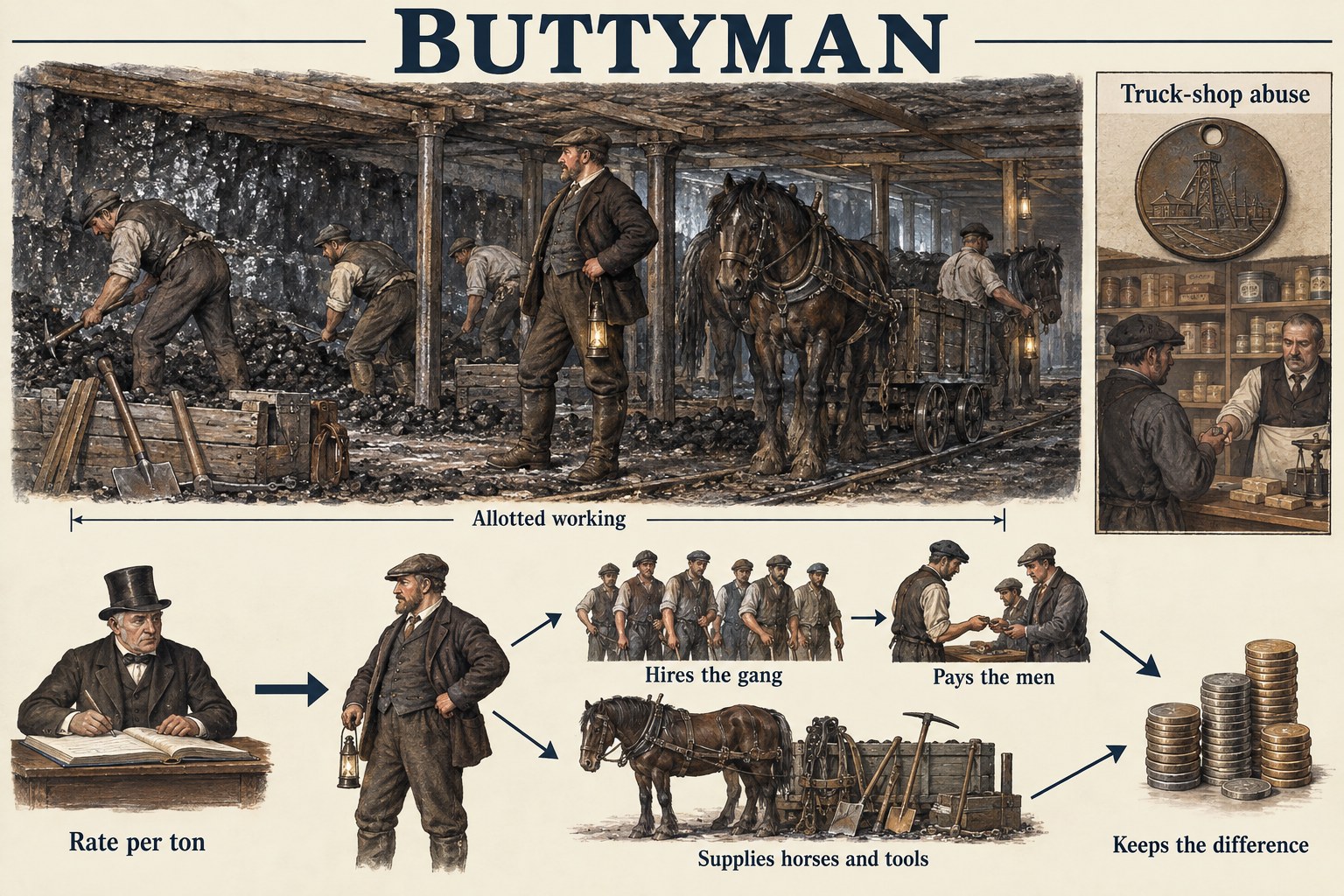
A subcontractor who took on a stretch of colliery working from the mine owner for an agreed price per ton, then hired, paid and equipped his own gang of miners to work it, keeping the difference as his own profit.
Historical usage
The system was already established by the early 19th century and remained widespread across British coalfields into the 1920s and 1930s. It began to break down after the Coal Mines Regulation Act 1872 restricted subcontracting, and was gradually replaced in most districts by a 'share-out' system, in which piecework earnings were divided equally among a working group rather than skimmed by a middleman.
How it worked
The buttyman contracted directly with the colliery owner or manager to deliver coal (or, in Shropshire and similar ironstone districts, ironstone too) from an allotted stretch of seam at an agreed rate per ton. He then employed and paid his own men -- usually by the day rather than by output -- and supplied, at his own expense, the horses and tools their work required, keeping the difference between what the owner paid him and what he spent on his men and equipment as his own profit.
Why it was used
For the mine owner, subcontracting the day-to-day running of a working place transferred the risk and management burden of recruiting, paying and disciplining a working gang onto someone else, while still fixing costs at a known rate per ton produced.
Risks & limitations
The system was open to serious abuse: buttymen or chartermasters were often the organisers of 'tommy' or 'lobby' shops, where miners were paid partly in tokens redeemable only for goods at the buttyman's own shop, frequently of poor quality and sold at inflated prices -- a truck-system abuse layered on top of the subcontracting itself.
Regional variation
In Shropshire and the Black Country, particularly in the coal and ironstone pits of the Coalbrookdale coalfield, the same role and system was known instead as a chartermaster; the underlying arrangement -- contracting to work a stall or stretch of seam and paying one's own men -- was identical to the buttyman system used elsewhere.
Related terminology
Mines associated with this term
5 examples chosen from 11 linked records — the term page is not an index.
- Bug and Wink Colliery — Leicestershire (well documented example)
Named in this record’s history: “…owners humbugged and hoodwinked them when working out wages by each butty team's coal. A later rector, A. E. Eager, wrote in 1949 that it was…” - Bycars Colliery — Staffordshire (well documented example)
Named in this record’s history: “…died at once and two more of their injuries. The jury censured the butty, Francis Amos, for not seeing that the lamps were locked. The…” - Gospel Oak Colliery — West Midlands (well documented example)
Named in this record’s history: “…Three incidents killed two men each. On 12 May 1860 Thomas Cadman, a butty, and Joshua Owen, a doggy, were killed by firedamp that came away…” - Graham's Navigation Colliery — Blaenau Gwent (well documented example)
Named in this record’s history: “…In February 1913 Sidney Edwards, a fifteen-year-old collier's butty, fell to the pit bottom from a landing 45 yards above it when the…” - Leeswood Main Colliery — Flintshire (well documented example)
Named twice in this record, first in the history: “…of the Coed Talon mines and ironworks. The pit was run on the chartermaster system, under which a gang master contracted with the owner to raise…”
Disasters associated with this term
5 examples chosen from 15 linked records, most direct relationship first.
- Brynmally Colliery explosion, 1889 (contextual relationship)
Named 6 times in this record, first in the summary: “…The inspector blamed lax discipline over lamps under the North Wales butty system.” - Bycars Colliery explosion, 1859 (contextual relationship)
Named 3 times in this record, first in the summary: “…by a stopping they were building. Six died; the jury censured the butty, Francis Amos, for not seeing that the lamps were locked.” - Cwrt Herbert Colliery explosion, 1906 (contextual relationship)
Fred Jenkins was gauging with his butty. - Gospel Oak Colliery explosion, 1860 (contextual relationship)
Named in this record’s narrative: “Thomas Cadman (44, a butty) and Joshua Owen (38, a doggy) were killed by the explosion. The…” - Great Bridge Colliery explosion, 1849 (contextual relationship)
Named in this record’s narrative: “…seven roads of seventy or eighty yards. The men descended with a butty who carried a safety lamp, and the explosion came while colliers…”
Sources
- (secondary) Glossary of coal mining terminology — Wikipedia
- (secondary) The Butty System (Staffordshire Past Track) — Staffordshire Past Track
- (secondary) Voices in the Coalshed: Butty System — National Coal Mining Museum for England
Record created: 31 August 2026 · Last researched: 31 August 2026