 MineArchive
Truck System
| Also known as | Tommy Shop (The English term for the company-owned shop itself.), Company Store (The general/American equivalent term.) |
|---|---|
| Category | Law & Custom |
The practice of paying miners' wages wholly or partly in goods or tokens ('scrip'), redeemable only at a shop owned by their own employer, rather than in ordinary currency — leaving workers dependent on their employer even for food and household goods.
Historical usage
The system spread rapidly through British mining districts from the late 18th century, reportedly taking hold particularly quickly in Staffordshire in the 1790s. It was made illegal specifically for miners by the Payment of Colliers' Wages Act 1817, then more broadly by the Truck Act 1831, which required wages to be paid 'in the current coin of the realm' across many trades, with only narrow, written-consent exemptions for rent, food eaten on the employer's premises, medicine and fuel. Enforcement was weak — no dedicated inspectors existed and penalties were minor, so the practice persisted illegally in many areas for decades. The Truck Amendment Act 1887 extended coverage to nearly all manual workers, banned employers from dictating how wages were spent, and gave Factory and Mines Department inspectors real prosecuting power; a further Truck Act in 1896 closed loopholes around excessive fines and materials charges. The Truck Acts remained law until the Wages Act 1986 repealed them, with their remaining substance folded into the Employment Rights Act 1996.
How it worked
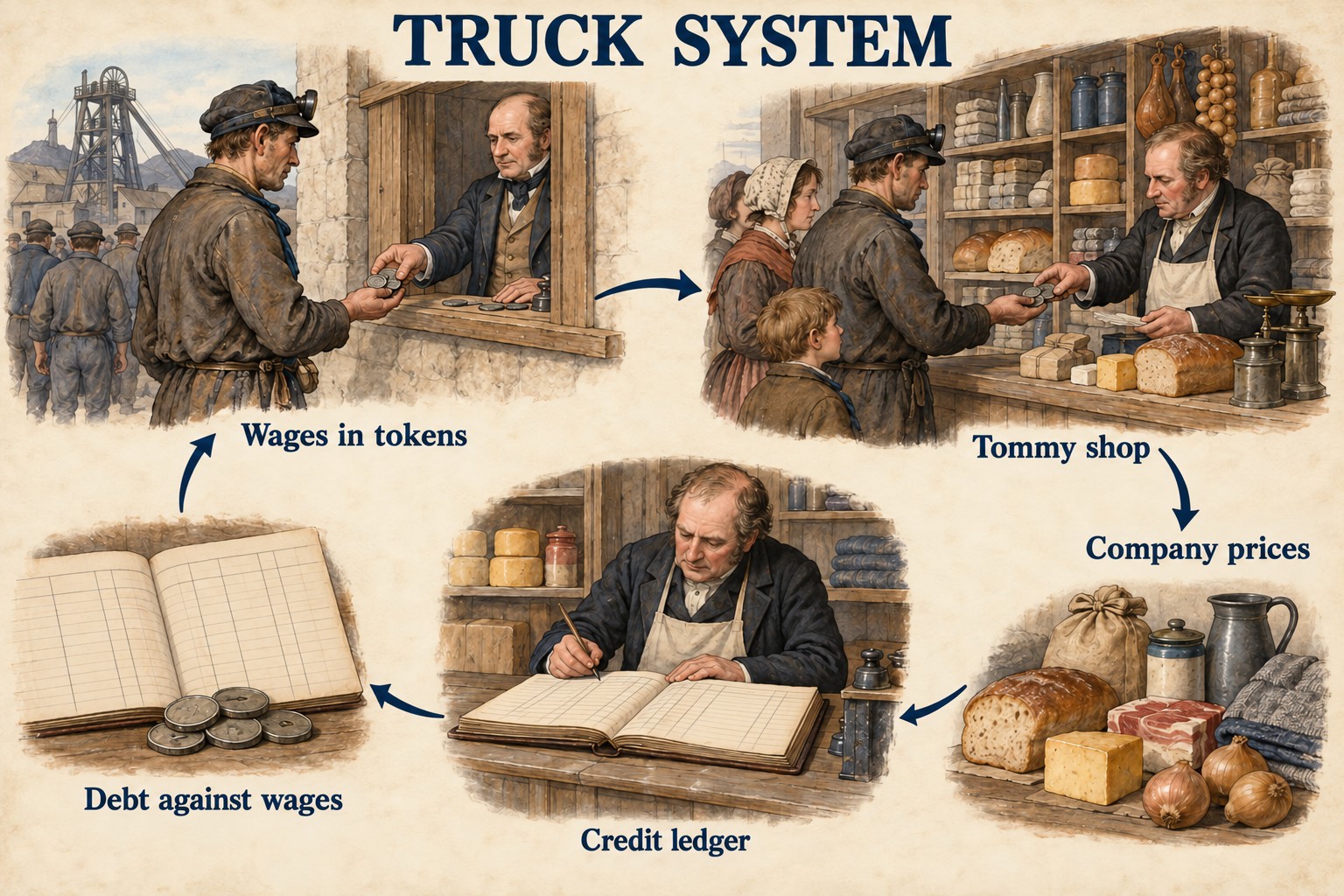
Instead of cash, miners were paid in tokens or credit usable only at a shop their own employer owned — known in England as a 'tommy shop'. With no other retailer to turn to, especially in newly-sunk pits far from any existing town, workers had no choice but to buy at whatever price the company set. Many were encouraged onto credit against future wages, a debt that grew faster than it could be paid off and bound a family to the company indefinitely.
Why it was used
Employers could point to a real practical problem in isolated colliery villages with no shops of their own — someone had to sell miners their food and tools. In practice, company stores quickly became recognised as a second profit centre in their own right: goods of poor quality sold at inflated prices, on credit terms designed to keep a workforce indebted and therefore unable to leave.
Risks & limitations
A workforce paid in scrip could not save real money, could not shop around for a fair price, and, once in debt to the company store, had little practical ability to leave for better-paid work elsewhere — the system's whole function was to entrench dependency, not a byproduct of it.
Regional variation
Known in England as a 'tommy shop'; comparable company-store systems existed under other names elsewhere.
Related terminology
Mines associated with this term
Included only where MineArchive's own research gives a reasonable evidential basis — not every mine where this might plausibly apply.
- Auchinraith Colliery — South Lanarkshire (well documented example)
James Merry ran his collieries and iron mines on it, the men obliged to spend their wages in the company shops. He built the rows they lived in as well. - Ballachulish Slate Quarries — Highland (well documented example)
The company store was one of the grievances behind the eighteen-month lockout that began in 1902 and the second dispute of 1905 to 1907, the quarriers demanding fairer treatment in it alongside safer working. - Belnahua Slate Quarries — Argyll and Bute (well documented example)
Named in this record’s history: “…for the workers in the south-east corner with a school and a company store; by the early 19th century they were shipping slate from Belnahua…”
Sources
- (secondary) Miners Truck System Tokens — Blantyre Project
- (secondary) Truck Acts — Wikipedia
Record created: 27 August 2026 · Last researched: 27 August 2026