 MineArchive
Tregurtha Downs Mine
| Also known as | Tregurtha Downs, St Aubyn's Engine House |
|---|---|
| Location | Tregurtha Downs, near Goldsithney, Cornwall — 50.1283, -5.4462 (exact) |
| Commodity | Tin |
| Type | Metal |
| Worked | from 27 March 1883 |
| Maximum depth | Unknown. |
Overview
A tin mine near Goldsithney opened in 1883 around a second-hand 80-inch pumping engine brought from Crenver and Abraham. It closed in 1885 owing its men weeks of wages, restarted in 1888, and after a fire wrecked the engine house in 1889 the men rebuilt it in nine days without pay.
History
The foundation stone of the engine house was laid on 24 August 1882. It went up 33 feet by 24 and 90 feet high, its base of granite from a Ludgvan quarry and the rest of stone from the Trevabyn quarries nearby, with a 90-foot stack fifty feet away — five feet six inches thick at the ground, tapering to one foot ten at the top — to draw four large boilers. The engine they housed was an 80-inch pumping engine built at Copperhouse by Sandys, Vivian and Co., which had already worked at Crenver and Abraham in Crowan. It was named St Aubyn after one of the directors, William Molesworth-St Aubyn, MP for Helston, and first fired on 27 March 1883.
By July that year Tregurtha and Owen Vean together were making five tons of tin a month, and when new stamps opened in June 1884 an estimated eighty tons of tinstone could be crushed every twenty-four hours. The following year the two mines were amalgamated, and on 18 April 1885 the mine closed and was put up for sale. Forty to fifty men who had gone unpaid for weeks were out of work, and their families with them. The 80-inch engine and the rest of the machinery went to auction on 19 June.
It restarted in 1888. Early on the morning of 4 January 1889 a fire in the engine house destroyed the timber and part of the pumping engine, putting more than two hundred and fifty men, women and boys out of work. The timber was replaced and the engine repaired in nine days by voluntary labour. The Cornishman wrote of the volunteers that every one had worked as good men do work, not for wages only but for their own repute and the good of their employers.
Geology
The mine worked tin in the ground between Marazion and Goldsithney, at the eastern end of the Land's End granite's aureole, where the lodes that made the Marazion and Perranuthnoe mines run. Its output is measured in the sources as tin and tinstone, the dressed and undressed ore.
Geological setting: Veins and Lodes (well documented example)
Workings
A pumping shaft served by the 80-inch St Aubyn engine, with four large boilers under a 90-foot stack, and stamps that from June 1884 could crush an estimated eighty tons of tinstone a day. The mine was worked with Owen Vean alongside it and the two were amalgamated in 1885.
Closure
Closed and put up for sale on 18 April 1885, the machinery auctioned that June; restarted in 1888 and working again after the fire of January 1889. The closure date is not known.
What remains
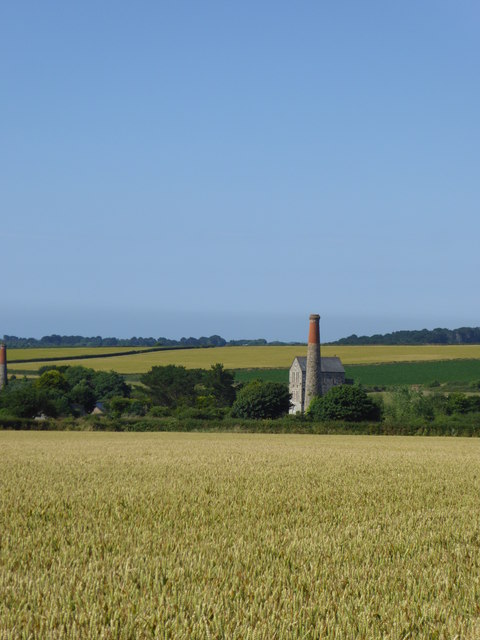
The engine house survives and has been converted into a house, with its chimney standing beside it — a use the photographers who record these buildings tend to approve of when it is done thoughtfully.
The pumping engine house, converted to a dwelling, and its chimney.
Redevelopment
The engine house is now a private house.
Related mines
- Crenver & Wheal Abraham — The 80-inch pumping engine that Tregurtha Downs was built around had already worked at Crenver and Abraham in Crowan before it was brought here and named St Aubyn in 1883.
- East Wheal Rose — The listing of the Tregurtha Downs engine house records it as similar in design to the engine house at East Wheal Rose.
- South Crofty — Tregurtha Downs' 80-inch pumping engine, designed by Samuel Grose and built at the Copperhouse Foundry, was moved on to South Crofty in 1903 and was still extant when this engine house was listed in 1987.
- Wheal Alfred — The 80-inch pumping engine that Tregurtha Downs was built around was originally fitted at Wheal Alfred Consols, the first of the four mines it worked at, according to the engine house's listing.
Nearby mines
- Penberthy Croft Mine — 1.3 miles (2.2 km) NE
- Halamanning Mine — 1.5 miles (2.5 km) E
- West Godolphin Mine — 2.9 miles (4.7 km) E
- Great Work Mine — 3.6 miles (5.8 km) E
- Wheal Grey Mine — 3.7 miles (6.0 km) E
Straight-line distance, within 9 miles (15 km). Show on the map.
What's uncertain
Points where sources disagree or the record could not be settled; both accounts are kept. All open questions in the archive.
- The BGS mine-plans catalogue holds a Mining Remediation Authority abandonment plan titled 'Tregurtha Downs' (catalogue OMR305, Tin Ore, dated 1891); the catalogue gives no location and the plan's details do not clearly tie it to this working, so it may belong to another of the same name. (uncertain) 4
Recorded claims
Individual factual claims, each attached to the source(s) that support it below. Where sources disagree, both are kept.
- The foundation stone was laid on 24 August 1882; the building was 33 ft by 24 ft and 90 ft high, of granite from a Ludgvan quarry and stone from the Trevabyn quarries, with a 90 ft stack fifty feet away to draw four boilers for an 80-inch pumping engine made at Copperhouse by Sandys, Vivian and Co. 1
- The 80-inch engine had previously worked in mines at Crenver and Abraham in the parish of Crowan; it was named St Aubyn after a director, William Molesworth-St Aubyn, MP for Helston, and first fired on 27 March 1883. 1
- The mine was amalgamated with Owen Vean and closed on 18 April 1885, put up for sale with forty to fifty men unpaid for many weeks thrown out of work; the engine and machinery were auctioned on 19 June 1885. 1
- A fire in the engine house early on 4 January 1889 destroyed the timber and part of the pumping engine, putting more than 250 men, women and boys out of work; the timber was replaced and the engine repaired in nine days by voluntary labour. 1
- The engine house survives and has been converted into a house. 2
- The engine house is listed at Grade II as 'Engine House at SW53783104', list entry 1143720, listed on 9 October 1987 and described under the heading Tregurtha Downs Mine: a beam engine house for an 80-inch pumping engine, circa 1880, probably granite ashlar to the bob wall with granite rubble elsewhere and granite and brick dressings, with original iron tie rods running the length of each wall. 3
- The list entry says the engine was built by the Copperhouse Foundry at Hayle to a design by Samuel Grose. 3
- The list entry gives the engine a longer history than the newspaper accounts do: it was originally fitted at Wheal Alfred Consols, then at Crenver, then at Wheal Abraham, before being moved to Tregurtha Downs. 3
- The engine moved to South Crofty in 1903 and was still extant when the building was listed in 1987. 3
- The house is on a rectangular plan with a thicker bob wall carrying a narrow doorway to the east and a large boiler doorway in the gable-ended wall to the west; a tall plinth, arched doorways front and rear, an arched stair window in each wing wall, tall rectangular windows and a blind oculus with a brick cross in the gable end. Inside are the original scissor-truss roof structure, the pit towards the bob wall and a round dressed granite cylinder platform. Some of the scantle slate roof and the boarded studwork over the bob wall survive. 3
- The list entry says the engine house is similar in design to one never completed at Tregurtha Farm nearby and to that at East Wheal Rose. 3
- The BGS mine-plans catalogue holds a Mining Remediation Authority abandonment plan titled 'Tregurtha Downs' (catalogue OMR305, Tin Ore, dated 1891); the catalogue gives no location and the plan's details do not clearly tie it to this working, so it may belong to another of the same name. (uncertain) 4
Photographs & further reading
The building of the engine house and stack, the second-hand 80-inch engine and its naming, the output figures, the 1885 closure with the men unpaid, and the fire of 1889 and the nine days of voluntary labour that repaired it.
View sourceThe Grade II listing of 9 October 1987: the fabric of the engine house inside and out, the engine's designer and maker, the four mines it worked at in turn, and the buildings it resembles.
View sourceSources
- (secondary) Tregurtha Downs — Wikipedia
- (observational) Tregurtha Downs Mine engine house, Geograph 82617 (Carl Weaver) — Geograph Britain and Ireland
- (primary) Engine House at SW53783104, St Hilary, list entry 1143720 — Historic England
- (primary) BGS / Mining Remediation Authority mine plans: TREGURTHA DOWNS — British Geological Survey / Mining Remediation Authority
Record created: 9 September 2026 · Last researched: 9 September 2026