 MineArchive
Sark's Hope Silver Mine
| Also known as | Sark's Hope Mine, Sark Silver Mines, Port Gorey Mine, Silverlode Mine |
|---|---|
| Location | Port Gorey, Little Sark — 49.4108, -2.3739 (approximate) |
| Commodities | Silver, Copper, Lead |
| Type | Metal |
| Worked | 1833 (Le Pot)–1845 (mining ceased) |
| Operators | John Hunt (1834–?), Guernsey and Sark Mining Company (1834–1847) |
Overview
The silver-lead mine at Port Gorey on the south coast of Little Sark, worked from the mid-1830s to 1845 by Cornish miners under a concession from the Seigneur of Sark. Four shafts went down below sea level and were pumped by steam, a railway and jetty were built, and a single cargo of ore was shipped before a flooded gallery drowned ten men in 1845; the debts cost the Le Pelley family the fief of Sark.
History
Ores of lead and silver had been dug on Little Sark as early as 1609, and there were claims of silver from 1817, but the island's mining era began in 1833, when the Cornish mining engineer John Hunt found silver at Le Pot, by Pot Bay on the east coast of the peninsula. In 1834 Pierre le Pelley III, Seigneur of Sark, granted Hunt a licence to search for silver, for 31 years at a rent of one pound a year and six per cent of the gross ore raised; one account gives the term as 21 years. The licence passed to the Guernsey and Sark Mining Company, floated with a capital of £1,000 in 200 shares of five pounds, of which the Seigneur took ten and Hunt thirty. Copper and silver were worked at Le Pot for about three years before the workings were abandoned to flooding.
The venture's real hope lay at the southern tip of Little Sark. At Port Gorey, where the Sark's Hope silver-lead lode cuts the foliated granite of the headland, the vein was found by chance during a rabbit hunt in 1836, and the mine that grew there was the only metal mine in the Channel Islands ever to produce ore in quantity. Four shafts were sunk close to the little harbour: Sark's Hope shaft furthest west, almost on the cliff edge; Le Pelley's shaft, carried down to 90 fathoms below sea level; the Pump shaft; and Prince's shaft at the eastern end, named for Captain John Prince, the mine's manager. The galleries are reckoned to have run some 2,000 feet in length and 700 feet in depth, all of it below the water, so that steam pumps were essential from the start. After the find the Seigneur extended the licence to 39 years and the shareholders put in a further £5,400 for a 120 horsepower steam engine to pump the shafts, a narrow-gauge railway, a crushing machine, a stamping mill and a loading station at Port Gorey, from which the ore, most of it bound for France, was shipped; one account says only a single cargo ever went. Hunt had the first ores made into a silver tea and coffee set, since lost, which was shown in London and at the company's office in Guernsey. The 1841 census found forty English-born men at the Silverlode mine, fifteen of them with their families, housed in groups of about six; one, Thomas Row, had married a Sark girl, Rachel Hamon. Other accounts put the number of Cornish miners brought over at up to 250, and the whole workforce at about eighty Sark and Cornish men at its height. Expected profits were spent before they were earned: the girls' school of 1841, now the island's visitor centre, was built by Seigneur Ernest le Pelley from the money the mines were to generate for the community.
Pierre le Pelley III drowned in 1839 when the boat carrying him to Guernsey was lost in a tidal race, and his brother Ernest succeeded him. A brief prosperity followed, but the mine never stopped needing money and new pumps. In 1840 the company borrowed £1,000 from the Guernsey bank of Priaulx, Le Marchant, Rougier and Co.; by 1844 more than £34,000 had been sunk in the venture against about £4,000 of silver and lead produced, and when a 230 horsepower engine was wanted to reach a new vein 460 feet below water level and to repay the bank, the investors refused. Ernest, convinced the mine would pay, obtained the Crown's permission to mortgage the fief of Sark itself for £4,000 to John Allaire, a Guernsey privateer. In 1845 the ceiling of the deepest gallery collapsed and the sea poured in, drowning ten miners; island legend has a ship laden with Sark silver wrecked off Guernsey the same day. The company was uninsured, and despite several attempts to revive the mine the workings were finally closed in 1847. Running costs had always been high, largely the price of shipping coal for the pumps and ore for sale, and the veins were narrow and poor; the mines returned very little silver overall, though one popular account has more than 25,000 ounces recovered. Pierre Carey le Pelley, Seigneur from 1849, could not keep up the mortgage and in 1852 sold the seigneurie to Marie Collings, Allaire's daughter and heiress, for £6,000, ending 120 years of Le Pelley rule.
The mines left Sark something besides debt. Visitors crossed from Guernsey to see them, and the inns and boats that served them stayed on for the scenery after the mines had closed, the beginning of the island's tourist trade. John Oxenham set his 1910 novel A Maid of the Silver Sea among the Little Sark mines and La Coupée, and the folk singer Tom Bliss later wrote The Silverlode of Sark from the stories still told on the island. The mine's minerals outlived it too: a specimen collected by Captain Prince about 1843 and kept in the Natural History Museum yielded in 1977 the first firmly established lead-bearing tennantite, and a 1983 study of the spoil tips at Le Pelley's shaft found pyrargyrite, pearceite, polybasite and acanthite among the silver minerals of the lode.
Geology
The Sark's Hope silver-lead lode cuts a foliated hornblende granite of Late Precambrian age at the southern point of Little Sark, 0.4 to 2.5 metres wide, more than 600 metres long, striking 028 to 037 degrees and dipping steeply to the north-west. The primary ore is pyrite and galena with chalcopyrite, tennantite, tetrahedrite and sphalerite, and the silver is carried in pyrargyrite, pearceite, polybasite and acanthite; the gangue is hematitic quartz, calcite and illite.
Geological setting: Hydrothermal Deposits (well documented example), Veins and Lodes (well documented example)
Workings
Four shafts at Port Gorey, from Sark's Hope shaft on the cliff edge in the west through Le Pelley's shaft, 90 fathoms below sea level, and the Pump shaft to Prince's shaft in the east, with galleries reckoned at 2,000 feet long and 700 feet deep, all below sea level and kept dry by a 120 horsepower pumping engine from the late 1830s, with a 230 horsepower engine sought in 1844 for a new vein 460 feet below water level. A narrow-gauge railway ran to the crushing machine, stamping mill and loading station at the harbour. The earlier Le Pot workings for copper and silver lay on the east coast of the peninsula.
Closure
Mining ceased in 1845 after the collapse of the deepest gallery flooded the workings and drowned ten men; the company, which was uninsured, was wound up in 1847. High running costs, chiefly the shipping of coal for the pumps and of ore, and narrow, poor veins had made the mine marginal throughout.
What remains
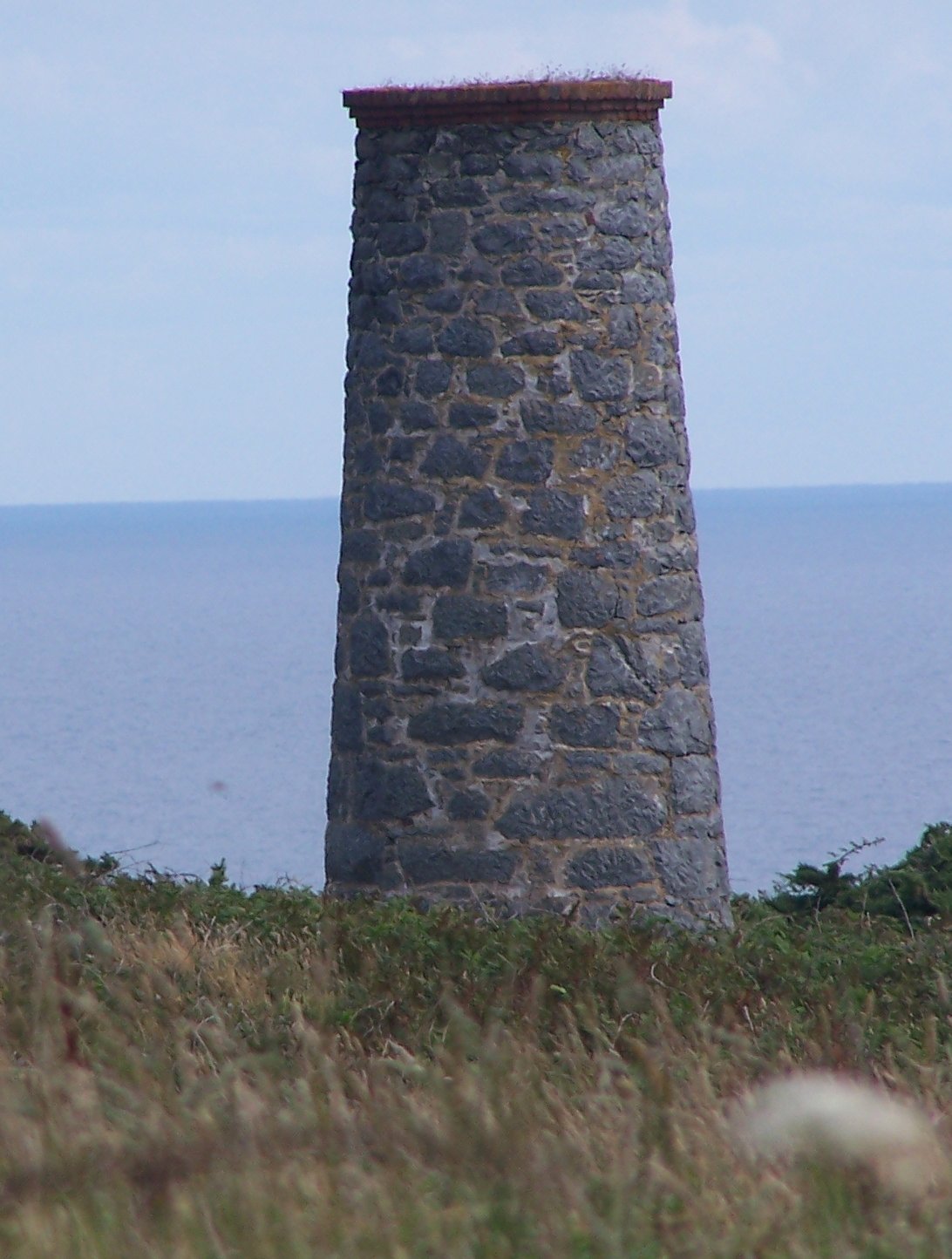
The outcrop workings of the lode were already hidden under thick vegetation by the 1980s, leaving the chimney, the surface ruins and the spoil tips as the visible remains.
A tapering stone chimney, probably the stack of the winding-engine boiler, stands on the headland above Port Gorey, with the ruins of the mine's other surface structures around it. The spoil tip of Le Pelley's shaft survives at the north-eastern end of the lode, and remains of the Le Pot mine can still be seen by Pot Bay.
Redevelopment
Unknown.
Disasters & major incidents
-
Sark's Hope Mine flooding, 1845
1845 · Flooding / Inundation · 10 fatalities
In 1845 the ceiling of the deepest gallery of Sark's Hope silver mine at Port Gorey, Little Sark, collapsed and the sea flooded the workings, drowning ten miners. The company was uninsured; mining ceased, the concern was wound up in 1847, and the debts cost the Le Pelley family the fief of Sark.
People
- Ernest le Pelley · landowner, 1839–1849 — Seigneur during the mine's final years; mortgaged the fief to fund it in 1844.
- Pierre le Pelley III (1799–1839) · landowner, 1834–1839 — Granted the 1834 mining concession as Seigneur.
What's uncertain
Points where sources disagree or the record could not be settled; both accounts are kept. All open questions in the archive.
- The mine is believed to have been about 2,000 feet long and 700 feet deep, and was served by a small-gauge railway and steam pumps. (uncertain) 1
- About 250 Cornish miners were brought to work the Sark mines. (disputed) 4,6
- More than 25,000 ounces of silver were recovered from one of the Sark mines. (disputed) 4
Recorded claims
Individual factual claims, each attached to the source(s) that support it below. Where sources disagree, both are kept.
- John Hunt, a Cornish mining engineer, found silver at Le Pot on Little Sark in 1833, and in 1834 Seigneur Pierre le Pelley III granted a mining concession for the island. 1,2,3,4
- Lead and silver ores were worked on Little Sark as early as 1609; the most intensive mining was between 1830 and 1845. 5
- Four shafts were sunk at Port Gorey: Sark's Hope shaft on the cliff edge, Le Pelley's shaft to 90 fathoms below sea level, the Pump shaft and Prince's shaft. 1
- The mine is believed to have been about 2,000 feet long and 700 feet deep, and was served by a small-gauge railway and steam pumps. (uncertain) 1
- The 1841 census listed forty English-born men working at the Silverlode mine on Little Sark, fifteen of them with families. 6
- At its height the mines employed up to 80 workers from Sark and Cornwall. 1,7
- About 250 Cornish miners were brought to work the Sark mines. (disputed) 4,6
- Captain John Prince was manager of Sark's Hope mine about 1843. 5
- In 1845 the ceiling of the deepest gallery collapsed and seawater flooded in, drowning ten miners. 8,3,6
- The company was uninsured against the 1845 collapse and was finally closed in 1847. 8
- Only one cargo of ore was ever shipped from Port Gorey, and the mines returned very little silver overall. 1
- More than 25,000 ounces of silver were recovered from one of the Sark mines. (disputed) 4
- Ernest le Pelley mortgaged the fief of Sark for £4,000 to John Allaire in 1844 to fund the mine, and in 1852 Pierre Carey le Pelley sold the seigneurie to Allaire's daughter Marie Collings for £6,000. 8,3
- The Sark's Hope silver-lead lode cuts a Late Precambrian foliated hornblende granite, is 0.4 to 2.5 m wide and more than 600 m long, and carries pyrargyrite, pearceite, polybasite and acanthite as silver minerals. 9
- The ruins of the mine's surface structures can still be seen at Port Gorey. 10,4
- Hunt's 1834 licence ran for 31 years at a rent of one pound a year and six per cent of the gross ore, and was later extended to 39 years. 11
- The licence passed to the Guernsey and Sark Mining Company, capitalised at £1,000 in 200 shares of £5, of which the Seigneur held ten and John Hunt thirty. 11
- A 120 horsepower steam engine pumped the shafts, and the works included a narrow-gauge railway, a crushing machine, a stamping mill and a loading station; most of the ore went to France. 11
- By 1844 more than £34,000 had been invested in the company against about £4,000 of silver and lead produced, and a loan of £1,000 had been taken from the Guernsey bank of Priaulx, Le Marchant, Rougier and Co. in 1840. 11
- In 1844 a 230 horsepower engine was wanted to work a new vein 460 feet below water level, and the investors refused to fund it. 11
- John Hunt had the first ores from the mine made into a silver tea and coffee set, now lost, exhibited in London and at the company's Guernsey office. 11
- Mindat places Sark's Hope Mine at 49.41083, -2.37389 on Little Sark. 12
Photographs & further reading
The peninsula's article, with the mining section describing the Le Pot and Port Gorey workings and the four shafts.
View sourceThe island's own short account of the enterprise that cost the Seigneurship.
View sourceIxer and Stanley's study of the lode and its minerals, with the mining history summarised from Mourant and Warren.
View sourceSources
- (secondary) Little Sark — Wikipedia
- (secondary) Pierre le Pelley III — Wikipedia
- (secondary) Silver Mines — Isle of Sark (Sark Tourism)
- (secondary) Silver Mining in the Channel Islands, Sark and Herm — Metal Detecting UK
- (primary) Plumbian tennantite from Sark, Channel Islands (Mineralogical Magazine 41, 1977) — Mineralogical Society
- (secondary) Cornish Miners on Sark — Family Tree Forum
- (secondary) Port Gorey (Sark) — Ports.org.uk
- (secondary) Pierre Carey le Pelley — Wikipedia
- (primary) Silver mineralization at Sark's Hope mine, Sark, Channel Islands (Mineralogical Magazine 47, 1983) — Mineralogical Society
- (secondary) Sark — Wikipedia
- (secondary) Silver mining in Sark (from Silver in the Channel Islands, Cohen and du Quesne Bird) — Jerripedia / theislandwiki
- (secondary) Sark's Hope Mine, Little Sark, Sark, Bailiwick of Guernsey — Mindat
- (secondary) Historical Buildings & Sites — Isle of Sark (Sark Tourism)
Record created: 16 October 2026 · Last researched: 16 October 2026