 MineArchive
Botallack Mine shaft accident, 1863
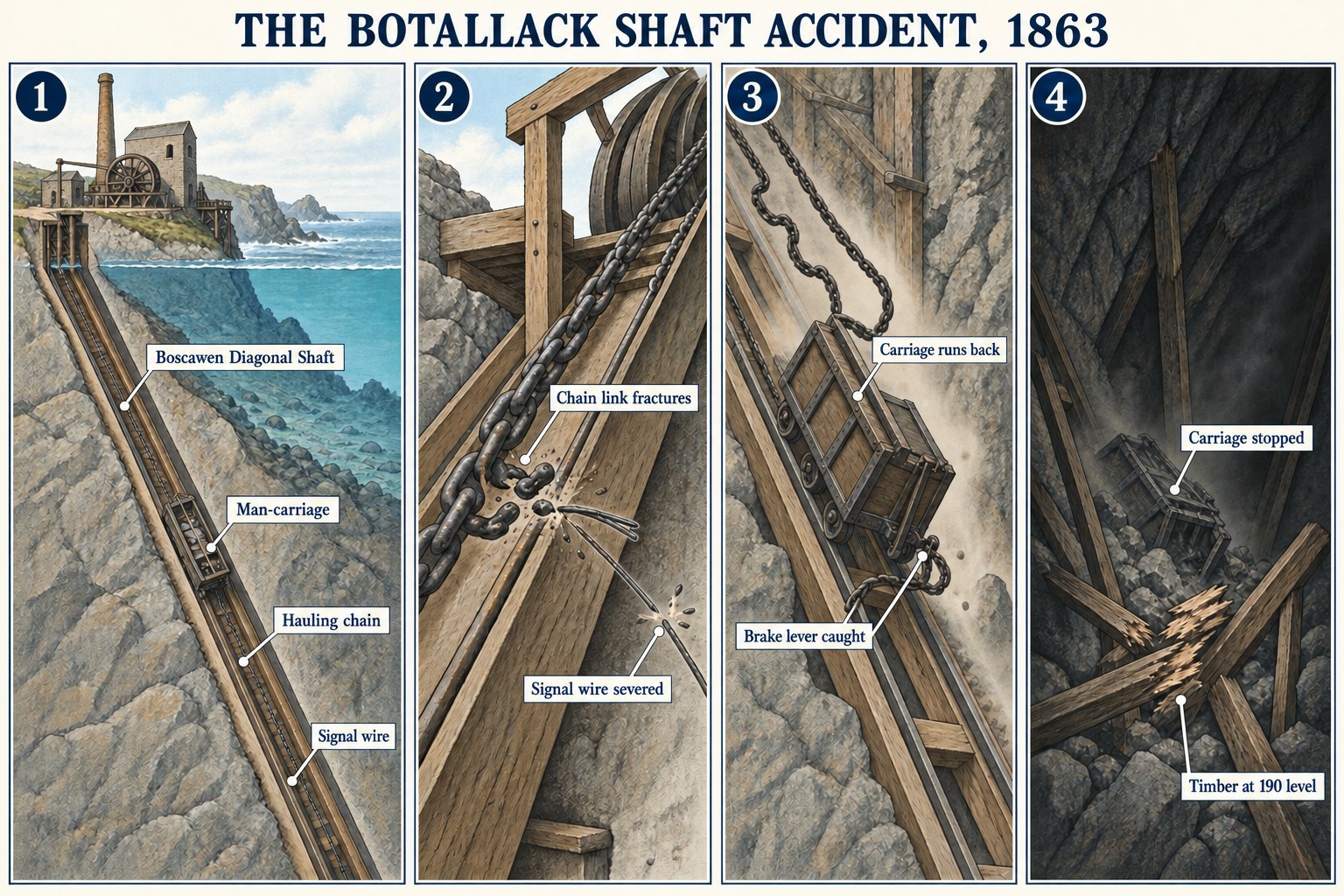
The chain hauling a man-carriage up the Boscawen Diagonal Shaft broke; the carriage ran back out of control and struck timber at the bottom, killing all nine men and boys aboard.
| Date | 18 April 1863 |
|---|---|
| Mine | Botallack Mine |
| Region | Cornwall |
| Type | Winding / Shaft Accident |
| Fatalities | 9 |
| Context | During active mining |
Location
Plotted at Botallack Mine. Recorded location. The large pin is the mine; the small round markers are the nearest mines on record. Click one for its page. View on full map
Cause
A link in the hauling chain fractured near the shaft entrance. The break also severed the signal wire to the winding engine, and the carriage's own brake lever was reportedly caught in its loop, leaving the occupants unable to stop it.
Contributing factors
The chain had been made new for the shaft and had worked for 13 months; it was warranted by its makers but never tested, the agent explaining that Government works tested their chains but the mine did not. The link that broke, of 9/16-inch iron, had been strained when rounds of chain piled on one another on the winding cage and the top round slipped. The carriage's sprung grippers could stop it on the rails, but the agent believed the brake handle had been left in its catch, and no mark of a grip was found on the rails afterwards.
What happened
On the evening of Saturday 18 April 1863, nine men and boys were being hauled up the Boscawen Diagonal Shaft at Botallack (a shaft driven at an angle of about 32.5 degrees, extending some 400 fathoms out beneath the seabed) when the chain drawing their carriage broke near the shaft mouth, with the carriage at about the 135-fathom level. The break also cut the signal wire linking the carriage to the winding engine, and the brake lever was later found caught in its loop, where it could not be worked. The carriage ran back down the incline out of control and struck timber at the 190 level with great force. Everyone aboard suffered fatal head injuries: John Chapple and his son, also John Chapple; Thomas Wall and his son Richard Wall; Michael Nicholas; John and Peter Eddy; and Thomas and Richard Nankervis. The carriage was sent back to Holman's to be cleaned and straightened, and two years later it carried the Prince and Princess of Wales on their visit to the mine.
Rescue & recovery
Captain Boyns went down the shaft as soon as word reached the count house and learned that the carriage had gone to the bottom. Thousands gathered at the mine while the bodies were found. They lay near the 190-fathom level, where a beam projected for loading the skip and a new piece of road was being put in, and it took hours to bring them all out.
Investigation & inquiry
An inquest was held on 24 April 1863 at Bolitho's Queen's Arms Inn, Botallack, before coroner W. Hichens. The jury returned a verdict of accidental death, recorded their confidence in the machinery generally, and recommended a subscription for the widows and orphans, to which the mine's adventurers contributed £50.
Changes to practice & legislation
At the inquest the agent suggested that in future the brake handle should be kept out of its catch on the way up.
Recorded claims
Individual factual claims, each attached to the source(s) that support it below. Where sources disagree, both are kept.
- Nine men and boys died when the haulage chain broke on the Boscawen Diagonal Shaft on 18 April 1863: John Chapple and his son John, Thomas Wall and his son Richard, Michael Nicholas, John and Peter Eddy, and Thomas and Richard Nankervis. 1,2
- The coroner's inquest jury returned a verdict of accidental death, expressed confidence in the machinery, and recommended a relief subscription for the widows and orphans, to which the mine's adventurers contributed £50. 2
- The hauling chain had been worked for 13 months and was warranted by its makers but never tested. 2
- The broken link, of 9/16-inch iron, had been weakened by the chain surging on the winding cage. 2
- Eight men and a boy died when the carriage fell back down the Boscawen Diagonal Shaft. 3,1,4
- The carriage was cleaned and straightened at Holman's and used for the royal visit to the mine two years later. 3,4
Related terminology
Mining terms this disaster is structurally linked to, with the nature of the relationship.
- Adventurer (contextual relationship)
The mine's adventurers — its shareholders — contributed £50 to the subscription the inquest jury recommended for the widows and orphans of the nine killed. - Captain (contextual relationship)
Named in this record’s rescue and recovery: “Captain Boyns went down the shaft as soon as word reached the count house…” - Count House (contextual relationship)
Named in this record’s rescue and recovery: “Captain Boyns went down the shaft as soon as word reached the count house and learned that the carriage had gone to the bottom. Thousands…” - Skip (contextual relationship)
Named in this record’s rescue and recovery: “…near the 190-fathom level, where a beam projected for loading the skip and a new piece of road was being put in, and it took hours to bring…” - Winding Engine (relevant method/equipment)
The break cut the signal wire between the man-engine carriage and the winding engine, leaving the brake unworkable.
Sources
- (secondary) Botallack Tin Mine Accident - Cornwall - 1863 — Northern Mine Research Society
- (primary) Inquest: Botallack Mine, 1863 — Online Parish Clerks, Cornwall (transcribed contemporary inquest report)
- (secondary) The history of Botallack — National Trust
- (secondary) Botallack Mine, Cornwall (Cornwall Calling) — Cornwall Calling
Record created: 20 August 2026 · Last researched: 20 November 2026