 MineArchive
Cook and Ddol Quarry
| Also known as | Cook and Ddol Slate Quarry, Chwarel y Cook a'r Ddol |
|---|---|
| Location | Hillside above and west of Llanberis, Gwynedd — 53.1245, -4.1531 (exact) |
| Commodity | Slate |
| Type | Slate |
| Worked | Early 19th century–early 20th century |
| Maximum depth | Unknown. |
| Operators | National Co-operative Quarries Ltd (1906–?) |
Overview
A pair of slate pits on the slope above Llanberis, worked intermittently from the early 19th century, run by the Hughes family in the 1880s and 1890s and taken over in 1906 by the National Co-operative Quarries Ltd.
History
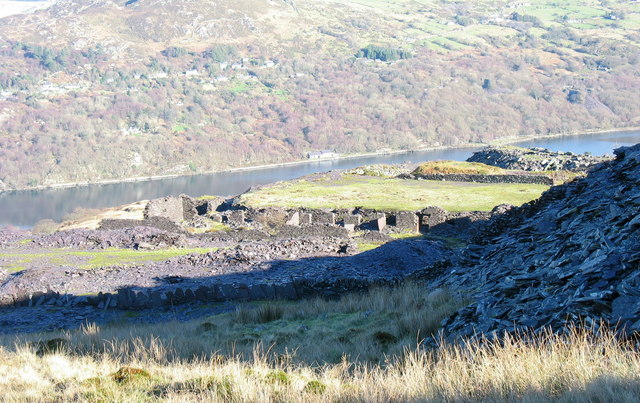
The Cook and Ddol quarries lie on the hillside above and west of Llanberis, two pits, Cook and Y Ddol, separated by a narrow causeway. They were worked intermittently from the early 19th century, and unusually for the small quarries of the area they had a mill of their own. Slate was carted out to the west until the Ffridd incline was built, after which a tramway ran to its head. Output probably never passed 1,000 tons a year; in 1882 26 men made 631 tons, and by 1898 there were 67 men. A steam mill level was built in the 1890s to replace the old dressing area a level lower.
In the 1880s and 1890s the quarries were run by G. and J. Hughes, who in 1888 sued a former quarryman for £7 19s they said had been overpaid on his monthly slate count. On St David's Day 1898 the owners, Richard Thomas of Caernarfon and G. J. Hughes, the quarry manager, gave the workmen a dinner at the Snowdon Valley Hotel. In January 1906 the Cook and Ddol estate of 52 acres, connected directly to the railway, was bought by the National Co-operative Quarries Ltd, a society separate from the Bethesda co-operative, which was the only concern in the industry pledged to trade union conditions and whose chairman was John Hodge of the British Steel Smelters; it meant to put in new machinery and work the lower depths. The quarry closed in the early 20th century.
Geology
Unknown.
Workings
Two pits, Cook and Y Ddol, separated by a narrow causeway, with a tramway to the head of the Ffridd incline.
Closure
Closed in the early 20th century, after the National Co-operative Quarries took it over in 1906.
What remains
The pits, tramway formations, reservoirs, incline structures and ruined buildings remain, including the steam mill level.
Two reservoirs, tramway and incline formations, the steam mill level of the 1890s and ruined buildings.
Redevelopment
Open hillside.
Related mines
- Cefn Du Quarry — Neighbouring quarries on the slope above Llanberis, both sending slate down the Ffridd incline.
Nearby mines
- Cefn Du Quarry — 0.3 miles (0.4 km) SW
- Glynrhonwy Quarry — 0.6 miles (1.0 km) E
- Vivian Quarry — 1.6 miles (2.6 km) E
- Garreg Fawr Iron Mine — 2.1 miles (3.4 km) SW
- Garreg Fawr Slate Quarry — 2.1 miles (3.4 km) SW
Straight-line distance, within 9 miles (15 km). Show on the map.
Recorded claims
Individual factual claims, each attached to the source(s) that support it below. Where sources disagree, both are kept.
- The Cook and Ddol quarry was a pit working, intermittent from the early 19th century, and one of the few in the immediate area to have its own mill. 1
- In 1882 Cook and Ddol produced 631 tons with 26 men; 67 men were employed in 1898. 1,2
- The steam mill level at Cook and Ddol was built in the 1890s, replacing the older reduction area one level lower. 3
- In 1888 Messrs G. and J. Hughes were the proprietors of Cook and Ddol Slate Quarry. 4,5
- In January 1906 the National Co-operative Quarries Ltd, chaired by John Hodge and pledged to trade union conditions, acquired the 52-acre Cook and Ddol estate. 6,7
- The Cook and Ddol quarry closed in the early 20th century. 1
Sources
- (secondary) Cook and Ddol Slate Quarry (NPRN 400674) — Coflein (RCAHMW)
- (observational) The south-facing wall of the Cook pit (Geograph 315726) — Geograph Britain and Ireland
- (observational) The steam mill level of the Cook and Ddol Quarry (Geograph 321604) — Geograph Britain and Ireland
- (primary) Carnarvon and Denbigh Herald, 12 October 1888: Action by quarry proprietors — Carnarvon and Denbigh Herald (Welsh Newspapers Online, National Library of Wales)
- (primary) Y Genedl Gymreig, 8 March 1898: Llanberis — Y Genedl Gymreig (Welsh Newspapers Online, National Library of Wales)
- (primary) Carnarvon and Denbigh Herald, 5 January 1906: The Cook and Ddol quarries — Carnarvon and Denbigh Herald (Welsh Newspapers Online, National Library of Wales)
- (primary) The Welsh Coast Pioneer, 12 January 1906: The Co-operative Quarries: a fresh start — The Welsh Coast Pioneer (Welsh Newspapers Online, National Library of Wales)
Record created: 20 October 2026 · Last researched: 20 October 2026