 MineArchive
Kemnay Quarry
| Location | Kemnay, Aberdeenshire — 57.2430, -2.4390 (exact) |
|---|---|
| Commodity | Granite |
| Type | Quarry |
| Worked | 1858–c. 1959 |
| Operators | John Fyfe (1858–?) |
Overview
Kemnay, opened in 1858 by the Aberdeen quarrymaster John Fyfe, grew into one of Scotland's great granite quarries — its stone built the Forth Bridge, London's Thames Embankment and Aberdeen's own Marischal College, reputedly the second-largest granite building in the world.
History
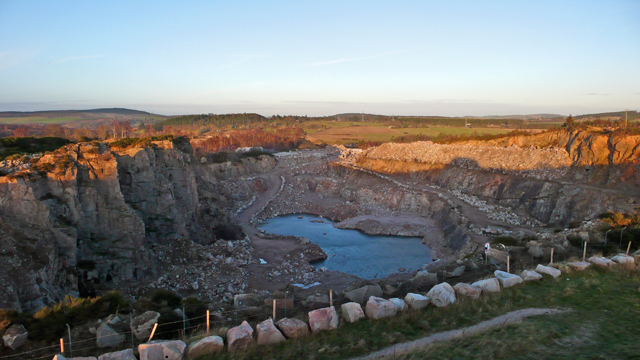
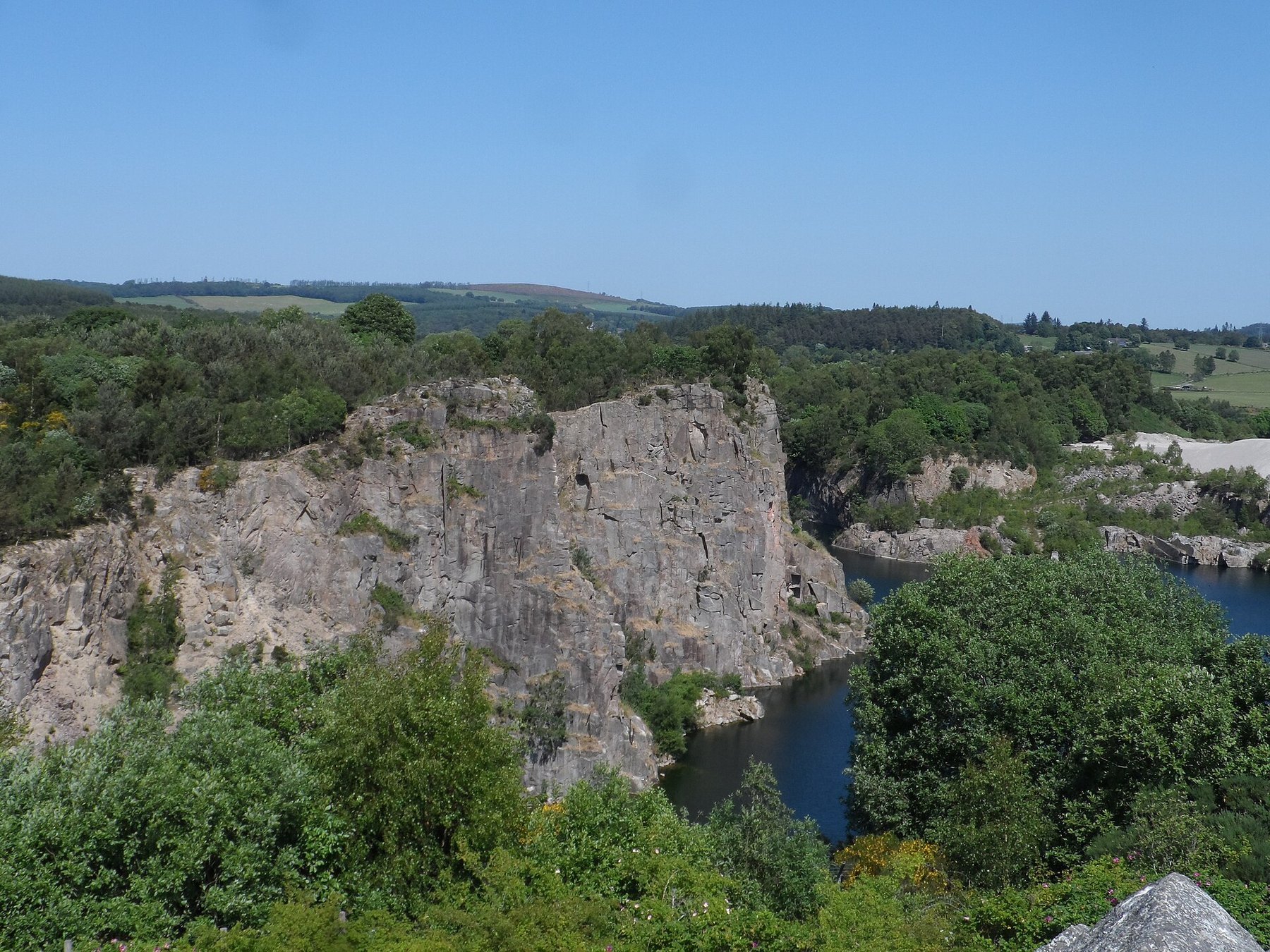
Kemnay Quarry was opened in 1858 by John Fyfe, initially to supply stone for the Alford Valley Railway's bridge construction, and rapidly grew into a major industrial employer in what had been a small rural community: by 1881 the quarry employed 480 men and 26 boys, with Fyfe building tenement housing for the workforce arriving to fill the jobs. Fyfe proved an energetic innovator, developing the 'blondin' aerial ropeway system that went on to be used at deep-pit quarries across Britain, and equipping the site with its own smiddy of sixteen forges and a joiners' workshop for dressing stone. Kemnay's distinctive light grey, sparkling muscovite-biotite granite was used in major structures across Britain, including the Forth Bridge, the Thames Embankment in London and the Cenotaph, and, closer to home, Aberdeen's Marischal College — reputedly the second-largest granite building in the world — and the city's Municipal Buildings. Large-scale quarrying continued until around 1959, when extraction of dimension stone ceased; the site has continued in use since for aggregate and walling-stone production, today marketed as 'Fyfestone', under later ownership.
Geology
The quarry worked light grey, muscovite-biotite granite of the Kemnay pluton, part of the Caledonian granite suite intruded into the surrounding metamorphic rocks of north-east Scotland.
Workings
Fyfe's 'blondin' aerial ropeway system, developed at Kemnay, allowed stone to be lifted directly out of the deepening quarry pit rather than hauled up ramps, and was subsequently adopted at deep quarries across Britain; the site also had its own smiddy with sixteen forges and a joiners' workshop for dressing stone.
Closure
Large-scale extraction of dimension stone ceased around 1959, though the site has remained in continuous use since for aggregate and walling-stone production.
What remains
The site remains active as a producer of crushed aggregate and walling stone, marketed as 'Fyfestone', under ownership that has changed since Fyfe's day; it is no longer worked for large dimension stone.
Recorded claims
Individual factual claims, each attached to the source(s) that support it below. Where sources disagree, both are kept.
- By 1881 the quarry employed 480 men and 26 boys. 1,2
- Kemnay granite was used in the Forth Bridge, the Thames Embankment, the Cenotaph, and Aberdeen's Marischal College, reputedly the second-largest granite building in the world. 1,2
- John Fyfe fired four shots at once by electrical blasting in 1872, and in 1873 a single electrical blast of eleven bores twenty feet deep brought down about 5,000 tons of granite. 1
- In 1881 four tenement blocks at the quarry housed 166 people in 29 households; a brick unit using accumulated granite dust was installed in 1941, 'Fyfestone' was launched in 1958, and quarrying ceased in 1959. 1
Sources
- (secondary) Kemnay Quarries - History — Kirkstyle
- (secondary) Kemnay Quarry — Kemnay Village
Record created: 24 August 2026 · Last researched: 24 September 2026