 MineArchive
Garden Pit Inundation, Landshipping, 1844
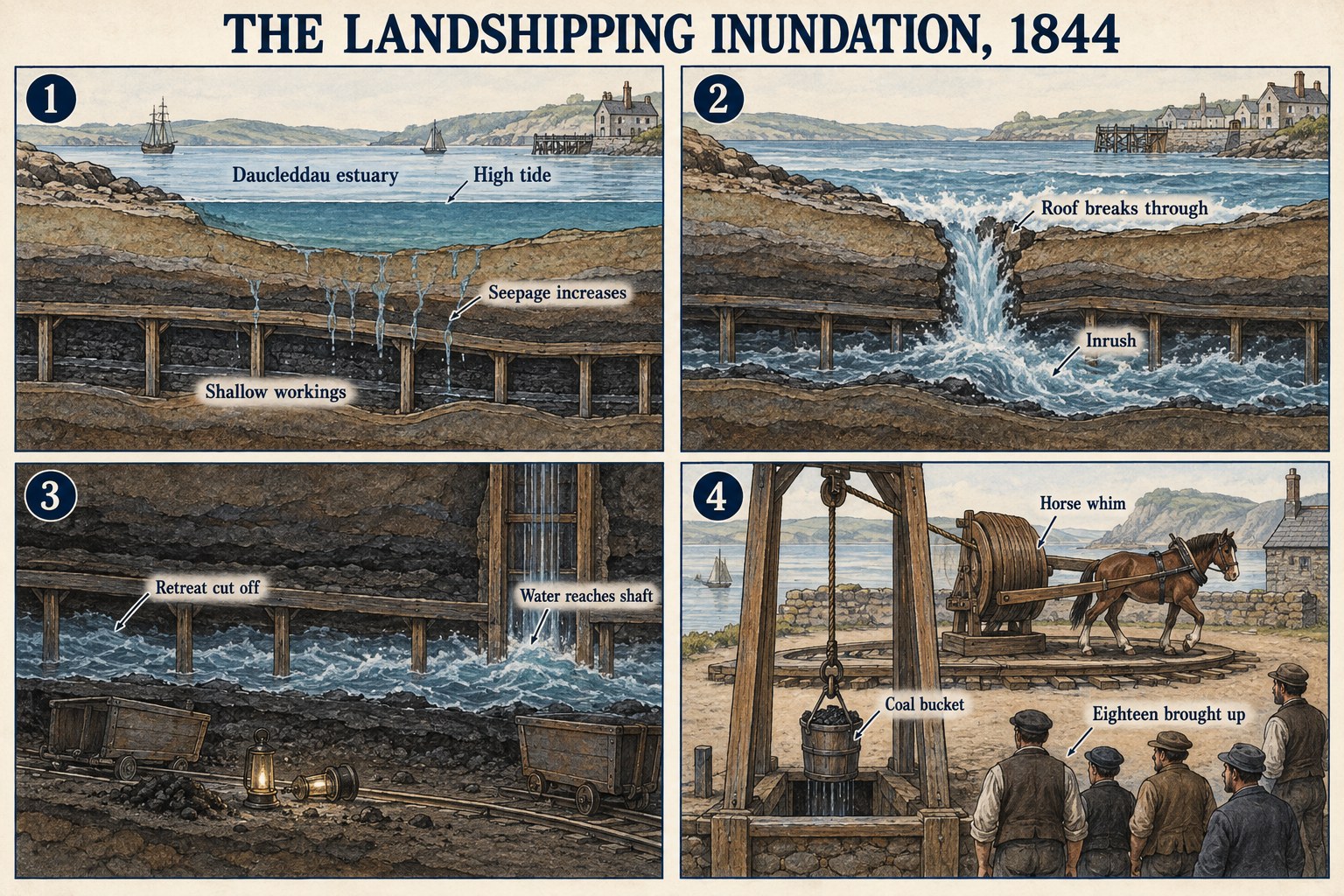
On the afternoon of 14 February 1844 the Daucleddau broke into the Garden Pit at Landshipping, whose workings ran a quarter of a mile out beneath the estuary. Fifty-eight people were below; thirty-three were cut off at once and forty drowned. Eighteen were brought up in the coal buckets by putting the horses to a gallop on the whim. It remains the worst loss of life in Pembrokeshire mining.
| Date | 14 February 1844 |
|---|---|
| Mine | Landshipping Colliery |
| Region | Pembrokeshire |
| Primary type | Flooding / Inundation |
| Associated types | Entrapment |
| Fatalities | 40 (Forty of the fifty-eight below. The 2002 memorial lists seven whose first name is given only as 'Miner', believed to be women and children.) |
| Context | During active mining |
Cause
The sea broke into the workings a short distance from the shore, where the pit had been driven out under the estuary.
Contributing factors
Welsh Coal Mines attributes the inrush to an unusually high tide putting extra weight on shallow workings, and records that the usual seepage had suddenly increased, that the men left the mine because of it, and that they were reassured and sent back an hour before the water came through.
What happened
At about half past three in the afternoon, with fifty-eight people at work below, the water broke in a short distance from the shore. For the thirty-three who were further into the mine, retreat was cut off immediately. The water is reported to have risen at seven fathoms a minute — forty-two feet.
The only way out was the shaft. By putting the horses to a gallop on the whim, the buckets normally used to raise coal were worked fast enough to bring up four men and fourteen boys. Forty did not come up.
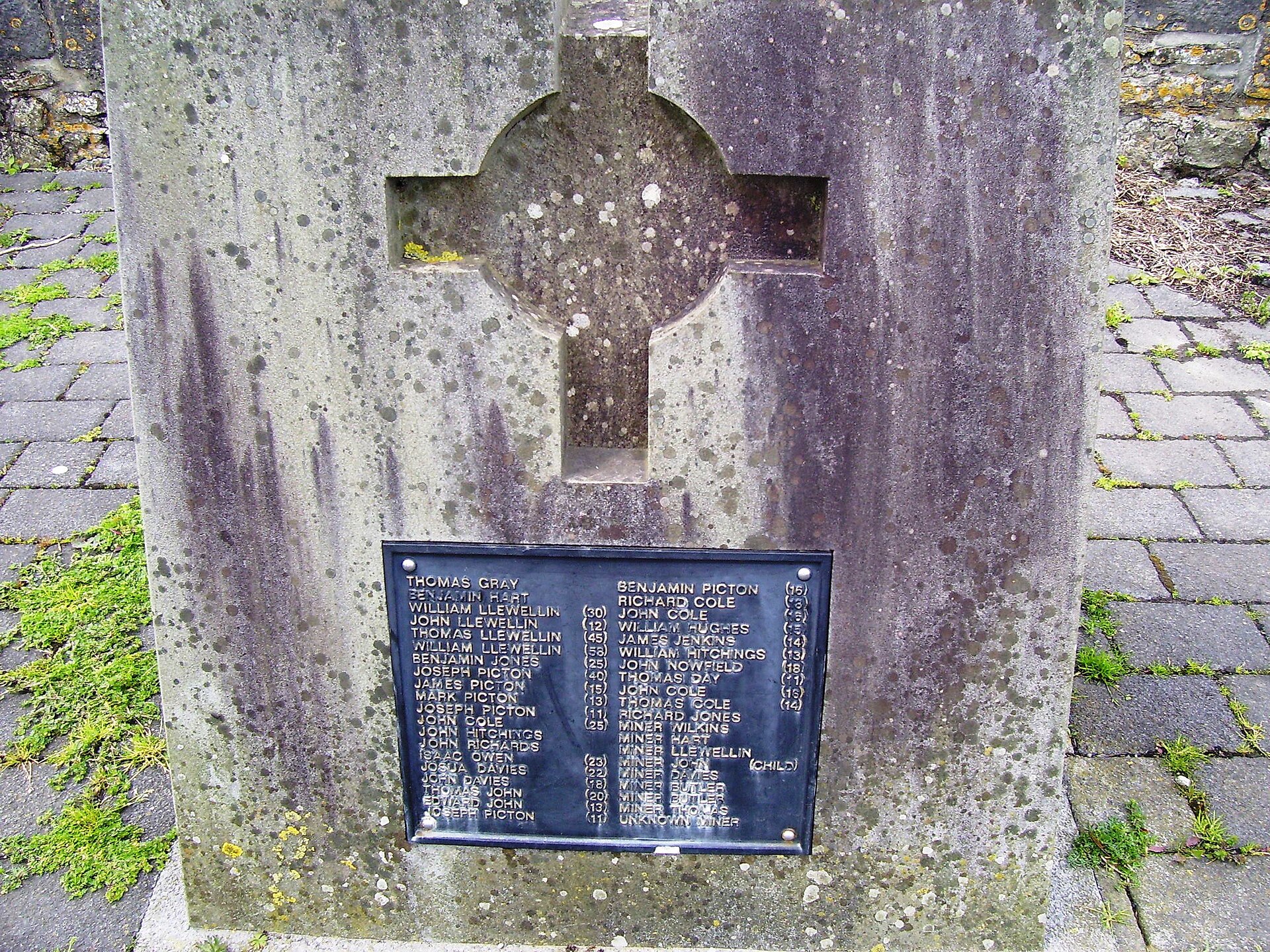
A memorial erected by the villagers at Landshipping Quay in 2002 lists the dead. Seven of the entries give only 'Miner' where a first name should be; these are believed to be women and children, working underground two years after the Act of 1842 had forbidden it.
Rescue & recovery
Four men and fourteen boys were brought up in the coal buckets, the horses on the whim driven at a gallop to raise them before the water reached the shaft.
Memorials & commemoration
A memorial to the forty who died was erected by villagers at Landshipping Quay in 2002.
What's uncertain
Points where sources disagree or the record could not be settled; both accounts are kept. All open questions in the archive.
- The water is reported to have risen at seven fathoms — forty-two feet — a minute. (uncertain) 2
- Welsh Coal Mines records that the usual seepage suddenly increased in volume, that the miners were concerned enough to leave the mine, and that they were sent back after being reassured all was well, the sea breaking in an hour later. The Coflein account does not mention this and gives the time as about half past three. (disputed) 1,2
- The memorial erected by villagers in 2002 lists seven names where the first is given only as 'Miner'. These are believed to be women and children, although an Act of Parliament of 1842 had prohibited women and boys under ten from working underground. (uncertain) 2
Recorded claims
Individual factual claims, each attached to the source(s) that support it below. Where sources disagree, both are kept.
- Forty of the fifty-eight people below were drowned — the worst single loss of life in Pembrokeshire mining. 1,2
- Fifty-eight people were working below when the water came in at around half past three in the afternoon; for the thirty-three working further into the mine, retreat was immediately cut off. 2
- By putting the horses to a gallop on the whim, the buckets used to raise coal brought up four men and fourteen boys. 2
- The water is reported to have risen at seven fathoms — forty-two feet — a minute. (uncertain) 2
- Welsh Coal Mines records that the usual seepage suddenly increased in volume, that the miners were concerned enough to leave the mine, and that they were sent back after being reassured all was well, the sea breaking in an hour later. The Coflein account does not mention this and gives the time as about half past three. (disputed) 1,2
- The memorial erected by villagers in 2002 lists seven names where the first is given only as 'Miner'. These are believed to be women and children, although an Act of Parliament of 1842 had prohibited women and boys under ten from working underground. (uncertain) 2
Related terminology
Mining terms this disaster is structurally linked to, with the nature of the relationship.
- Coal (contextual relationship)
Named 4 times in this record, first in the summary: “…cut off at once and forty drowned. Eighteen were brought up in the coal buckets by putting the horses to a gallop on the whim. It remains…” - Fathom (contextual relationship)
Named in this record’s narrative: “…cut off immediately. The water is reported to have risen at seven fathoms a minute — forty-two feet. The only way out was the shaft. By…” - Inrush (contextual relationship)
Named in this record’s contributing factors: “Welsh Coal Mines attributes the inrush to an unusually high tide putting extra weight on shallow workings,…” - Shaft (contextual relationship)
Named twice in this record, first in the narrative: “…seven fathoms a minute — forty-two feet. The only way out was the shaft. By putting the horses to a gallop on the whim, the buckets normally…” - Whim (contextual relationship)
Named 3 times in this record, first in the summary: “…up in the coal buckets by putting the horses to a gallop on the whim. It remains the worst loss of life in Pembrokeshire mining.”
Sources
- (secondary) Garden Pit, Landshipping — Welsh Coal Mines
- (primary) Garden Pit, Landshipping Colliery (NPRN 401345) — Royal Commission on the Ancient and Historical Monuments of Wales
Record created: 3 September 2026 · Last researched: 3 September 2026