 MineArchive
Landshipping Colliery
| Also known as | Garden Pit |
|---|---|
| Location | Landshipping, Martletwy, on the Daucleddau, Pembrokeshire — 51.7599, -4.8886 (exact) |
| Commodity | Coal |
| Type | Coal |
| Worked | from 1788 |
| Maximum depth | Sources disagree: Coflein gives the shaft as 67 feet deep, Welsh Coal Mines as 67 yards. |
| Operators | Sir Hugh Owen (1800–?) |
Overview
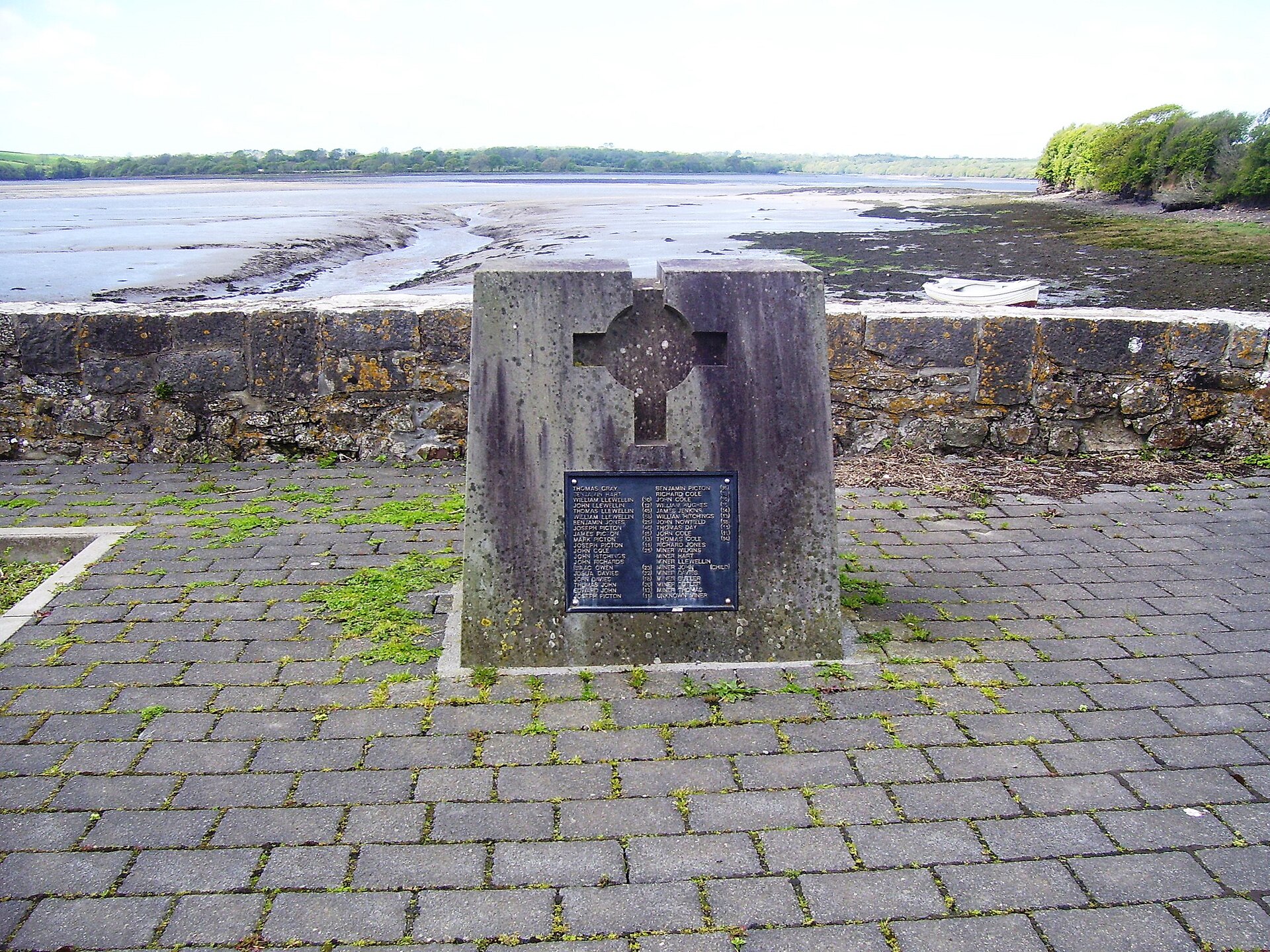
A Pembrokeshire anthracite colliery on the Daucleddau estuary, whose Garden Pit was reopened in 1788 and driven a quarter of a mile out beneath the river. On the afternoon of 14 February 1844 the water broke into the workings and forty of the fifty-eight people below were drowned — the worst single loss of life in Pembrokeshire mining.
History
Coal mining was important to this small village from the mid-eighteenth century, most of its anthracite going out by sea. The Garden Pit was reopened in 1788 after a period of closure, and around 1800 Sir Hugh Owen installed a steam engine for haulage and pumping — making it one of the earliest collieries in the county to use the technology. With the engine the shaft was deepened and the workings driven a quarter of a mile out under the river, and output rose to some 10,000 tons a year, shipped from the quay.
On the afternoon of 14 February 1844 the water broke into the workings a short distance from the shore. Fifty-eight people were below; retreat was cut off for the thirty-three furthest in, and forty were drowned (see Disasters, below).
The colliery did not recover its former importance. The Ordnance Survey's first-edition 25-inch mapping annotates the site 'Old Culm Pit' and shows the bank on the north and west of the shaft entrance; an oval depression some forty metres to the south suggests a second pit entrance, perhaps a replacement for the Garden Pit.
Geology
The colliery worked the anthracite of the Pembrokeshire Coalfield, the far western end of the South Wales Coalfield, where the measures are intensely folded and the coal has been carried to the highest rank. What made the working dangerous was not the coal but the cover: the seams run out under the tidal Daucleddau, and the strata between the workings and the estuary bed were thin enough that a rising tide over shallow, robbed ground could and did let the water through.
Workings
A shaft pit with workings driven a quarter of a mile out beneath the Daucleddau estuary. From about 1800 a steam engine did the haulage and the pumping — the pit had a constant seepage of water — and coal was raised in buckets on a whim worked by horses. Anthracite was shipped out from the quay below the site.
Closure
The closure date is not known. The colliery never recovered its former scale after 1844, and the Ordnance Survey's first-edition mapping records the site as an old pit.
What remains
Modern aerial photography shows only grass at the entrance to the Garden Pit, with a dwelling over the site of the second pit entrance. A memorial to the forty who died was erected by villagers at Landshipping Quay in 2002.
Nothing of the colliery survives above ground; a memorial stands at the quay.
Related mines
- Sprinkle and Nash Colliery — Both Pembrokeshire anthracite collieries on the Cleddau estuary a few miles apart.
Nearby mines
- Sprinkle and Nash Colliery — 1.1 miles (1.8 km) W
- Hook Colliery — 3.1 miles (5.0 km) NE
- Loveston Colliery — 5.2 miles (8.4 km) E
- Reynolton Colliery — 5.5 miles (8.8 km) E
- Jeffreston Colliery — 6.0 miles (9.6 km) SE
Straight-line distance, within 9 miles (15 km). Show on the map.
Disasters & major incidents
-
Garden Pit Inundation, Landshipping, 1844
14 February 1844 · Flooding / Inundation · 40 fatalities
On the afternoon of 14 February 1844 the Daucleddau broke into the Garden Pit at Landshipping, whose workings ran a quarter of a mile out beneath the estuary. Fifty-eight people were below; thirty-three were cut off at once and forty drowned. Eighteen were brought up in the coal buckets by putting the horses to a gallop on the whim. It remains the worst loss of life in Pembrokeshire mining.
What's uncertain
Points where sources disagree or the record could not be settled; both accounts are kept. All open questions in the archive.
Recorded claims
Individual factual claims, each attached to the source(s) that support it below. Where sources disagree, both are kept.
- Garden Pit was opened in 1788, and around 1800 Sir Hugh Owen installed a steam engine for haulage and pumping, after which the shaft was extended and the workings driven a quarter of a mile out under the river. 1,2
- Production was increased to around 10,000 tons a year, transported by sea from the quay. 1,2
- Coflein records the shaft as 67 feet deep; Welsh Coal Mines gives 67 yards. (disputed) 1,2
- Modern aerial photography shows only grass at the entrance of the Garden Pit, with a dwelling over the site of a second pit entrance suggested by an oval depression some forty metres to the south. 2
Photographs & further reading
The national monuments record for the colliery, with the history of the pit, a detailed account of the 1844 inundation and rescue, and what can still be seen on the ground.
View sourceSources
- (secondary) Garden Pit, Landshipping — Welsh Coal Mines
- (primary) Garden Pit, Landshipping Colliery (NPRN 401345) — Royal Commission on the Ancient and Historical Monuments of Wales
Record created: 3 September 2026 · Last researched: 3 September 2026