 MineArchive
Hook Colliery
| Location | Hook, Pembrokeshire — 51.7789, -4.8225 (approximate) |
|---|---|
| Commodity | Coal |
| Type | Coal |
| Worked | 1850–1948 |
| Maximum depth | Unknown. |
| Operators | Harcourt Powell (1850–1870), Hook Colliery Co (1875–1948) |
Overview
Hook Colliery, on the Western Cleddau estuary in Pembrokeshire, was the leading mine of the small, isolated Pembrokeshire Coalfield, producing anthracite prized for burning almost smokeless — including, reputedly, in Queen Victoria's own palaces. At its peak it shipped coal as far as Singapore and St Helena, mostly by sea from its own quay, before flooding finally beat its pumps in 1948.
History
Thomas Harcourt Powell opened Hook Colliery around 1849-1850, working it until the late 1860s; the mine passed through several hands before the Hook Colliery Co took over from 1875, running it for most of its working life. At its peak the colliery employed over 250 men and produced around 40,000 tons of anthracite a year. Until a rail link to the main line at Johnston was built in the early 1900s, almost all of Hook's coal left by sea from the colliery's own quay, reaching customers as far afield as Singapore and the South Atlantic island of St Helena. The colliery's smokeless anthracite was reputedly favoured by Queen Victoria and used in royal palaces. Nationalised in 1947 along with the rest of the industry, the colliery closed the following year after finally losing its long battle against flooding in the West Drift; a private attempt to reopen it in the 1950s, led by geologist T. W. Harcourt Roberts, did not succeed.
Geology
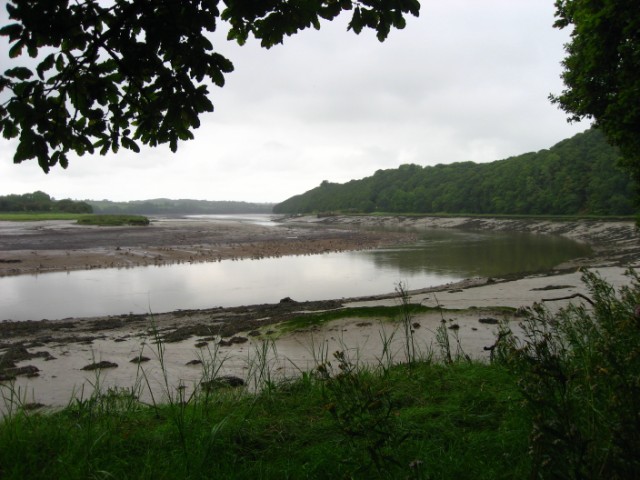
Hook worked anthracite seams of the small, geologically distinct Pembrokeshire Coalfield, mined close to the Western Cleddau estuary.
Geological setting: Sedimentary Beds and Seams (well documented example)
Workings
Workings included a West Drift, whose flooding ultimately could not be controlled by pumping and forced the colliery's closure.
Closure
The colliery closed in 1948, a year after nationalisation, once flooding in the West Drift finally overcame the pumps; a 1950s private attempt to reopen the mine was unsuccessful.
What remains
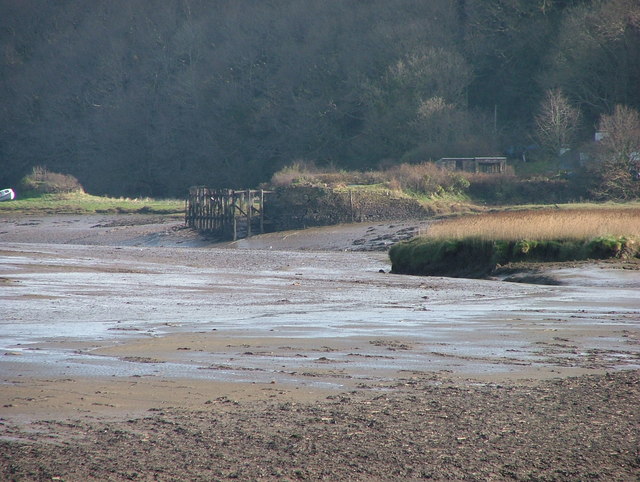
The colliery quay survives on the Western Cleddau below the village, built around 1790 and served by an incline; the hulk of an old wooden vessel lies on the mud beside it. Little else of the colliery is visible. The Hook History Society keeps the mine's history locally.
The colliery quay on the Western Cleddau, constructed around 1790 and served by an incline down from the workings, with a wrecked wooden hull on the foreshore beside it.
Redevelopment
None. The quay and the shoreline remain open ground.
Related mines
- Sprinkle and Nash Colliery — Neighbouring pits on the Daugleddau, both working the Pembrokeshire anthracite and both shipping from their own quays on the tidal water.
Nearby mines
- Landshipping Colliery — 3.1 miles (5.0 km) SW
- Loveston Colliery — 3.4 miles (5.5 km) SE
- Thomas Chapel Colliery — 4.0 miles (6.4 km) SE
- Sprinkle and Nash Colliery — 4.1 miles (6.6 km) W
- Broadmoor Colliery — 4.8 miles (7.7 km) SE
Straight-line distance, within 9 miles (15 km). Show on the map.
What's uncertain
Points where sources disagree or the record could not be settled; both accounts are kept. All open questions in the archive.
- Hook's smokeless anthracite was reputedly favoured by Queen Victoria and used in royal palaces. (uncertain) 3
Recorded claims
Individual factual claims, each attached to the source(s) that support it below. Where sources disagree, both are kept.
- At its peak Hook Colliery employed over 250 men and produced around 40,000 tons of anthracite a year. 1
- Anthracite from Hook was shipped as far as Singapore and St Helena, mostly by sea from the colliery's own quay until a rail link to Johnston was built in the early 1900s. 2
- Hook's smokeless anthracite was reputedly favoured by Queen Victoria and used in royal palaces. (uncertain) 3
- The colliery closed in 1948, a year after nationalisation, once flooding in the West Drift overcame its pumps. 1
- The colliery quay on the Western Cleddau was constructed around 1790 and served by an incline; it survives and is reachable on a footpath. 1
Photographs & further reading
The colliery's owners from Thomas Harcourt Powell onwards, its output and workforce, the quay and the rail link to Johnston, and the flooding of the West Drift that closed it.
View sourceSources
- (secondary) Hook Colliery — welshcoalmines.co.uk
- (secondary) Coal Was Sent all Over the World — Hook History Society
- (secondary) Riverside Colliery with Royal Patronage — Hook History Society
- (secondary) Pembrokeshire Coalfield — Wikipedia
Record created: 20 August 2026 · Last researched: 9 September 2026