 MineArchive
Thomas Chapel Colliery
| Location | Thomas Chapel, Begelly, near Kilgetty, Pembrokeshire — 51.7444, -4.7481 (approximate) |
|---|---|
| Commodity | Coal |
| Type | Coal |
| Worked | 1784–1867 |
| Maximum depth | 468 feet (New Hayes Pit) |
| Operators | Thomas Stokes and Company (1842–1842), Morgan Hughes and Company (1842–?), Pembrokeshire Iron and Coal Company (1851–1867) |
Overview
A group of anthracite pits at Thomas Chapel, Begelly, worked from 1784 at the head of the Saundersfoot Railway. Six men drowned in an inrush in 1838, and the 1842 Royal Commission found young girls hauling coal underground; the colliery was finally abandoned in 1867.
History
Thomas Chapel Colliery, in Begelly parish near Kilgetty, was the name for a group of anthracite workings in the eastern Pembrokeshire coalfield, confined between the Reynalton fault to the west and the Bramble Hill fault to the east, with a mineral take of 1,000 acres. Welsh Coal Mines dates its first pits, the Old Wheel Pit (165 feet) and the Hay Pit, to 1784, followed by the Stump Park, Hackett and Air pits in the 1790s and the Horse Wheel, Pond Landing and Pond Engine pits in 1836-40, working the Lower Level and Kilgetty seams; Coflein says only that it had opened by 1843. A four-foot-gauge tramway, part of the Saundersfoot Railway, reached it in the 1830s, and its anthracite was shipped from Saundersfoot to south-east England for the brewing trade. On 16 June 1838 the miners cut into old water-filled workings and six men of Begelly drowned; it took pumping night and day at two pits, helped by a steam engine at a third, before the bodies could be reached. William Brace, named as the owner in one account and the manager in another, was charged with manslaughter on the prosecution of one victim's father, but the case went no further than the grand jury at Haverfordwest in March 1839. The Royal Commission of 1842 found children as young as seven working there as trammers, among them girls of eleven dragging loads along roadways under three feet high. It was held in 1842 by Thomas Stokes and Company, or by Morgan Hughes and Company, and was bought in 1851 by the Pembrokeshire Iron and Coal Company; two more colliers drowned in an inrush in July 1854. Abandoned as 'Thomas Chapel or New Hayes' in 1857, it was listed again from 1858 and finally abandoned in 1867, as New Hayes; a company registered in 1875 to acquire it offered it for auction in 1878.
Geology
Anthracite of the Pembrokeshire coalfield: the Lower Level and Kilgetty seams, in ground bounded by the Reynalton and Bramble Hill faults.
Geological setting: Sedimentary Beds and Seams (well documented example)
Workings
Several shallow shafts: the Old Wheel Pit (165 ft) and Hay Pit (114 ft) of 1784, Stump Park (1790, 162 ft), Hackett (1794, 174 ft) and Air (1799, 108 ft) pits to the Lower Level seam, the Horse Wheel (60 ft), Pond Landing (96 ft) and Pond Engine (144 ft) pits of 1836-40 to the Kilgetty seam, and the 10-foot New Hayes Pit to the Kilgetty seam at 468 ft. Windlasses, skips and trams underground; the Saundersfoot Railway ran from the pit mouth.
Closure
Abandoned in 1857 as 'Thomas Chapel or New Hayes', listed again from 1858 and finally abandoned in 1867 as New Hayes (Welsh Coal Mines). Another account on the same page has it worked by the Pembrokeshire Iron Company in 1865, in a list of 1869 and closed before 1880. The Saundersfoot and Tenby Collieries Company, registered in 1875 to acquire it, advertised it for auction on 17 May 1878.
What remains
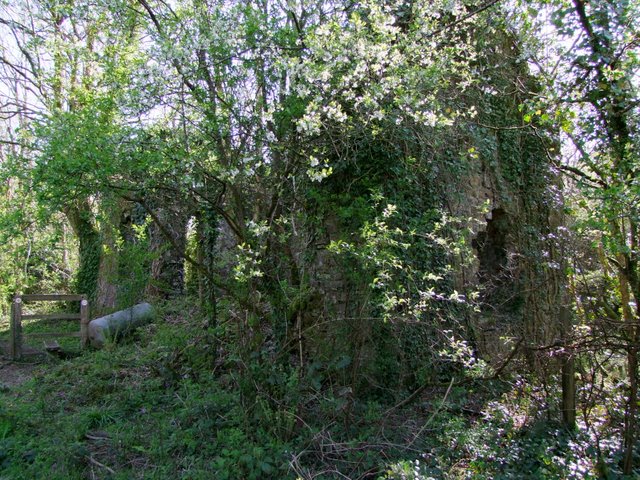
A ruined, ivy-covered stone building stands in woodland on the colliery site (photographed in 2009).
The 1889 Ordnance Survey map shows tips, an old engine house and an old shaft, and the 1907 map an old coal shaft; a ruined stone building survives among trees.
Related mines
- Grove Colliery, Kilgetty — Both worked by the Pembrokeshire Iron and Coal Company, which bought Thomas Chapel in 1851 and sank the Grove pit from 1852.
Nearby mines
- Loveston Colliery — 1.5 km W
- Grove Colliery, Kilgetty — 2.8 km SE
- Kilgetty Colliery — 2.9 km SE
- Wood Level Colliery — 3.6 km E
- Bonville's Court Colliery — 4.0 km SE
Straight-line distance, within 15 km. Show on the map.
People
- William Brace · manager, 1838–1839 — Owner (WCM) or manager (snorbens) at the 1838 inrush; charged with manslaughter, the case went no further than the grand jury.
- Morgan Hughes · partner, 1842–1854 — Of Morgan Hughes and Co., owners in 1842; described in 1854 as formerly of Thomas Chapel Colliery.
- Thomas Stokes · proprietor, 1842 — Named as proprietor in the 1842 Royal Commission report.
What's uncertain
Points where sources disagree or the record could not be settled; both accounts are kept. All open questions in the archive.
- The first pits of Thomas Chapel Colliery, the Old Wheel Pit and the Hay Pit, were sunk in 1784, with more shafts in the 1790s and in 1836-40. (disputed) 1
- Thomas Chapel coal mine had opened by 1843, and was the northern end of the Saundersfoot Railway. (disputed) 2
- The 1842 Royal Commission report names Thomas Stokes as proprietor of Thomas Chapel Colliery, and it was owned by Thomas Stokes and Company in 1842. (disputed) 1
- In 1842 Thomas Chapel was owned by Messrs Morgan, Hughes and Co.; a court notice of 1854 names Morgan Hughes 'formerly of Thomas Chapel Colliery'. (disputed) 1
Recorded claims
Individual factual claims, each attached to the source(s) that support it below. Where sources disagree, both are kept.
- The first pits of Thomas Chapel Colliery, the Old Wheel Pit and the Hay Pit, were sunk in 1784, with more shafts in the 1790s and in 1836-40. (disputed) 1
- Thomas Chapel coal mine had opened by 1843, and was the northern end of the Saundersfoot Railway. (disputed) 2
- On 16 June 1838 an inrush of water drowned six men, James Thomas, Isaac Rees, Henry Lewis, George Tasker, John Bowen and William Phillips, all of Begelly; William Brace was charged with manslaughter. 1,3
- The case against William Brace, brought by James Thomas of Thorny Park, father of one of the dead, failed to get beyond the grand jury at Haverfordwest on 11 March 1839. 3
- The 1842 Royal Commission report names Thomas Stokes as proprietor of Thomas Chapel Colliery, and it was owned by Thomas Stokes and Company in 1842. (disputed) 1
- In 1842 Thomas Chapel was owned by Messrs Morgan, Hughes and Co.; a court notice of 1854 names Morgan Hughes 'formerly of Thomas Chapel Colliery'. (disputed) 1
- The Pembrokeshire Iron and Coal Company bought the colliery in 1851; it was abandoned in 1857 as 'Thomas Chapel or New Hayes', reopened, and finally abandoned in 1867 as New Hayes. 1
- Ordnance Survey 25-inch maps of 1889 and 1907 show tips, an 'Old Engine House' and 'Old Shaft', and an 'Old Shaft (Coal)'. 2
Photographs & further reading
The pits and their depths, the 1838 and 1854 inrushes, the 1842 Royal Commission evidence and the later owners.
View sourceThe national monuments record entry, with what the 1889 and 1907 Ordnance Survey maps show on the site.
View sourceA local history of the 1838 inrush, its victims and the failed manslaughter prosecution of William Brace.
View sourceSources
- (secondary) Thomas Chapel colliery — Welsh Coal Mines
- (secondary) Thomas Chapel Colliery, Thomas Chapel (NPRN 400205) — Coflein (RCAHMW)
- (secondary) The Importance Of The Thomas Chapel Colliery Disaster — A Pembrokeshire Mining Community
- (primary) Broom / Broom Upper / Hackett / Shipping Upper / Thomas Chapel or Hayes New (Mining Remediation Authority abandonment plan R13542, via BGS catalogue item 21864323) — British Geological Survey / Mining Remediation Authority
Record created: 19 September 2026 · Last researched: 19 September 2026