 MineArchive
Grove Colliery, Kilgetty
| Location | Kilgetty and Begelly, Pembrokeshire — 51.7344, -4.6936 (exact) |
|---|---|
| Commodity | Anthracite |
| Type | Coal |
| Worked | 1856–1884 |
| Maximum depth | 105 fathoms (189 m) to the Kilgetty Vein. |
| Operators | Pembrokeshire Iron and Coal Company (1852–?) |
Overview
A Pembrokeshire anthracite pit sunk by the Pembrokeshire Iron and Coal Company to feed the iron furnaces it was establishing at Kilgetty. Considered from 1845, decided on in 1852 and opened in 1856, it had a shaft described in 1859 as the largest in Wales, sunk 105 fathoms to reach the Kilgetty Vein — which proved very disappointing. It drained the older Kilgetty Colliery, to which it was linked underground, and outlived the ironworks it was built for, ceasing regular working in 1884. Its Cornish beam engine house survives as a scheduled ancient monument.
History
In 1845, in anticipation of establishing iron furnaces at Kilgetty, the Pembrokeshire Iron and Coal Company began to consider sinking a new pit at Grove. The decision was taken in 1852 and the pit opened in 1856, by which time the ironworks was in production. It was linked underground to the workings of the older Kilgetty Colliery, which it drained, had a tramway straight to the ironworks, and was also connected to the Saundersfoot Railway. The shaft was of large diameter — described in 1859 as the largest in Wales. Its main purpose was to reach the Kilgetty Vein at 105 fathoms, and the vein proved very disappointing. Regular exploitation nevertheless outlived the ironworks and ceased in 1884; thereafter the shaft was kept for pumping and ventilation. By 1900 it was proposed to move all the machinery from Grove to Kilgetty Colliery, which was presumably done. A fully equipped stable is reported still to stand at the foot of the shaft. The local historian M. R. C. Price described the enterprise as "an imaginative and expensive venture that went badly wrong" — but its engine house, Cadw notes, is a magnificent ruin.
Welsh Coal Mines dates the start of sinking to 1853 and the proving of the Kilgetty seam, at 210 yards, to 1858, after an outlay of £30,000. The shaft was elliptical, 16 feet 6 inches by 12 feet 6 inches, wound by an engine with two 40-inch cylinders and a 15-foot drum; two cages each carried two trams, and two horses worked underground. In 1878 the pit was linked to the Lower Level Pit and, by a drivage of 870 yards, to Kilgetty Pit. In July 1886, when only four men went down it, the night man William Stephens was killed as he was being drawn up the shaft. The Lower Level and Kilgetty workings of Grove and Lower Level were abandoned in 1900.
Geology
The Pembrokeshire anthracite field. The whole point of the sinking was the Kilgetty Vein, found at 105 fathoms, and the whole disappointment of it was that the vein did not repay the largest shaft in Wales.
Workings
A single very large-diameter shaft, 105 fathoms to the Kilgetty Vein, with a tramway to the Kilgetty ironworks and a connection to the Saundersfoot Railway, and an underground link to the older Kilgetty Colliery which it drained. The machinery in about 1900 consisted of an engine of 274 horsepower with an 80-inch cylinder, a ten-foot stroke in house and eight feet in the pit. The shaft has since been capped in concrete. The shaft was elliptical, 16 ft 6 in by 12 ft 6 in; the winding engine had two 40-inch cylinders with a 42-inch stroke and a 15-foot drum, and two cages each carried two trams. In 1878 it was linked to the Lower Level Pit and by an 870-yard drivage to Kilgetty Pit.
Closure
Regular working ceased in 1884, the colliery having outlived the ironworks it was sunk to supply. The shaft was afterwards maintained for pumping and ventilation, and by 1900 it was proposed to remove all the machinery to Kilgetty Colliery.
What remains
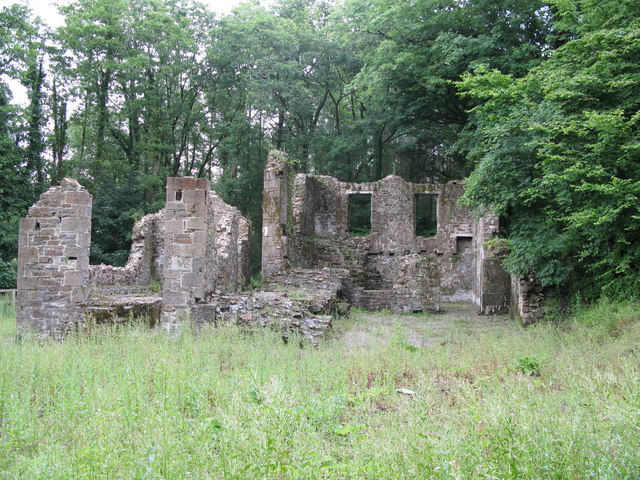
The shaft has been capped in concrete and the engine house stands with a few other ruined buildings — a very large Cornish-type beam engine house about 7 m by 10 m, roofless but complete to its full height, faced in squared limestone over a local sandstone backing, its bob-wall 1.65 m thick and entirely of limestone. It is a scheduled ancient monument (Pe 418) as well as being listed.
The Cornish beam engine house, roofless but full height, with a tall arched aperture to the front, a wider archway to the rear, brick-arched openings in the side walls and splayed high-level windows; the capped shaft; and a few other ruined buildings. The ruined winding engine houses, the original and a later one built beside it, also stand.
Related mines
- Kilgetty Colliery — Grove was sunk from 1852 a few hundred yards from the older Kilgetty Colliery and opened in 1856 linked underground to its workings, which it drained; by 1900 it was proposed to move all Grove’s machinery over to Kilgetty.
- Thomas Chapel Colliery — Both worked by the Pembrokeshire Iron and Coal Company, which bought Thomas Chapel in 1851 and sank the Grove pit from 1852.
Nearby mines
- Kilgetty Colliery — 0.3 miles (0.5 km) NW
- Wood Level Colliery — 0.3 miles (0.5 km) NW
- Bonville's Court Colliery — 1.4 miles (2.3 km) SW
- Broom Colliery — 1.8 miles (3.0 km) W
- Moreton Colliery — 2.2 miles (3.5 km) SW
Straight-line distance, within 9 miles (15 km). Show on the map.
Disasters & major incidents
-
Grove Colliery shaft accident, 1855
14 May 1855 · Winding / Shaft Accident · 2 fatalities
Two colliers fell to their deaths from a stage being lowered down the shaft of the Grove Pit, Kilgetty, on 14 May 1855, a year before the pit was opened for coal.
Recorded claims
Individual factual claims, each attached to the source(s) that support it below. Where sources disagree, both are kept.
- In 1845, in anticipation of establishing iron furnaces at Kilgetty, the Pembrokeshire Iron and Coal Company began to consider sinking a new pit at Grove; the decision was taken in 1852 and the pit opened in 1856. 1
- The shaft was of large diameter, described in 1859 as the largest in Wales; its main purpose was to reach the Kilgetty Vein at 105 fathoms, and the vein proved very disappointing. 1
- The pit was linked underground to the workings of the older Kilgetty Colliery, which it drained, and had a tramway link directly to the ironworks as well as a connection to the Saundersfoot Railway. 1
- Regular exploitation of the colliery outlived the ironworks and ceased in 1884, after which the shaft was maintained for pumping and ventilation; by 1900 it was proposed to remove all machinery from Grove to Kilgetty Colliery. 1
- The surviving building is a very large Cornish-type beam engine house about 7 m by 10 m, roofless but complete to full height, faced in squared limestone over a sandstone backing with a bob-wall 1.65 m thick entirely of limestone; it is a scheduled ancient monument, Pe 418. 1
- Sinking began in 1853 and the Kilgetty seam was proved at 210 yards in 1858 after an outlay of £30,000. 2
- The shaft was elliptical, 16 ft 6 in by 12 ft 6 in, with a twin-cylinder winding engine and a 15-foot drum. 2
- In 1878 it was linked to the Lower Level Pit and by an 870-yard drivage to Kilgetty Pit. 2
- The night man William Stephens was killed while being drawn up the shaft at the end of July 1886, when only four men went down the pit. 3
- The Lower Level and Kilgetty workings of Grove and Lower Level were abandoned in 1900. 4
- The ruined winding engine houses survive beside the shaft. 5
Photographs & further reading
The statutory description of the surviving engine house and the history behind it: the ironworks it was built for, the largest shaft in Wales and the vein that disappointed.
View sourceGrove Colliery's sinking, engines, links to Kilgetty and closure.
View sourceInquest on William Stephens, killed in the shaft of the Grove Pit.
View sourceSources
- (primary) Grove Colliery Cornish beam engine house — Cadw list entry 18276 — Cadw, via British Listed Buildings
- (primary) Bonville's Court Colliery — Welsh Coal Mines, from the Inspector of Mines lists
- (primary) Tenby Observer, 5 August 1886: Accident at Grove Colliery — National Library of Wales, Welsh Newspapers
- (primary) BGS / Mining Remediation Authority mine plan: GROVE AND LOWER LEVEL, Lower Level and Kilgetty seams, abandoned 1900 — British Geological Survey
- (observational) Geograph 876347: Grove Colliery, Stepaside (Stephen Dewhirst, 2008) — Geograph Britain and Ireland
- (primary) Kilgetty Colliery (NPRN 308436) — Royal Commission on the Ancient and Historical Monuments of Wales
Record created: 7 September 2026 · Last researched: 7 September 2026