 MineArchive
Iron Replacement Deposits
| Category | Deposit Types |
|---|
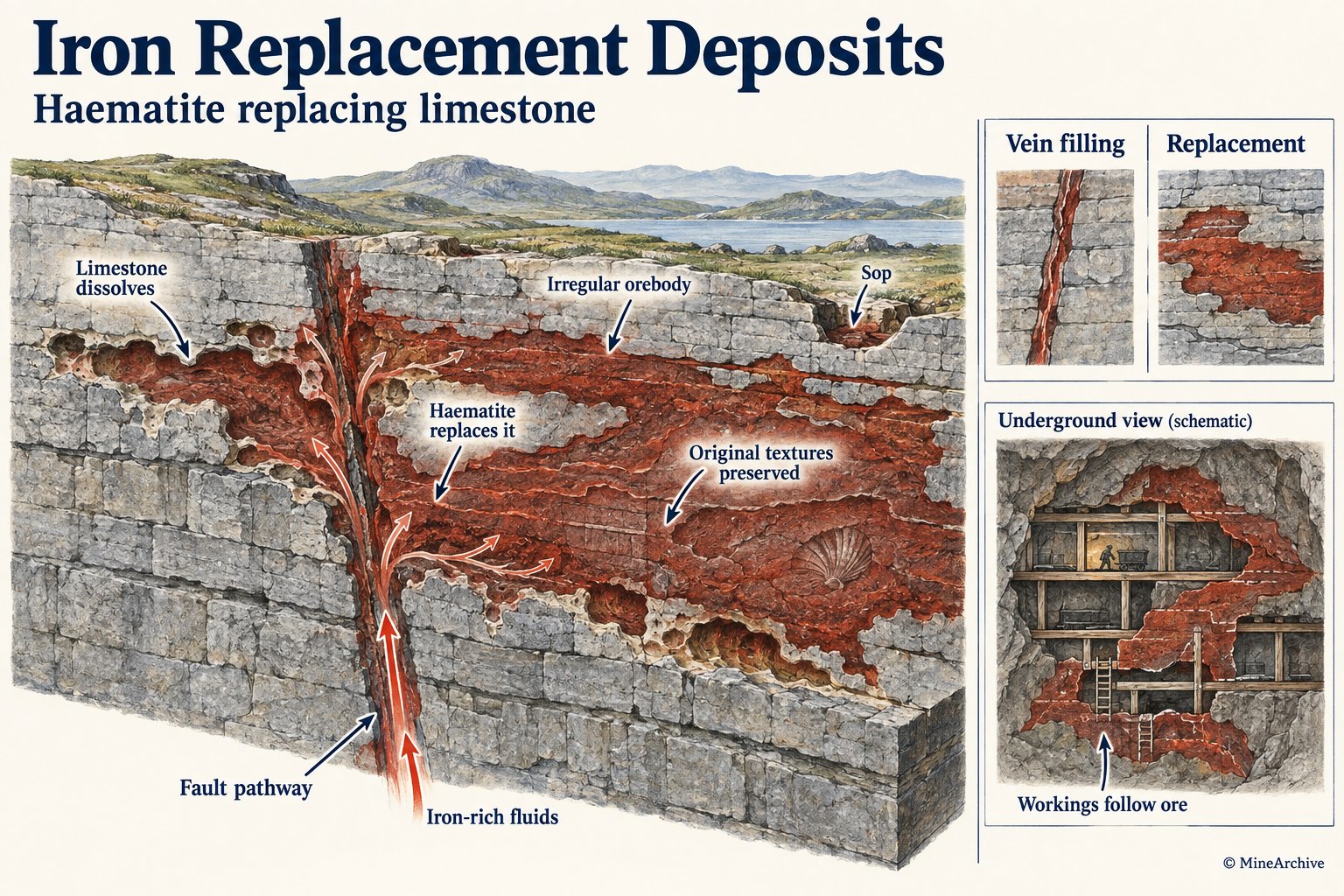
An iron ore body formed not by filling an open fracture, like a vein, but by fluids chemically dissolving away limestone and depositing solid iron oxide in its place — the process behind West Cumbria's exceptionally rich haematite deposits, once among the most productive iron orefields in Britain.
How it forms
Iron-rich fluids — thought to have leached iron from either the red Permo-Triassic sediments that once covered the area or the granite underlying the Lake District, driven by heat at depth — moved upward through fault-controlled pathways into the region's Carboniferous limestone. Rather than simply filling a crack the way a hydrothermal vein does, these fluids reacted chemically with the limestone itself, dissolving it away and replacing it, often almost exactly in place, with solid haematite (iron oxide) — original limestone features like bedding planes, stylolites and even fossils are sometimes still faintly preserved within the replaced ore, direct evidence that the iron took the exact place the limestone used to occupy rather than simply filling an empty space. Exactly when this happened is still debated: some evidence points to the Permian or Early Triassic, other evidence to a later, post-Triassic date, and the question hasn't been conclusively settled.
Why minerals concentrate here
Because replacement follows wherever fluid actually reached the limestone — along faults, and, in the Furness area, down into large, roughly conical dissolution hollows in the limestone called 'sops' — the iron ended up concentrated exactly where those pathways and cavities happened to be, rather than spread evenly through the rock. Hodbarrow's ore, at the junction of the limestone with later sediments near the Duddon Estuary, reached an exceptional purity of 55-65% iron by weight precisely because the replacement there was so complete.
Typical shape of the deposit
Large, irregular, flat-lying masses, following the shape of the dissolved-out limestone and any faults or karst cavities that channelled the mineralising fluid — genuinely without the regular tabular geometry a vein has, and correspondingly harder to predict in advance from the surface than a well-defined lode.
What this means for mining
Because a replacement orebody's shape follows old dissolution cavities and fault zones rather than a single predictable plane, working it demanded a different kind of underground judgement from vein mining — levels and stopes had to follow an irregular, three-dimensional mass rather than a narrow, roughly planar target, with orebody boundaries that could change abruptly and unpredictably as the ore was worked. Some of the largest individual haematite bodies at Hodbarrow were exceptionally rich but also, by their nature, isolated and irregular rather than part of a single continuous system.
Associated commodities
Iron (West Cumbria's haematite is the product of this replacement process, one of several ways iron ore forms.)
Related geology
Faults and Fractures, Sedimentary Ironstones
Diagrams
Images
MineArchive examples
Included only where MineArchive's own research gives a reasonable evidential basis — not every mine where this geology might plausibly apply. Showing the 10 strongest examples of 16 linked mines.
- Little Garth Mine — Cardiff (well documented example)
A haematite orebody held in Carboniferous Limestone and worked as irregular masses and great cavities rather than as a vein or seam — the replacement geometry this record's own geology section describes, and the reason its caverns took the shapes they did. - Beckermet Mine — Cumbria (well documented example)
The mine's own recorded geology explicitly describes haematite orebodies formed by iron-rich fluids replacing pockets and fissures in Carboniferous limestone. - Clearwell Caves — Gloucestershire (well documented example)
Clearwell's own workings are recorded as an unusually pure haematite ore (reported over 80% iron) occurring in pockets within the ore body and the surrounding Carboniferous ('Crease') Limestone — the same replacement mechanism already linked from Doward, across the Wye in the same orefield. - Crossfield Mine — Cumbria (well documented example)
The record describes haematite worked in Carboniferous limestone in the west Cumbrian orefield, where the BGS regional geology describes the orebodies as large irregular or flat-lying replacements of limestone beside faults rather than as veins. - Doward Iron Mines — Herefordshire (well documented example)
Doward iron occurs as irregular replacement bodies in the Carboniferous Limestone, the same orefield as the Forest of Dean across the river. - Heights Pasture Mine — County Durham (well documented example)
The iron worked here is limonite in the flats at the High Flats horizon of the Great Limestone, formed by the oxidation of the carbonates ankerite and siderite that had replaced the limestone. - Llanharry Iron Mine — Rhondda Cynon Taf (well documented example)
Haematite and goethite concentrated within Carboniferous Limestone — the same broad replacement process as the west Cumberland orefield, and quite unlike the bedded Jurassic ironstones. - Rookhope (Boltsburn Mine) — County Durham (well documented example)
The 1892 discovery was of 'flats' — near-horizontal replacement bodies where the Great Limestone has been replaced outwards from the vein, the form that made Boltsburn briefly one of the richest mines in England. - Dalzell's Moor Row Mine — Cumbria (well documented example)
The mine worked west Cumbrian haematite, which the British Geological Survey describes as replacing the Carboniferous limestone as flats along the bedding, as veins along faults, and as irregular masses. - Eskett Pit — Cumbria (well documented example)
The pit worked west Cumbrian haematite, which replaces the Carboniferous limestone as flats along the bedding, as veins along faults and as irregular masses.
See all 16 linked mines.
Sources
- (primary) Haematite deposits of Cumbria — BGS Earthwise
- (secondary) Iron mining — Industrial History of Cumbria
Record created: 22 August 2026 · Last researched: 22 August 2026