 MineArchive
Little Garth Mine
| Also known as | Garth Iron Mine, Lesser Garth Mine, Garth Mine |
|---|---|
| Location | Lesser Garth Hill, Pentyrch, near Taff's Well, Cardiff — 51.5327, -3.2729 (exact) |
| Commodities | Iron, Ochre |
| Type | Iron |
| Worked | Early 19th century–1884 |
| Maximum depth | About 400 ft (122 m) at abandonment in 1884. |
| Operators | Richard Blakemore (1805–1837), Thomas W. Booker (1837–1879) |
Overview
Little Garth was a haematite mine at the top of Lesser Garth Hill, the ridge running east from Pentyrch between Gwaelod-y-garth and Radyr, just outside Cardiff. It was the ore body that fed the Pentyrch ironworks and, through them, the Melingriffith tinplate works, and it was worked on a scale that its modest name does not suggest: four surface entries driven downwards after the ore until they had to be linked underground by a maze of caverns and staple shafts, one cavern about 200 ft long, 100 ft wide and 70 ft high with no support in it at all. It was abandoned in 1884 and flooded to the level of its access tunnel, and its site now lies within the quarry that has eaten the hill around it.
History
Iron-making in this area is thought to go back to Roman times, but how far this body of haematite was worked then, or at any time before the end of the eighteenth century, is not known.
The mine was taken up in earnest by Richard Blakemore, who acquired the Melingriffith tinplate works together with the Pentyrch iron works in 1805 and began exploiting the underground mineral veins in the early years of the century. Previous owners had used coal-measures ironstone together with imported Lancashire haematite; Blakemore, with his nephew Thomas W. Booker assisting him, built the enterprise into a major source of tinplate production, and from 1837 the sole management was vested in Booker by his uncle.
At first the mine was worked by sheer muscle power and the liberal use of black powder, with a horse-powered windlass raising ore and spoil from the depths and packhorses carrying it down tracks on the steep wooded hillside to the furnaces at Pentyrch. The packhorses gave way to a horse-drawn tramway running to a lower-level tramway alongside the Pentyrch road, which the Coed-y-bedw mine tramway also joined and which ended at the ironworks; some stone sleepers of the inclined tramway can still be seen in the woods. A steam engine supplied by the Neath Abbey Ironworks eventually replaced the horse-driven windlass.
Between 1842, when some fifty men and boys were employed, and 1860 the mine received substantial investment. The largest piece of it was a rock tunnel 400 yards long, driven south-eastwards from the low-level tramway near the Pentyrch road to intersect the main working chamber about 200 ft below the top surface level — a capstone recovered from its portal in 1930 bore the inscription "June 30th 1842". The tunnel gave an easier and shorter horse-drawn rail route to and from the mine close to the furnaces, did away with the high-level tramway, and served as a drainage outlet at that depth, working with a Cornish beam pump to dewater the lower ground.
In the early 1870s the mine was turning out about 15,000 tons of ore a year, with room to increase it from caverns below tunnel level, together with some 265 tons of high-grade ochre, prepared at Melingriffith for sale to paint manufacturers in Bristol. Booker went bankrupt in 1879, and from 1880 the mine produced only yellow ochre under the liquidators — 127 tons in 1880, and a mere 11 tons by the end. It was officially abandoned in June 1884, unable to adapt financially to the new market for steel. By then something like 700,000 tons of haematite had been taken out by hand, and some estimates run as high as a million.
It did not quite finish there. The mine was partly reopened on a short lease in 1926; that under-funded venture employed six or seven men on average and ceased in 1936, and a successor lease taken up to mine the haematite failed within the same year. In 1937 ten men were employed for another short spell before that too fizzled out and the workings were left to re-flood. Its last use came in the Second World War, when the high caverns stored anti-aircraft shells and other ordnance, served by small diesel locomotives. Attempts by local people to have the mine preserved as a visitor attraction in the 1950s, and to obtain heritage protection through the local MP and Cadw in the 1990s, both came to nothing.
Geology
The ore was haematite, held in the Carboniferous Limestone of the Garth ridge alongside the dolomite that the modern quarry works. Deposits of this kind form where iron-rich solutions replace limestone along joints, faults and cavities rather than filling a regular vein, which is why the ore here occurred as irregular masses and great cavities rather than as a workable seam — the mine's celebrated caverns are the shape of the orebody, not of any plan the miners imposed on it. The site belongs to the Llanharry to Taff's Well iron-ore belt, the main haematite ground of Glamorgan. The ore also yielded high-grade yellow ochre, the hydrated form of the same iron oxide, which became the mine's only product in its last years.
Geological setting: Iron Replacement Deposits (well documented example)
Workings
Four main entries began at the surface and were driven downwards following the haematite, so that they might fairly be called quarries at first; the extent of the working eventually forced them to be linked below ground by a maze of caverns and staple shafts. Some caverns reached remarkable size, one estimated at about 200 ft long, 100 ft wide and 70 ft high with not a support in sight. The main pit was some 120 ft across at the surface, and the overall depth of the workings at abandonment in 1884 was about 400 ft. Access and drainage from 1842 came through the 400-yard rock tunnel driven from the low-level tramway to meet the main chamber about 200 ft down, assisted by a Cornish beam pump.
Closure
Booker's bankruptcy in 1879 effectively ended ore production; the liquidators worked the mine for yellow ochre alone from 1880, and it was officially abandoned in June 1884, unable to adapt financially to the new market for steel. It flooded up to the level of the entry tunnel, which leaves roughly 200 ft of the workings under water. The short reopenings of 1926 to 1937 did not change that, and the mine was left to re-flood after the last of them.
What remains
The workings survive underground and are visited. Reports from 2012 and 2013 describe entering by the main tunnel, drill marks and calcite on the walls, a pump still in place in a side adit with its pipe running up the passage past a platform, and beyond it a very deep blue lake filling a chamber — the flooded lower workings. One adit ends where it has been backfilled. Above ground the hill itself has largely gone: the site lies within the large Cemex quarry, known earlier as the Steetley quarry, and a 2013 visitor photographed the quarry from the hilltop with the mine beneath his feet.
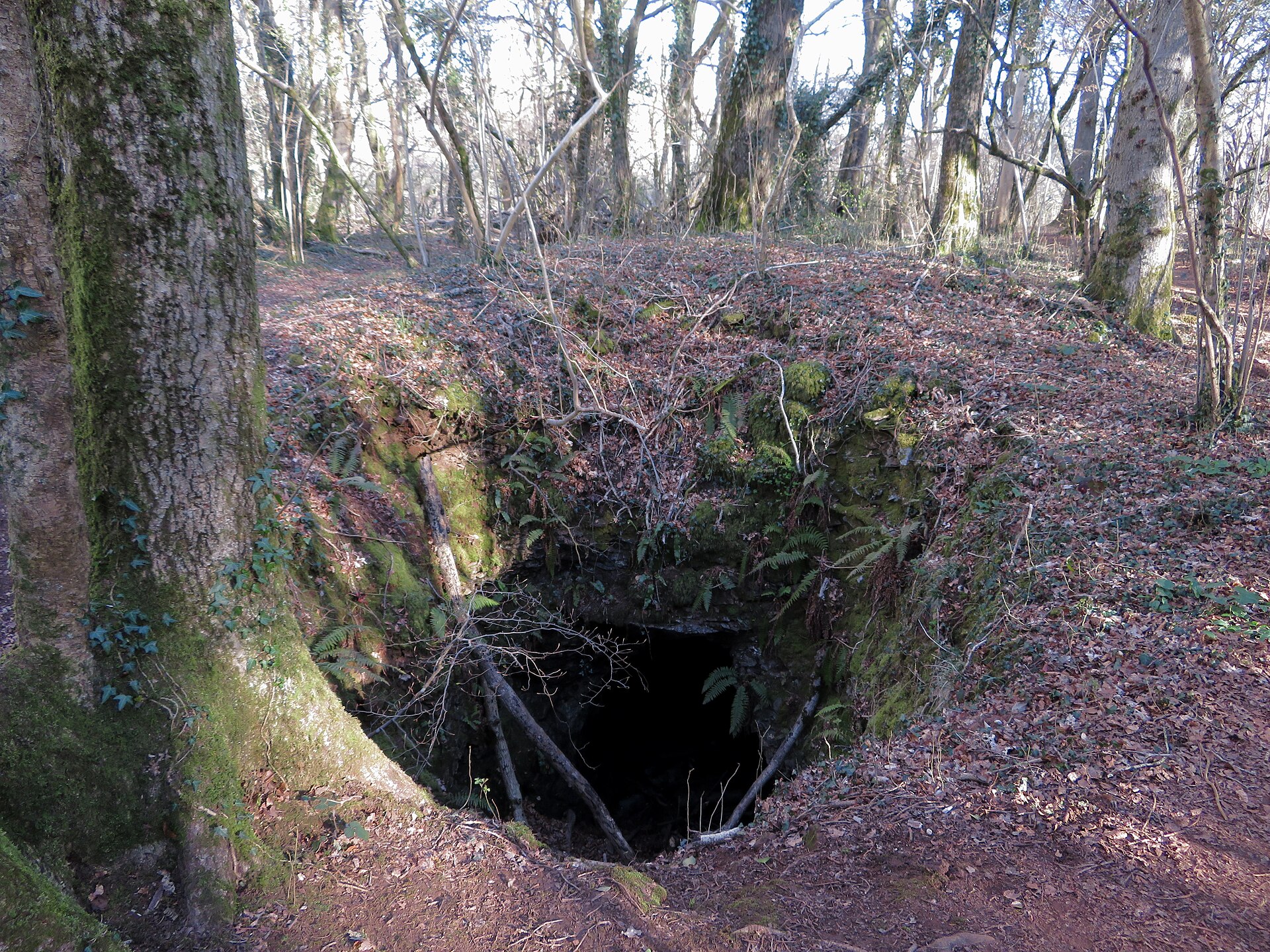
Adits and shafts on Lesser Garth Hill, one of them photographed in April 2021, and stone sleepers of the inclined tramway still lying in the woods below. The main pit and much of the hill around the workings have been taken by the adjoining quarry.
Nearby mines
- Lan Colliery — 0.7 miles (1.1 km) N
- Rockwood Colliery — 1.2 miles (2.0 km) N, Rhondda Cynon Taf
- Nantgarw Colliery — 2.1 miles (3.4 km) N, Rhondda Cynon Taf
- South Cambria Colliery — 2.2 miles (3.5 km) W
- Energlyn Colliery — 3.3 miles (5.3 km) NE, Caerphilly
Straight-line distance, within 9 miles (15 km). Show on the map.
What's uncertain
Points where sources disagree or the record could not be settled; both accounts are kept. All open questions in the archive.
- It is estimated that some 700,000 tons of haematite were removed by hand over the lifetime of the mine, with some estimates as high as 1,000,000 tons. (uncertain) 2,4
- The BGS mine-plans catalogue holds a Mining Remediation Authority abandonment plan titled 'Garth' (catalogue OM1636, Iron Ore, dated 1884); the catalogue gives no location and the plan's details do not clearly tie it to this working, so it may belong to another of the same name. (uncertain) 5
Recorded claims
Individual factual claims, each attached to the source(s) that support it below. Where sources disagree, both are kept.
- The earliest recorded workings are those of Richard Blakemore, who began exploiting the underground mineral veins in the early years of the 19th century when he acquired the Melingriffith tin-plate works along with the Pentyrch iron works. 1,2
- In 1840 an adit was driven from ST 116 827 into the giant cavern of ore. 1
- A rock tunnel 400 yards long was driven south-eastwards from the low-level tramway near the Pentyrch road to intersect the main working chamber some 200 ft below the top surface level; a capstone retrieved from the portal in 1930 bore the inscription 'June 30th 1842'. 2
- Some fifty men and boys were employed at the mine in 1842. 2,3
- The four main entries were eventually linked below ground by a maze of caverns and staple shafts, one cavern estimated at about 200 ft long, 100 ft wide and 70 ft high without support; the overall depth of the workings at abandonment in 1884 was approximately 400 ft, and the main pit some 120 ft in diameter at the surface. 2,4
- In the early 1870s the mine produced approximately 15,000 tons of ore a year together with some 265 tons of high-grade ochre, prepared at Melingriffith for sale to paint manufacturers in Bristol. 2,4
- Booker went bankrupt in 1879; from 1880 to 1884 the mine produced only yellow ochre under the liquidators, 127 tons in 1880 and 11 tons at the time of closure, and it was officially abandoned in June 1884 owing to its inability to adapt financially to the new market for steel. 2,4
- It is estimated that some 700,000 tons of haematite were removed by hand over the lifetime of the mine, with some estimates as high as 1,000,000 tons. (uncertain) 2,4
- Victorian and later visitors were given tours of the mine even after closure, on account of its vast scale and of the various colours of the water in the flooded chambers caused by the effects of sunlight on the submerged mineral veins. 1
- The mine's final period of use was during the Second World War, when the high caverns were used to store anti-aircraft shells and other ordnance, served by small diesel locomotives. 4,3
- The mine became flooded up to the entry tunnel level, leaving some 200 ft of it under water. 1,3
- The BGS mine-plans catalogue holds a Mining Remediation Authority abandonment plan titled 'Garth' (catalogue OM1636, Iron Ore, dated 1884); the catalogue gives no location and the plan's details do not clearly tie it to this working, so it may belong to another of the same name. (uncertain) 5
Photographs & further reading
The fullest account of the mine found anywhere online: the Blakemore and Booker years, the tramways down to Pentyrch, the 1842 tunnel and its dated capstone, and the slide from iron ore into ochre and bankruptcy.
View sourceThe national monuments record for the mine, which adds the 1840 adit into the cavern of ore and the detail that visitors were shown the flooded chambers for the colours of the water long after closure.
View sourceSources
- (primary) Little Garth Mine (General), Pentyrch — NPRN 33954 — Coflein / RCAHMW
- (secondary) Garth Iron Mine — The Southern Taff Vale: its Industrial Archaeology and history
- (observational) Garth — the mine with a grizzly secret (visit report, July 2013) — Derelict Places
- (observational) South Wales Iron Mine, Glamorgan (visit report, April 2012) — 28DaysLater
- (primary) BGS / Mining Remediation Authority mine plans: GARTH — British Geological Survey / Mining Remediation Authority
Record created: 5 September 2026 · Last researched: 5 September 2026