 MineArchive
Heights Pasture Mine
| Also known as | Heights Mine |
|---|---|
| Location | Westgate, between Eastgate and Westgate, Weardale, County Durham — 54.7434, -2.1208 (approximate) |
| Commodities | Fluorspar, Iron, Lead |
| Type | Mineral |
| Worked | from 1850 (Weardale Iron Company) |
| Maximum depth | Unknown. The workings follow three veins and the flats at the High Flats horizon in the Great Limestone rather than descending from a shaft. |
| Operators | Weardale Iron and Coal Company (1850–1868) |
Overview
A Weardale mine between Eastgate and Westgate, worked on three roughly parallel veins — Heights North, Heights South and West Cross — reaching the flats at the High Flats horizon in the Great Limestone. The Beaumont Company tried the flats for lead in the early 1860s, but iron ore was the principal object: the Weardale Iron Company worked the mine from 1850 to 1868 for limonite formed by the oxidation of ankerite and siderite. The vuggy flats have since yielded emerald-green twinned fluorite up to four centimetres across.
History
The Heights mine sits on the north side of Weardale between Eastgate and Westgate. It is not one working but a number of them, established on three primary veins — Heights North, Heights South and West Cross — the first two roughly parallel and the third crossing them. The object of the workings was the associated flats at the High Flats horizon within the Great Limestone.
Lead was tried here first: the Beaumont Company, which ran much of the Weardale and Allendale orefield, attempted extraction from the flats in the early 1860s. But the principal focus at Heights was iron. The Weardale Iron Company operated the mine between 1850 and 1868, working commercial iron deposits in the flats adjacent to the veins — limonite formed by the oxidation of iron carbonates, chiefly ankerite and siderite.
What has kept the mine's name alive since is neither iron nor lead. The flats around the main veins are notably vuggy, and they have yielded impressive specimens of twinned emerald-green fluorite with crystals up to four centimetres, along with well-formed pale purple material. Weardale is the heart of England's fluorite country, and Heights is one of the localities that made it so.
Geology
The North Pennine orefield. Three primary veins — Heights North, Heights South and West Cross — cut the Carboniferous sequence, the first two roughly parallel with the third crossing them, and the workings were driven to reach the flats at the High Flats horizon within the Great Limestone. The iron in those flats is limonite, formed by the oxidation of the carbonates ankerite and siderite. The flats are notably vuggy, which is why they have produced such good crystal specimens: twinned emerald-green fluorite to four centimetres and well-formed pale purple material.
Geological setting: Iron Replacement Deposits (well documented example), Veins and Lodes (well documented example)
Workings
Numerous underground workings rather than a single mine, established on the three veins and driven to the flats beside them. The site lies at about 371 m on the fell above Westgate and is on private land.
Closure
The Weardale Iron Company's working ran from 1850 to 1868. The date activity ended at the site as a whole is not known.
What remains
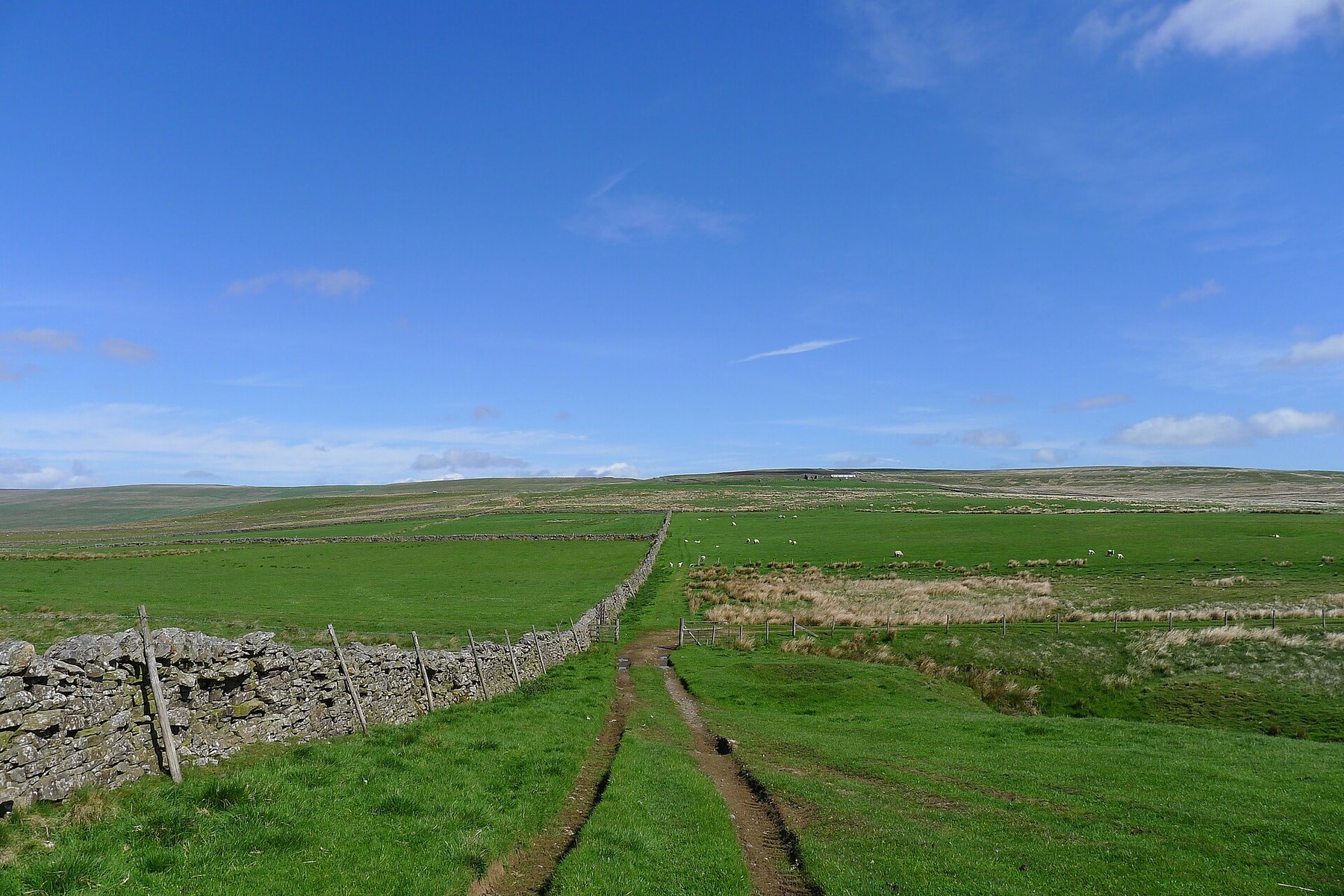
The workings are on private land on the fell between Eastgate and Westgate, crossed by the Weardale Way. The mine's continuing reputation is as a mineral locality rather than as an industrial site.
Related mines
- Cambokeels Mine — Both lie on the same stretch of Weardale between Eastgate and Westgate and both were tried for lead by the Beaumont Company before finding their real value in another mineral — Cambokeels in fluorspar, Heights in iron; Heights Pasture is named on the Cambokeels record.
Nearby mines
- West Rigg Opencast — 0.8 miles (1.2 km) W
- Cambokeels Mine — 0.8 miles (1.4 km) E
- Slitt Mine — 1.1 miles (1.7 km) W
- Brandon Walls Mine — 1.1 miles (1.8 km) N
- Stotsfield Burn Mine — 1.4 miles (2.3 km) NE
Straight-line distance, within 9 miles (15 km). Show on the map.
Recorded claims
Individual factual claims, each attached to the source(s) that support it below. Where sources disagree, both are kept.
- The Heights mine comprises numerous underground workings on three primary veins — Heights North, Heights South and West Cross — the first two roughly parallel with the third intersecting them, driven to reach the flats at the High Flats horizon in the Great Limestone. 1
- Although the Beaumont Company attempted lead extraction from the flats in the early 1860s, the principal focus at Heights was iron ore, the Weardale Iron Company operating the mine between 1850 and 1868 and working limonite formed by the oxidation of ankerite and siderite. 1
- The flats around the main veins are notably vuggy and have yielded twinned emerald-green fluorite with crystals up to four centimetres, along with well-formed pale purple specimens. 1,2
Photographs & further reading
An account of the Weardale localities and what each has produced, placing Heights among the dale's notable fluorite sites.
View sourceSources
- (observational) Heights Pasture — Buddlepit Mine Database
- (secondary) Weardale: the heart of England's fluorite country — The Assay House
- (observational) The Weardale Way on Westgate Heights Pastures — Geograph Britain and Ireland
Record created: 9 September 2026 · Last researched: 9 September 2026