 MineArchive
Fan House
| Category | Structures & Machinery |
|---|
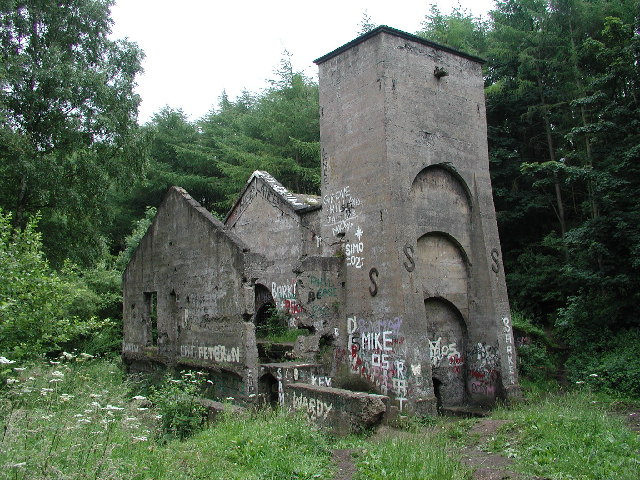
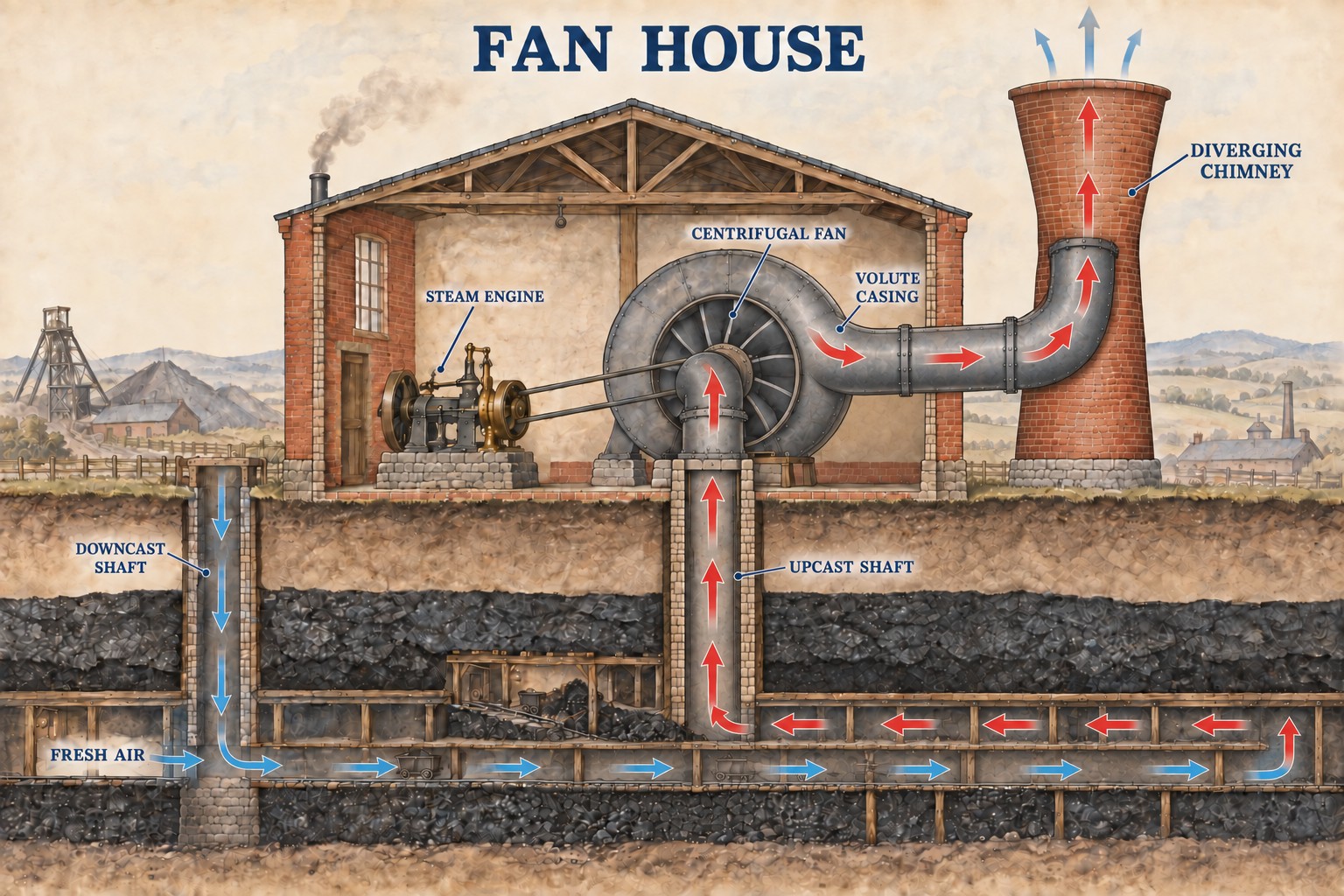
The building housing the mechanical fan that drove a mine's ventilation system, usually a Guibal or Waddle-type centrifugal fan driven by a steam engine.
Historical usage
Mechanical ventilation fans began to replace furnace-based ventilation ('the furnace draught') in British mines from the 1860s, following the Belgian engineer Théophile Guibal's 1859-62 design, which enclosed the fan in a spiral volute casing and a diverging chimney to recover more of its energy as useful draught. A rival design, the open-running Waddle fan -- built by the Waddle Engineering and Fan Company of Llanelli -- dispensed with the casing and could be mounted in the open air, at some cost in efficiency (roughly 40% for a Waddle against 55-65% for a well-built Guibal). Both types remained in use well into the 20th century, some kept on as standby plant into the 1950s, and a handful of fan houses survive intact or as ruins at old mine and colliery sites.
How it worked
A large centrifugal fan, driven by a dedicated steam engine (later electric motor), was connected to the mine's upcast shaft and drew stale air up and out of the workings, pulling fresh air in through the downcast shaft to replace it. The fan house was built around the fan and its engine to protect them from weather and, in a Guibal installation, to house the spiral casing and chimney that recovered extra draught from the spinning air.
Why it was used
Mechanical fans could move far more air, far more reliably, than the older furnace-draught method (a coal fire kept burning at the bottom of the upcast shaft) -- important as mines went deeper and workings extended further from the shaft, both of which made adequate natural ventilation harder to achieve.
Risks & limitations
A fan house and its fan represented a serious capital investment and, once installed, became a single point of failure for the whole mine's ventilation -- a fan breakdown, as at Maypole Colliery in 1908, could leave a mine badly ventilated at exactly the moment (following an explosion) when good ventilation mattered most.
Related terminology
Furnace Ventilation, Waddle Fan
Mines associated with this term
5 examples chosen from 25 linked records — the term page is not an index.
- Eston Ironstone Mines — North Yorkshire (surviving physical example)
A Guibal fan house (nicknamed the 'SS Castle') survives on the hill, built for a 37-foot fan installed in 1869. - Wynnstay Colliery — Wrexham (surviving physical example)
The colliery's Walker Fan House is a separately Scheduled Monument alongside the winding engine house. - Great Western Colliery — Rhondda Cynon Taf (well documented example)
Named 4 times in this record, first in the summary: “…shaft of the mid-1870s survives: the engine house, headframe and fan house are scheduled, and the 1875 winding engine is the only large steam…” - Hemingfield Colliery — South Yorkshire (well documented example)
Named twice in this record, first in the history: “…(see Disasters, below). Ventilation shafts followed in 1852-53 and a fan house in 1854, and the Rainborough shaft in 1864-65. By 1869 the pit…” - New Hawne Colliery — West Midlands (well documented example)
Named twice in this record, first in the surface remains: “…housing both survive, together with a third listed structure. Guibal fan houses are uncommon survivals anywhere in Britain, and the pairing of…”
Disasters associated with this term
Included only where MineArchive's own research gives a reasonable evidential basis, with the nature of the relationship stated — not every disaster where this term might plausibly apply.
- Hemingfield Colliery Explosion, 1852 (contextual relationship)
Named in this record’s changes to practice: “…shafts were sunk in 1852-53 to improve ventilation, connected to a fan house built in 1854.” - Leycett Colliery explosion, 1880 (contextual relationship)
Named in this record’s narrative: “…came at about half past eight; it lifted the roof off the new fan house, but the fan itself was undamaged and kept turning, which is why the…” - Llantrisant Colliery explosion, 1941 (contextual relationship)
Named in this record’s narrative: “…the pithead and several neighbouring buildings, and flattened the fan house at the end of the engine hall. Four men died: the manager John…” - Maypole Colliery explosion, 1908 (contextual relationship)
Named in this record’s summary: “…mining disaster. The blast wrecked the pithead winding gear and the fan house that ventilated the whole mine, and it took until 1917, nine years…”
Sources
- (primary) Guibal fanhouse at Skelton Shaft iron mine — Historic England
- (secondary) Waddle fan — Wikipedia
Record created: 31 August 2026 · Last researched: 31 August 2026