 MineArchive
New Hawne Colliery
| Location | Hawne, Halesowen, West Midlands — 52.4594, -2.0644 (exact) |
|---|---|
| Commodity | Coal |
| Type | Coal |
| Worked | 1864–1920s |
| Maximum depth | Unknown. |
| Operators | New British Iron Company (1864–1893) |
Overview
New Hawne Colliery at Hawne in Halesowen is regarded as the last working colliery in the Black Country. Owned by the New British Iron Company, it began producing coal in 1864 and worked into the 1920s. The seam over most of its take was thirty feet thick — the Thick Coal of the South Staffordshire field — and taking it left underground voids so large that the ground above collapsed into them as the coal came out. Water was the other problem: by 1919 the pit was raising an average of only 692 tons of coal a week while pumping 351,360 gallons of water a day. The 1926 General Strike finished it, there being nobody to keep the pumps going and no economic case for draining the workings afterwards. Three structures on the site are listed buildings.
History
The colliery was opened by the New British Iron Company and began producing coal in 1864, raising other minerals alongside it. In 1873, minerals being thought to lie to the south, permission was given to extend the mining area 38 acres in that direction, and ownership later passed to the family of Shelah Garratt, a coal-master who died in 1893 and who owned Hawne Bank Farm on the extended ground. The pit worked on into the 1920s and is generally regarded as the last working colliery in the Black Country, an area whose coal had been got since the Middle Ages and whose Thick Coal made it one of the most intensively worked landscapes in Britain. Its end came not from exhaustion but from a stoppage: the General Strike of 1926 left nobody to control the flooding, and once the workings had filled it was judged uneconomical to drain them.
Geology
The colliery worked the South Staffordshire coalfield, where the Thick Coal — also called the Ten Yard Coal, several seams merged into one — reaches an extraordinary thickness. Over most of New Hawne's take the seam was thirty feet thick. That is the fact behind everything else about the pit: extracting a bed that deep left voids too large to stand, so that as the coal was drawn the ground above fell into the hole. The same shattered, collapsed ground made the workings extremely difficult to keep dry.
Geological setting: Sedimentary Beds and Seams (well documented example)
Workings
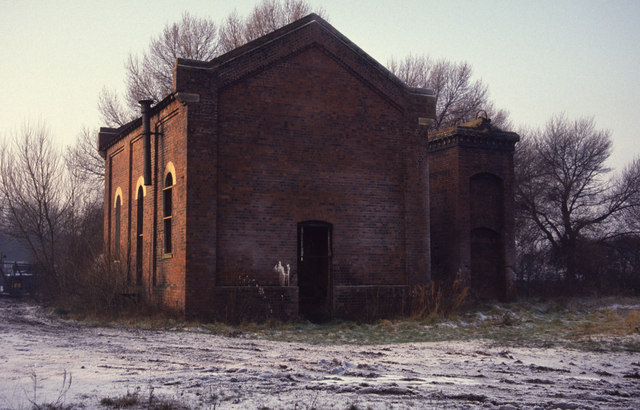
Working a thirty-foot seam meant enormous underground holes that were very unstable, and as the coal was extracted the roof and the ground above came down into the space. Drainage became steadily harder as a result: in 1919 the colliery was pumping 351,360 gallons of water a day and producing an average of only 692 tons of coal a week — a ratio that explains why the pit could not survive an interruption to pumping. The surviving buildings include the winding engine house and the housing for a Guibal fan, the mechanical ventilator that drew air through the workings.
Closure
The 1926 General Strike finished the colliery altogether: with no one to control the flooding of the mine during the stoppage, and the cost of draining it afterwards judged uneconomical, it did not reopen.
What remains
Derelict but standing. Three structures on the site are listed buildings, and the winding engine house and Guibal fan housing were described in 1991 as Grade II listed but unloved, and a rare survivor. The site has been visited and photographed repeatedly by urban explorers, with reports from December 2011 and February 2020.
The winding engine house and the Guibal fan housing both survive, together with a third listed structure. Guibal fan houses are uncommon survivals anywhere in Britain, and the pairing of engine house and fan house on one site is rarer still.
Nearby mines
- Homer Hill Colliery — 1.2 miles (2.0 km) W
- Beech Tree Colliery — 1.3 miles (2.1 km) W
- Saltwells Wood Coal Workings — 2.0 miles (3.2 km) NW
- Windmill End Colliery — 2.3 miles (3.7 km) N
- Brettell Lane Colliery — 3.3 miles (5.2 km) W
Straight-line distance, within 9 miles (15 km). Show on the map.
What's uncertain
Points where sources disagree or the record could not be settled; both accounts are kept. All open questions in the archive.
- The BGS mine-plans catalogue holds a Mining Remediation Authority abandonment plan titled 'Hawne' (catalogue 11705, Thick, dated 1897); the catalogue gives no location and the plan's details do not clearly tie it to this working, so it may belong to another of the same name. (uncertain) 3
Recorded claims
Individual factual claims, each attached to the source(s) that support it below. Where sources disagree, both are kept.
- New Hawne is regarded as the last working colliery in the Black Country. 1
- The mine, owned by the New British Iron Company, began producing coal in 1864; permission was given in 1873 to extend the mining area 38 acres southwards, and ownership passed to the family of Shelah Garratt, coal-master and owner of Hawne Bank Farm, who died in 1893. 1
- The seam over most of the area was thirty feet thick, which meant enormous underground holes that were very unstable; as the coal was extracted the ground above fell into the hole. 1
- By 1919 the colliery was pumping 351,360 gallons of water a day while producing an average of only 692 tons of coal a week. 1
- The 1926 General Strike finished the mine altogether, there being no one to control the flooding of the workings, after which draining them was considered uneconomical. 1
- Three structures on the site are listed buildings; a 1991 photograph records the winding engine house and Guibal fan housing as Grade II listed and a rare survivor. 1
- A dated exploration report of December 2011 records the colliery as derelict but standing, with its surviving structures photographed in place; further reports from the site are dated 2020. 2
- The BGS mine-plans catalogue holds a Mining Remediation Authority abandonment plan titled 'Hawne' (catalogue 11705, Thick, dated 1897); the catalogue gives no location and the plan's details do not clearly tie it to this working, so it may belong to another of the same name. (uncertain) 3
Photographs & further reading
A dated exploration report photographing what survives of the last Black Country colliery — the engine house, the fan housing and the rest of the standing structures.
View sourceSources
- (secondary) New Hawne Colliery — Wikipedia
- (observational) New Hawne Colliery, Halesowen, December 2011 — Derelict Places urban exploration forum
- (primary) BGS / Mining Remediation Authority mine plans: HAWNE — British Geological Survey / Mining Remediation Authority
Record created: 4 September 2026 · Last researched: 4 September 2026