 MineArchive
Windmill End Colliery
| Also known as | Windmill End Pumping Station, Cobb's Engine House |
|---|---|
| Location | Windmill End, Netherton, Rowley Regis, West Midlands — 52.4928, -2.0689 (approximate) |
| Commodity | Coal |
| Type | Coal |
| Worked | 1830–1925 or 1928 |
| Maximum depth | The pumping shaft was 525 feet (160 m) deep. |
| Operators | Earl of Dudley's Mining Department (1830–?), Sir Horace St Paul (1831–?), Oldhill Mines Drainage Company (1870–1880), Staffordshire Mines Drainage Commission |
Overview
A Black Country colliery sunk beside the Dudley Canal at Netherton in 1830, so wet that within a year its owner had built the pumping engine house that outlived it. Cobb's Engine House lifted water from a shaft 525 feet deep into the canal for the best part of a century, the last colliery pumping engine working in the district, and its roofless shell and 95-foot chimney still stand.
History
The Dudley Canal Line No. 2 was completed in 1798, running past the collieries of Netherton, and Windmill End Colliery's No. 3 pit was sunk beside it in 1830, most probably by the Earl of Dudley's mining department. Water flooded the pit, and in about 1831 Sir Horace St Paul — who had come into the land through his marriage to Anna Maria, daughter of John Ward, 2nd Viscount Dudley and Ward — put up an engine house to hold a Watt-type single-acting condensing pumping engine. From a shaft 525 feet deep it lifted an average of 367,500 gallons of water a day into the canal, for which the canal company paid the mine owners fourpence a lock-full. The engine was re-cylindered and converted to the Cornish cycle in the 1860s, delivering perhaps twenty horsepower at thirty revolutions a minute, and was overhauled in 1874; through the 1870s it worked for the Oldhill Mines Drainage Company, and the building was later owned by the Staffordshire Mines Drainage Commission and known officially, from 1877, as Windmill End Pumping Station. In 1919–20 financial trouble in the local coal trade left many pits to flood and Cobb's became the last colliery pumping engine at work in the area; accounts of its end differ, one giving 1925 after the run of strikes that culminated in the General Strike and another 1928. A winding engine of Newcomen type standing next to the engine house was bought by Henry Ford, taken down in 1928 and shipped to his museum at Dearborn in Michigan, where it is displayed as 'The Dudley Engine, circa 1791'; some accounts say instead that it was the pumping engine that went. The name Cobb is said to be that of a farmer who held the land before the pit was sunk.
Geology
The colliery worked the coal measures of the South Staffordshire coalfield at Netherton. Water was the defining condition of the ground here: the pit flooded from the start, and the district's pits were eventually drained by a common pumping arrangement rather than pit by pit.
Workings
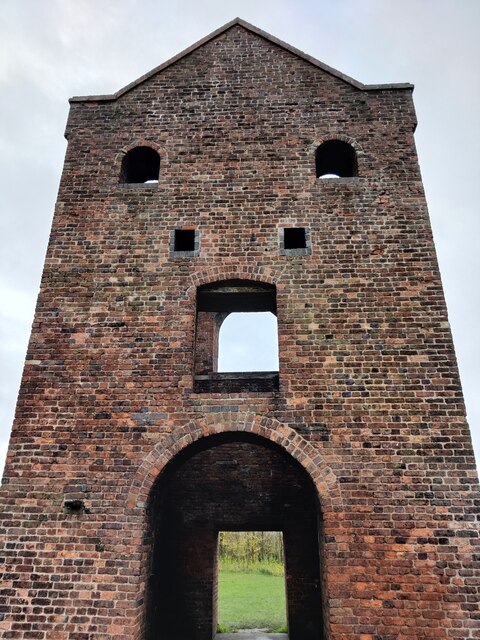
The abandonment plan for the ground names Windmill End alongside Buffrey, Big Pulley Pit, Meadow Pit, Cobbs Pit, Engine Pit and Bye Pit. The pumping shaft was 525 feet deep. Its engine house was of brick in three storeys — a cylinder floor at ground level, a chamber floor above and a bob or beam loft at the top — with the south gable built thicker than the other walls to carry the beam: it has a flat-headed plug-rod portal at ground level and a round-arched bob portal under the apex, with the cylinder portal in the north gable and segmental-headed windows east and west. The boiler chimney, 95 feet high, tapers from 11 feet 6 inches square at the base to 4 feet at the top.
Closure
Pumping ended in the 1920s, after the engine had outlasted the pits it was built to drain; the accounts give either 1925, following the strikes of the mid-1920s, or 1928. The winding engine beside it went to Michigan in 1928.
What remains
The engine house and chimney are a scheduled monument and a Grade II listed building, and stand in the Bumble Hole and Warrens Hall local nature reserves. The house is a roofless shell — the floors and roof are gone — and was restored in the 1980s after fifty years of decay; a lightning conductor runs the full height of the chimney. Historic England's listing calls it the earliest surviving engine house of its type and one of the few left in the Black Country.
The engine house shell with its plug-rod and bob portals, and the tapering boiler chimney. The grassed-over Blow Cold Bank colliery spoil heap, the canal arms and the mouth of the Netherton tunnel lie around it, with a bridge that once carried a tramway serving the mine.
Redevelopment
The pit ground is now the Bumble Hole and Warrens Hall local nature reserves, of ponds, canals, grassland and small woods.
Nearby mines
- Saltwells Wood Coal Workings — 2.4 km SW
- Wren's Nest Limestone Mines — 3.3 km N
- Beech Tree Colliery — 3.4 km S
- New Hawne Colliery — 3.7 km S
- Foxyards Colliery — 4.0 km NW
Straight-line distance, within 15 km. Show on the map.
What's uncertain
Points where sources disagree or the record could not be settled; both accounts are kept. All open questions in the archive.
- Windmill End Colliery's No. 3 pit was sunk in 1830 beside the Dudley Canal Line No. 2, most likely by the Earl of Dudley's mining department. (uncertain) 1
- The engine house and plant closed in 1925 after a lengthy series of miners' strikes. (disputed) 1
- The engine ceased work in 1928, having become the last colliery pumping engine operating in the area after the flooding of 1919–20. (disputed) 2
Recorded claims
Individual factual claims, each attached to the source(s) that support it below. Where sources disagree, both are kept.
- Windmill End Colliery's No. 3 pit was sunk in 1830 beside the Dudley Canal Line No. 2, most likely by the Earl of Dudley's mining department. (uncertain) 1
- The engine pumped an average of 367,500 gallons a day into the canal from a shaft 525 feet deep, the canal company paying the mine owners fourpence per lock-full. 2,1
- The engine house was erected in about 1831 by Sir Horace St Paul and was later owned by the Staffordshire Mines Drainage Commission. 3
- A winding engine of Newcomen type was removed from the site in 1928 and transferred to the Henry Ford Museum in Michigan. 3,1
- The engine house and plant closed in 1925 after a lengthy series of miners' strikes. (disputed) 1
- The engine ceased work in 1928, having become the last colliery pumping engine operating in the area after the flooding of 1919–20. (disputed) 2
Photographs & further reading
A dated history of the engine house and a description of its architecture, drawing on Hadfield, Chapman and Collins on the Black Country canals and coalfield.
View sourceSources
- (secondary) Cobb's Engine House & Chimney — Industrial Tour
- (secondary) Cobb's Engine House — Wikipedia
- (primary) Cobbs Engine House and chimney, Warrens Hall Park (List entry 1229552) — Historic England
- (primary) Abandoned mine plan catalogue entry: WINDMILL END, BUFFREY, BIG PULLEY PIT, MEADOW PIT, COBBS PIT, ENGINE PIT, BYE PIT — British Geological Survey
- (primary) Cobb's Engine House, Warley (List entry 1005899) — Historic England
Record created: 22 September 2026 · Last researched: 22 September 2026