 MineArchive
Haden Hill Colliery
| Location | Corngreaves, near Cradley Heath, West Midlands — 52.4733, -2.0581 (exact) |
|---|---|
| Commodities | Coal, Ironstone |
| Type | Coal |
| Worked | By 1869–after 1913 |
| Operators | Brettell and Company (owner) — Named among the owners (Durham Mining Museum); years not given W. Bassano and Co. (owner) — Named among the owners (Durham Mining Museum); owner in 1905 per NMRS record 7368 seen in search |
A Black Country colliery at Corngreaves, near Cradley Heath, owned by Brettell and Company and W. Bassano and Co., working the Thick and Brooch coals with ironstone and employing some 340 people in 1894.
Location
Recorded location. The large pin is this mine; the small round markers are the nearest mines on record. Click one for its page. View on full map
History
Haden Hill Colliery lay at Corngreaves, about seven miles west of Birmingham on the South Staffordshire coalfield. Its owners were Brettell and Company and W. Bassano and Co. Deaths recorded there from 1869 show it working the Thick coal by then. In 1894 it had two mines: No. 1 employed 184 people, 148 of them below ground, and No. 2 employed 157, 112 below, both raising manufacturing and steam coal. Workings from No. 1 in the Brooch, Thick, Ironstone and White seams were abandoned that year. The colliery employed 250 in 1896 and 269 in 1900, falling to 150 in 1905, when it was raising ironstone alongside coal from the Brooch and Thick seams. Workings in the Thick, Gubbin and White were abandoned in 1909, and No. 1's Brooch workings in 1913.
The inspectors' reports record a long run of single deaths, from a twelve-year-old driver, James Pugh, found under a full tub in 1878, to men crushed on the endless-rope haulage. Two accidents in the summer of 1905 each killed two men (see Disasters, below). On 25 June the driver Enoch Armstrong and the fireman John Brooks were killed by gob-stink and blackdamp, and on 13 July the loader Arthur Bridgwater and the stallman Isaac Dunn were buried when old gob and timber came away at the face of a gate road in the Thick coal.
Geology
Coal Measures of the South Staffordshire coalfield. The colliery worked the Thick and Brooch coals with ironstone, and its abandonment plans also record the Gubbin and White seams.
Workings
Two mines, No. 1 and No. 2, in 1894. Coal was worked in stalls and gate roads in the Thick coal, with endless-rope haulage underground and an endless-rope tramway at the surface; the colliery also had a wharf from which boats were loaded.
Closure
The closing date is not known. The last abandonment plan, for No. 1's Brooch workings, is dated 1913.
Nearby mines
- New Hawne Colliery — 1.0 miles (1.6 km) S
- Rowley Hall Colliery — 1.2 miles (1.9 km) NE
- Coombs Wood Colliery — 1.2 miles (2.0 km) SE
- Windmill End Colliery — 1.4 miles (2.3 km) N
- Homer Hill Colliery — 1.5 miles (2.5 km) W
Straight-line distance, within 9 miles (15 km). Show on the map.
Disasters & major incidents
- Haden Hill Colliery blackdamp, 1905
25 June 1905 · Gas / Asphyxiation · 2 fatalitiesTwo men, the driver Enoch Armstrong and the fireman John Brooks, were killed by gob-stink and blackdamp at W. Bassano and Co.'s Haden Hill Colliery, Blackheath, on the afternoon of 25 June 1905.
At about half past three on the afternoon of 25 June 1905, two men at Haden Hill Colliery, Blackheath, then worked by W. Bassano and Co., were overcome by gob-stink and blackdamp. Enoch Armstrong, 34, a driver, and John Brooks, 38, a fireman, both died. Less than three weeks later a fall of roof at the same colliery killed two more men (see Haden Hill Colliery roof fall, 1905).
- Haden Hill Colliery roof fall, 1905
13 July 1905 · Collapse / Roof Fall · 2 fatalitiesA fall of roof and side from old gob at the face of a gate road in the Thick coal at Haden Hill Colliery, Blackheath, on the morning of 13 July 1905 buried and killed two men.
At about 9 a.m. a mass of roof and side came away from the old gob at the face of a gate road in the Thick coal. A lot of timber suddenly reeled out, and the two men were buried under small coal and debris. The colliery belonged to W. Bassano and Co. It was the second fatal accident there in three weeks: on 25 June two other men had died in gob-stink and blackdamp.
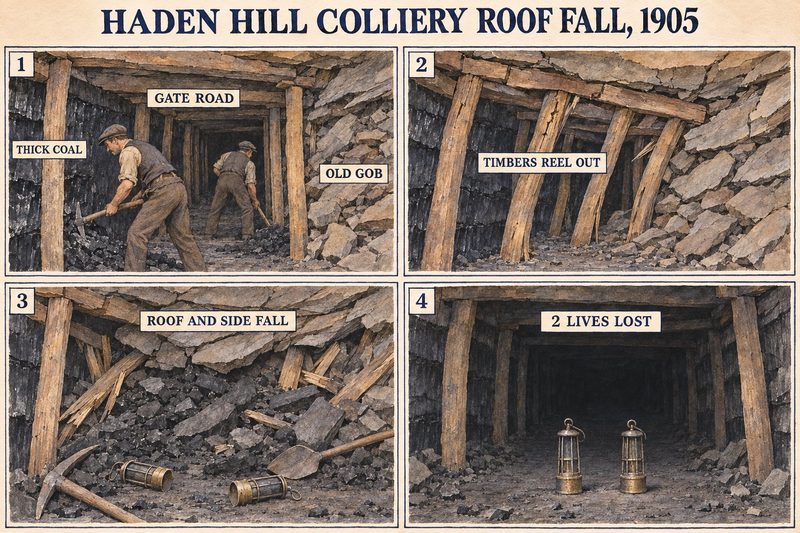
The Haden Hill Colliery roof fall of 1905 in four stages © MineArchive
Further reading
Owners, output and employment from 1894 to 1905, seams, and the deaths recorded at the colliery from 1869.
View sourceSources
- (primary) Haden Hill Colliery (Durham Mining Museum) — Durham Mining Museum
- (primary) BGS / Mining Remediation Authority mine plan 21924811: Haden Hill No. 1, Brooch, Thick, Ironstone and White, abandoned 1894 — British Geological Survey
- (primary) BGS / Mining Remediation Authority mine plan 21910944: Haden Hill, Thick, abandoned 1909 — British Geological Survey
- (primary) BGS / Mining Remediation Authority mine plan 21917128: Haden Hill No. 1, Brooch, abandoned 1913 — British Geological Survey
Record created: 5 November 2026 · Last researched: 9 November 2026