 MineArchive
Great Western Colliery
| Also known as | Gyfeillion Colliery, Hetty Pit, Tymawr and Lewis Merthyr Colliery |
|---|---|
| Location | Hopkinstown, near Pontypridd, Rhondda Cynon Taf — 51.6091, -3.3665 (exact) |
| Commodity | Coal |
| Type | Coal |
| Worked | August 1851–November 1983 |
| Maximum depth | 542 yards (about 496 m) at No. 2 Pit, the deepest of the complex. |
| Operators | John Calvert (1851–1854), Great Western Railway (1854–1865), Great Western Colliery Co. Ltd. (1865–1928), Powell Duffryn Steam Coal Company (1928–1947), National Coal Board (1947–1983) |
Overview
A large Glamorgan colliery at Hopkinstown near Pontypridd, begun as the Gyfeillion Pit by the Yorkshire railway contractor John Calvert in 1851 and worked for 132 years under six owners, the Great Western Railway among them. An underground fire in 1893 killed 63 men and boys. Its Hetty shaft of the mid-1870s survives: the engine house, headframe and fan house are scheduled, and the 1875 winding engine is the only large steam engine in Wales still in working order.
History
John Calvert, a Yorkshireman who had been Brunel's principal contractor on the Taff Vale Railway, stayed in south Wales after the line was finished and turned to coal. He began sinking at Gyfeillion in August 1848 and struck coal at 149 yards in May 1851, marking the opening that August with a roasted ox and a procession. Within three years he was in financial difficulty and sold the colliery and its coke ovens to his largest customer, the Great Western Railway, which bought after a three-month trial in 1854 and worked it profitably until advertising it for sale in March 1864.
The sale dragged on until 1 April 1865. The purchasers formed Great Western & Fowlers United Collieries Ltd. that June, renamed Great Western Colliery Co. Ltd. in October 1866, which went into voluntary liquidation for reconstruction in March 1878 and was immediately re-registered under the same name. This company drove the great expansion: the Hetty shaft was sunk in the mid-1870s to the Six Feet seam at 392 yards, Nos. 2 and 3 following shortly after, and the old Tymawr shaft was deepened to the Five Feet seam at 500 yards in 1890.
On 11 April 1893 fire broke out underground and killed 63 (see Disasters, below). Recovery was quick — 475 men at Great Western No. 2 and 604 at Tymawr by 1896 — and by 1918 the colliery employed 3,162. Powell Duffryn took over in 1928, and by 1934 the Great Western Colliery Company as its subsidiary controlled three collieries employing 2,270 men and raising 650,000 tons a year. Nationalisation followed in 1947.
In 1958 Lewis Merthyr Colliery a few miles to the north-west was amalgamated with Great Western and connected underground under a £1.2 million scheme; coal winding ceased at the Lewis Merthyr surface and was redirected through the Tymawr shafts. The combined pit was renamed Tymawr and Lewis Merthyr Colliery in 1969. The last coal was raised in June 1983 and the complex closed that November, ending 132 years of working.
Geology
The colliery worked the South Wales Coalfield's steam and house coal seams on the northern side of the Taff valley at Pontypridd. Over its life it took the Six Feet, Four Feet, Lower Four Feet, Five Feet, Nine Feet, Red and Fforest Fach seams, the different shafts specialising in different seams as the complex grew — Hetty No. 2 on the Nine Feet and Red, Hetty No. 3 on the Fforest Fach, and Tymawr on the Five Feet, Four Feet, Lower Four Feet and Nine Feet.
Geological setting: Sedimentary Beds and Seams (well documented example)
Workings
A large multi-shaft complex: seven shafts on the Tymawr side alone, and a further six at Lewis Merthyr once the two were joined. The Gyfeillion pit was 148 yards; No. 2, an ellipse of 14 ft 4 in by 10 ft 9 in, reached 542 yards; No. 3 was 18 ft in diameter and 155 yards; the Hetty 16 ft and 392 yards; No. 1 (Tymawr until closure) 20 ft and 416 yards; the Tymawr pit an ellipse of 16 ft by 10 ft at 476 yards; and the Typica pit 74 yards. Ventilation was by two Schiele fans of 15 ft 3 in diameter at the pit tops, and compressed air generated at surface powered underground haulage engines. A bank of coke ovens stood on the east side of the site.
Closure
The last coal was raised at Tymawr on 21 June 1983 and the Tymawr and Lewis Merthyr complex closed on 26 November 1983. The colliery infrastructure was demolished soon afterwards, the Hetty Pit structures excepted.
What remains
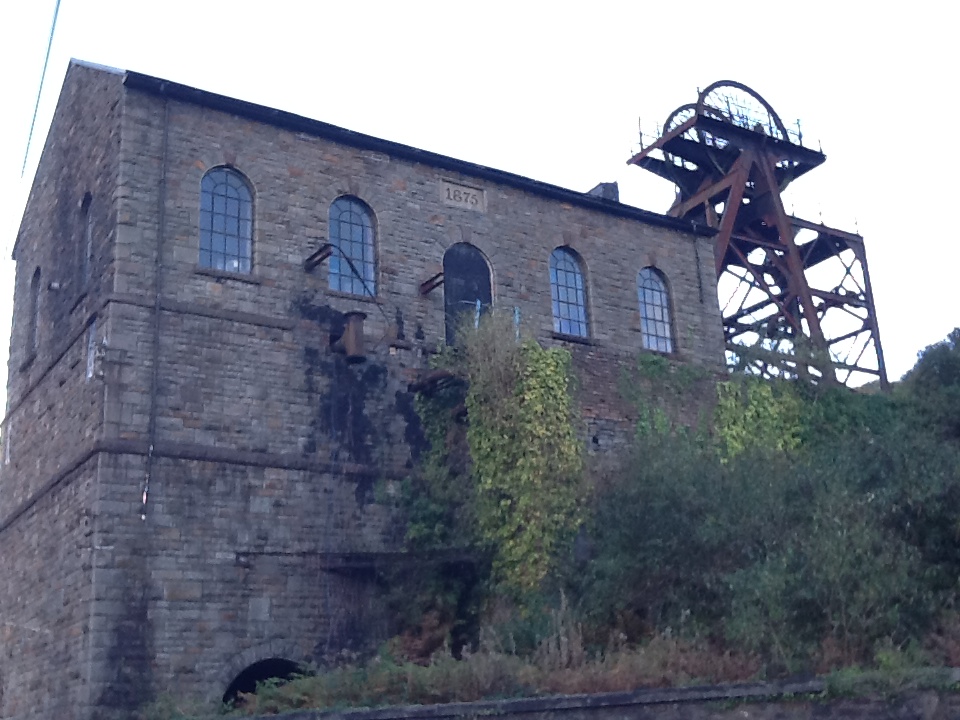
The winder house and headframe at Hetty Pit, together with the fan house and drift, are the sole surviving remains of the colliery. The engine house and headframe were listed Grade I by Cadw on 3 August 1984 and the fan house Grade II*; the whole group was made a Scheduled Monument on 28 July 1994. After closure the site was abandoned and badly vandalised through the late 1980s and early 1990s, copper wire and brass fittings being stripped out. From the mid-1990s volunteers led by Brian Davies, curator of Pontypridd Museum, regained access and restored the 1875 winding engine to working order; the Great Western Colliery Preservation Trust was formed in 2010 to continue the work, and a National Lottery Heritage Fund award of over £300,000 in 2024 has paid for headframe refurbishment and a permanent air compressor, so the engine can now be run on demand rather than only for occasional demonstrations.
Hetty Pit engine house, headframe, fan house and drift, with the 1875 Barker & Cope winding engine in situ — the only large steam engine in Wales in working order and the oldest two-cylinder horizontal winding engine in the UK still on its original site.
Redevelopment
The Hetty Pit group is preserved and operated as a heritage site by the Great Western Colliery Preservation Trust; the rest of the colliery was cleared after 1983.
Related mines
- Lewis Merthyr Colliery — Amalgamated in 1958 under a £1.2 million scheme that connected the two collieries underground: coal winding ceased at the Lewis Merthyr surface and was redirected through the Great Western's Tymawr shafts, and the combined pit was renamed Tymawr and Lewis Merthyr Colliery in 1969.
- Maritime Colliery — Bought but deliberately not worked: the Great Western Colliery Company purchased the Maritime in 1894, adding some 500 acres, and rather than reopening the Maritime pit extended its own workings into the ground to reach the best of the coal.
- Newbridge Colliery, Pontypridd — John Calvert's second pit, at Gyfeillion, which became the Great Western Colliery, was wound by a similar engine.
Nearby mines
- Pwllgwaun Colliery — 0.8 miles (1.3 km) SE
- Lewis Merthyr Colliery — 1.0 miles (1.6 km) W
- Tymawr Colliery — 1.0 miles (1.6 km) W
- Newbridge Colliery, Pontypridd — 1.1 miles (1.8 km) SE
- Maritime Colliery — 1.2 miles (1.9 km) SE
Straight-line distance, within 9 miles (15 km). Show on the map.
Disasters & major incidents
-
Great Western Colliery roof fall, 1875
4 July 1875 · Collapse / Roof Fall · 2 fatalities
Falls of roof killed two men repairing a steam-heated return airway at the Great Western Colliery, Hopkinstown, on Sunday 4 July 1875. -
Great Western Colliery arch collapse, 1884
1 January 1884 · Collapse / Roof Fall · 2 fatalities
An underground arch being built at the Great Western Colliery, Hopkinstown, collapsed on New Year's Day 1884 when a prop gave way, killing the two masons building it. -
Great Western Colliery Fire, 1893
11 April 1893 · Fire · 63 fatalities
An underground fire at the Great Western Colliery, Hopkinstown, on 11 April 1893 trapped around 200 men in the Four Feet seam east of the Hetty Pit. About 150 were brought out alive; 63 men and boys, aged between 14 and 61, died. -
Great Western Colliery roof fall, 1907
12 October 1907 · Collapse / Roof Fall · 2 fatalities
A timberman and his assistant were buried by a fall of roof in the Nine Feet seam at the Great Western Colliery, Hopkinstown, on 12 October 1907 while securing a road. -
Great Western Colliery explosion, 1913
December 1913 · Explosion · 2 fatalities
Two men were killed at the Great Western Colliery, Pontypridd, at the end of December 1913 when gas released by a fall of roof was fired by a naked light.
Recorded claims
Individual factual claims, each attached to the source(s) that support it below. Where sources disagree, both are kept.
- John Calvert began sinking at Gyfeillion in August 1848 and struck coal at 149 yards in May 1851; the colliery opened that August. 1,2
- The Great Western Railway bought the colliery from Calvert in 1854 after a three-month trial and worked it directly until advertising it for sale on 19 March 1864. 3,2
- The Great Western Colliery Company sank the Hetty shaft in the mid-1870s to the Six Feet seam at 392 yards, with shafts Nos. 2 and 3 following shortly afterwards; the old Tymawr shaft was deepened to the Five Feet seam at 500 yards in 1890. 3,1
- By 1918 the Great Western employed 3,162 men, making it one of the largest employers in the Pontypridd area. 3,2
- Lewis Merthyr Colliery was amalgamated with Great Western in 1958 and connected underground under a £1.2 million scheme, coal winding being redirected through the Tymawr shafts; the combined pit was renamed Tymawr and Lewis Merthyr Colliery in 1969. 2
- The last coal was raised in June 1983 and the complex closed on 26 November 1983, ending 132 years of working. 3,2
- The Hetty engine house and headframe were listed Grade I on 3 August 1984 and the fan house Grade II*; the whole group became a Scheduled Monument on 28 July 1994. 2
- The 1875 Barker & Cope winding engine, originally steam and later converted to compressed air, is the only large steam engine in Wales still in working order and the oldest two-cylinder horizontal winding engine in the UK on its original site. 2,4
Photographs & further reading
The corporate history shaft by shaft, with the depth and diameter of each of the seven Tymawr-side pits and the seams and manpower recorded in the Inspector of Mines lists.
View sourceThe national monuments record for the site, identifying which structures survive and the separate record numbers for the Hetty winder house, headframe and fan house.
View sourceThe volunteer trust that restored the 1875 Hetty winding engine to working order, with news of the current headframe restoration and details of when the engine runs.
View sourceSources
- (primary) Gyfeillion Colliery; Great Western Colliery and Coke Works, Pontypridd (NPRN 407677) — Royal Commission on the Ancient and Historical Monuments of Wales
- (secondary) Great Western Colliery — Wikipedia
- (secondary) The Great Western Colliery, Hopkinstown, Pontypridd — Welsh Coal Mines
- (observational) Great Western Colliery Preservation Trust — Great Western Colliery Preservation Trust
- (secondary) Gareth Harris, 'The Great Western Colliery Disaster' — People's Collection Wales
Record created: 3 September 2026 · Last researched: 3 September 2026