 MineArchive
Newbridge Colliery, Pontypridd
| Also known as | Newbridge Colliery |
|---|---|
| Location | Gelliwion, Pontypridd, Rhondda Cynon Taf — 51.5961, -3.3505 (exact) |
| Commodity | Coal |
| Type | Coal |
| Worked | 1844 (sinking)–1897 |
| Maximum depth | 55 yards (No. 3 Rhondda seam) |
| Operators | John Calvert (1844–?), Fowler Brothers, Newbridge and Rhondda Coal Company |
Overview
John Calvert's pit at Gelliwion, Pontypridd, sunk in 1844 to the No. 3 Rhondda seam at 55 yards, whose 1845 beam engine, the first steam winding engine in the Rhondda, survives at the Treforest campus of the University of South Wales.
History
Newbridge Colliery at Gelliwion, Pontypridd, was begun in 1844 by John Calvert, a Yorkshireman who had been the main contractor for the Taff Vale Railway and stayed on to mine coal. Production began in 1845 from the No. 3 Rhondda seam at 55 yards. That year a beam engine built by the Varteg Ironworks was installed to wind the shaft and, through a rod and 'tee bob', to work the pump at its foot; it was the first steam winding engine in the Rhondda. Winding was at first by an iron flat chain with wooden blocks through the links, later replaced by rope, and the pit was ventilated by a furnace in a bratticed, split shaft.
The engine was given a new cylinder, 26½ inches by five feet, by Brown, Lenox and Company of Pontypridd in 1861. By 1869 the colliery belonged to the Fowler brothers, by 1880 to the Newbridge and Rhondda Coal Company, and later to the Crawshays. In 1896 it employed 489 men raising house and steam coal. It closed in 1897 and the shaft was abandoned.
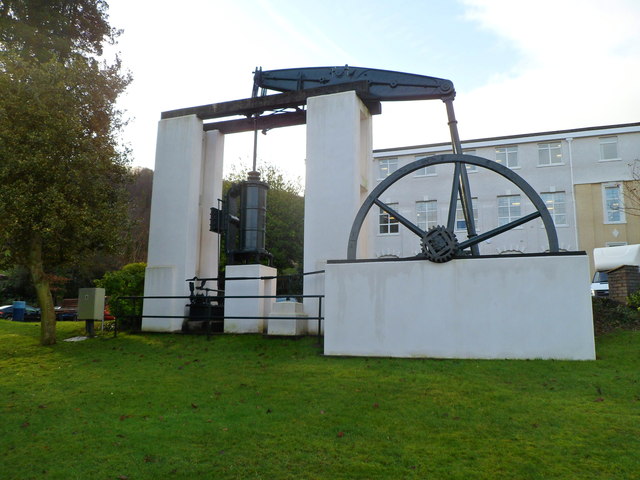
The engine house stood derelict, the beam still in place in a well-known postcard of 1912. Around 1920 the engine was moved and re-erected in the grounds of the South Wales and Monmouthshire School of Mines at Trefforest, later the University of Glamorgan and now part of the University of South Wales, where it is preserved as Calvert's Engine.
Geology
Coal Measures of the South Wales coalfield: the No. 3 Rhondda seam at 55 yards.
Workings
A split shaft ventilated by furnace; a combined winding and pumping beam engine of 1845 (Varteg Ironworks) with a 'tee bob' to the pump rod; flat-chain and later rope winding.
Closure
Closed in 1897 and the shaft abandoned; the engine may have been worked as late as 1919.
What remains
The colliery's beam engine survives, re-erected about 1920 at the Treforest campus of the University of South Wales.
The 1845 beam engine (Calvert's Engine), preserved off site at Treforest.
Redevelopment
Unknown.
Related mines
- Great Western Colliery — John Calvert's second pit, at Gyfeillion, which became the Great Western Colliery, was wound by a similar engine.
Nearby mines
- Maritime Colliery — 0.1 miles (0.1 km) S
- Pwllgwaun Colliery — 0.5 miles (0.8 km) N
- Great Western Colliery — 1.1 miles (1.8 km) NW
- Cwm Colliery — 1.9 miles (3.0 km) S
- Lewis Merthyr Colliery — 1.9 miles (3.1 km) NW
Straight-line distance, within 9 miles (15 km). Show on the map.
What's uncertain
Points where sources disagree or the record could not be settled; both accounts are kept. All open questions in the archive.
- The engine was last worked in 1919. (disputed) 2
Recorded claims
Individual factual claims, each attached to the source(s) that support it below. Where sources disagree, both are kept.
- John Calvert began sinking Newbridge Colliery in 1844; production from the No. 3 Rhondda seam at 55 yards began in 1845. 1,2
- The 1845 winding engine, built by the Varteg Ironworks, also powered the water pump and was the first steam winding engine in the Rhondda. 1,2
- The Fowler brothers owned the colliery in 1869, the Newbridge and Rhondda Coal Company in 1880, and later the Crawshays. 1,2
- In 1896 the colliery employed 489 men. 1,2
- The colliery closed in 1897. 1,2
- Around 1920 the engine was re-erected in the grounds of the School of Mines at Trefforest, now part of the University of South Wales. 2
- The engine was last worked in 1919. (disputed) 2
Photographs & further reading
The site's page on the colliery, with its c.1912 photograph of the derelict engine house and the owners from the inspectors' lists.
View sourceSources
- (secondary) Welsh Coal Mines: Newbridge Colliery — Welsh Coal Mines
- (secondary) Calvert's Engine (Newbridge Colliery) — Wikipedia
Record created: 17 October 2026 · Last researched: 17 October 2026