 MineArchive
Journey
| Dialect | South Wales |
|---|---|
| Category | Structures & Machinery |
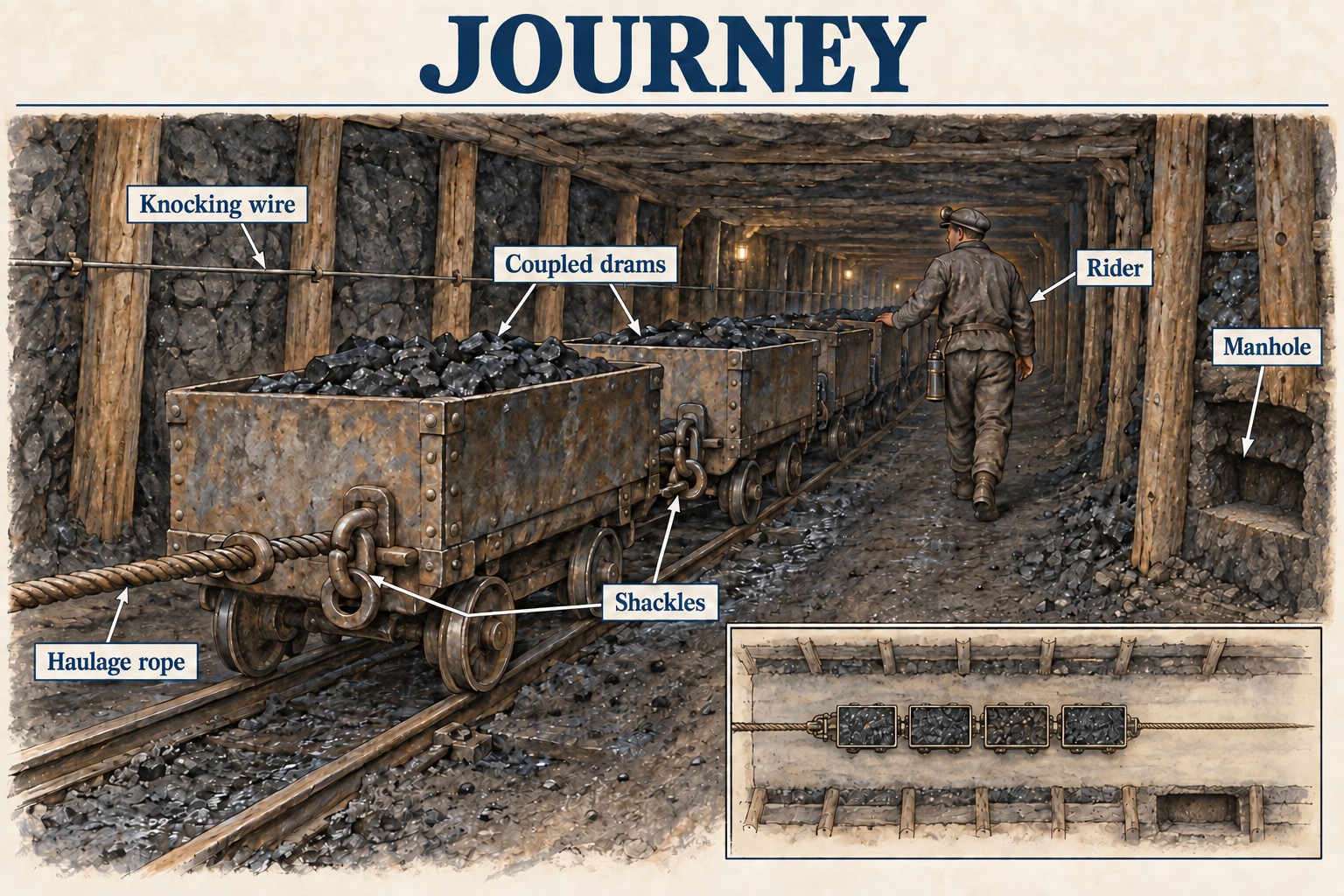
A train of trams or drams coupled together and hauled along an underground roadway by rope, the South Wales word for what the North East calls a set.
Historical usage
Gresley's 1883 glossary marks the word South Welsh and defines it as a train or set of trams all coupled together running upon an engine plane, 'as many as forty sometimes'. The Welsh Coal Mines glossary, drawn from twentieth-century colliery practice, puts a journey at about twenty-five drams shackled together and hauled in and out from the pit bottom by an endless rope or by main and tail rope. The man who went with it was the journey-man or rider.
How it worked
Drams were coupled with shackles and drawn along the main road — the dukie — by a haulage engine at the surface or at an engine plane underground, either on an endless rope running continuously or on a main-and-tail system that pulled the journey in one direction and back the other. The rider travelled with it and signalled the engineman by knocking wire, a length of thin rope hung along the roadway and connected at intervals to a signal. Sprags were pushed through the wheel spokes to slow or hold drams, and manholes were cut into the sides of the roadway at intervals so that men could stand clear as a journey went by.
Why it was used
One rope and one engine could move far more coal than horses, and a colliery raising several hundred tons a day needed the coal brought from the districts to the shaft faster than a haulier and a pony could bring it.
Risks & limitations
A moving journey on a road men also walked was one of the great killers underground, second only to falls of roof. The colliery fatality lists are full of it: boys detaching clips at the shaft sidings and falling between the tubs, men caught by a journey while carrying report books to the pit bottom, riders run over on inclines when a coupling or a brake failed. Manholes and refuge holes existed precisely because there was nowhere else to go when a journey came.
Regional variation
In Northumberland and Durham the same train is a set, run on a rolley-way and attended by a rolley-way man; Greenwell's northern glossary has rolley, rolley-way and rolley-way man but no journey. The vehicles differ with the word: drams and trams in South Wales, tubs and formerly corves in the North East.
Related terminology
Haulier, Incline, Tub, Waggonway
Mines associated with this term
5 examples chosen from 32 linked records — the term page is not an index.
- Sirhowy Ironworks — Blaenau Gwent (well documented example)
Named in this record’s history: “…where the Monmouthshire Canal Company's own tramroad continued the journey to Newport; it opened in 1805. Between 1794 and 1818 the works were…” - Swinden Quarry — North Yorkshire (well documented example)
Named in this record’s workings: “…significant tonnage by rail, though there can be up to 42,000 lorry journeys a year on the B6265 as well. Internal shunting is done by the…” - Beckwith Mine — Isle of Man (well documented example)
Named in this record’s history: “…coal back for the mine's own pumping-engine boilers on the return journey. Despite this rich beginning, the deeper part of the mine and its…” - Bettisfield Colliery — Flintshire (well documented example)
Named in this record’s history: “…and 415 people were returned in 1933. In December 1909 a runaway journey of tubs jerked the endless rope in the main haulage level and killed…” - Blaenau Saron Colliery — Carmarthenshire (well documented example)
Named in this record’s history: “…Blaynea mine, Llandebie", run over by trams while riding a full tub journey on an underground incline. The Northern Mine Research Society, which…”
Disasters associated with this term
5 examples chosen from 34 linked records, most direct relationship first.
- Gellyceidrim Colliery runaway journey, 1897 (direct cause)
A journey of twelve trams ran back. - Ynysfeio Colliery runaway journey, 1892 (relevant method/equipment)
A full journey of trams on the incline. - Abercynon Colliery Haulage Accident, 1906 (contextual relationship)
Named 3 times in this record, first in the summary: “…28 April 1906, about fifteen minutes before the end of the shift, a journey of twenty-four full trams of coal ran away underground at Abercynon…” - Bettisfield Colliery haulage accident, 1909 (contextual relationship)
Named 3 times in this record, first in the summary: “A full journey of tubs broke loose from a self-acting jig at Bettisfield Colliery,…” - Blaenclydach Colliery spake runaway, 1941 (contextual relationship)
Named twice in this record, first in the cause: “The man-riding journey ran away down the drift; the mechanical or human failure behind the…”
Sources
- (primary) W. S. Gresley, A Glossary of Terms used in Coal Mining (1883) — W. S. Gresley; digitised by the Internet Archive
- (secondary) Glossary of South Wales colliery terms — Welsh Coal Mines
Record created: 4 September 2026 · Last researched: 4 September 2026