 MineArchive
Swinden Quarry
| Also known as | Rylstone Quarry |
|---|---|
| Location | North of Cracoe, south-west of Grassington, Wharfedale, North Yorkshire — 54.0506, -2.0312 (exact) |
| Commodity | Limestone |
| Type | Quarry |
| Worked | 1899–Still active |
| Maximum depth | Planned in 2001 as a pit about 170 m deep; the floor was being taken from 155 m to 135 m above sea level, and eventually 120 m, under a later deepening consent. |
| Operators | P. W. Spencer (1899–?), J. W. Spencer and Son (?–1965), Lime Sand Mortar Group (1965–?), Tilling Construction (?–1970), Tilcon (1970–2000), Tarmac (2000–?) |
Overview
A working limestone quarry in Wharfedale between Cracoe and Grassington, begun in its modern form by P. W. Spencer in 1899 and greatly enlarged in 1902 when the railway reached it. Much of its output still leaves by rail on the surviving stub of the Skipton–Grassington line, where the site is known by another name again — Rylstone.
History
Quarrying in the vicinity dates back to 1793, but the modern works were started by P. W. Spencer in 1899 and greatly enlarged in 1902 with the opening of the adjacent railway. The early work was done by hand with iron splitting tools and hammers, the rock blasted and then broken into 'foot long' pieces and thrown straight into the kilns; mechanical crushers arrived only in 1948. The earliest company name linked to the site, J. W. Spencer and Son, was bought out in 1965 by the Lime Sand Mortar Group, and Swinden later passed to Tilling Construction, which became Tilcon in 1970. A British Steel contract in 1971 brought two new kilns working around the clock, and the calcium dust they spread over the surrounding area led the High Court in 1983 to order the company to pay £120,000 in compensation and costs. That line, the 8.75-mile branch from Skipton, opened in 1902 with Rylstone as its only intermediate station; the quarry has been known in railway terminology as Rylstone Quarry ever since.
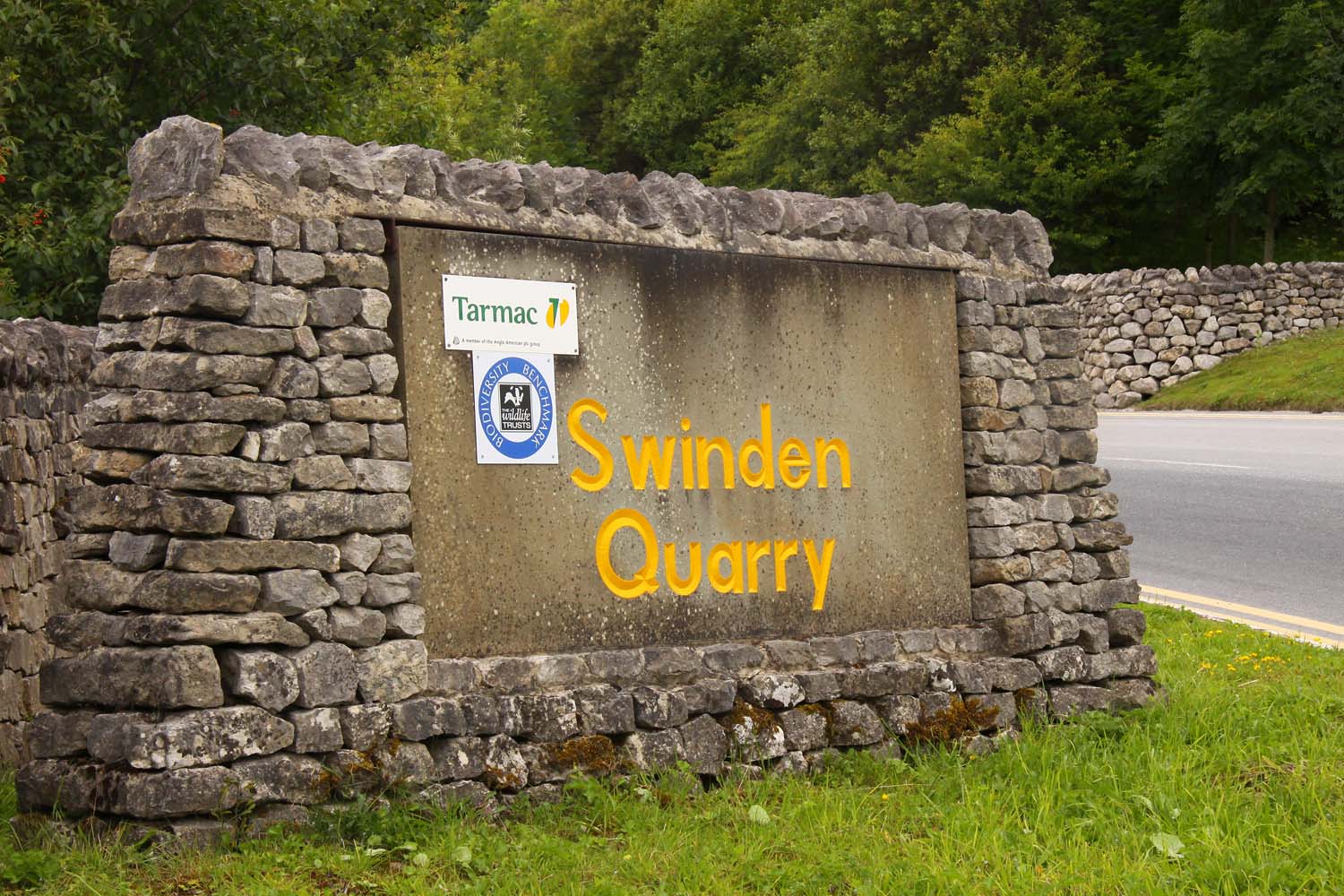
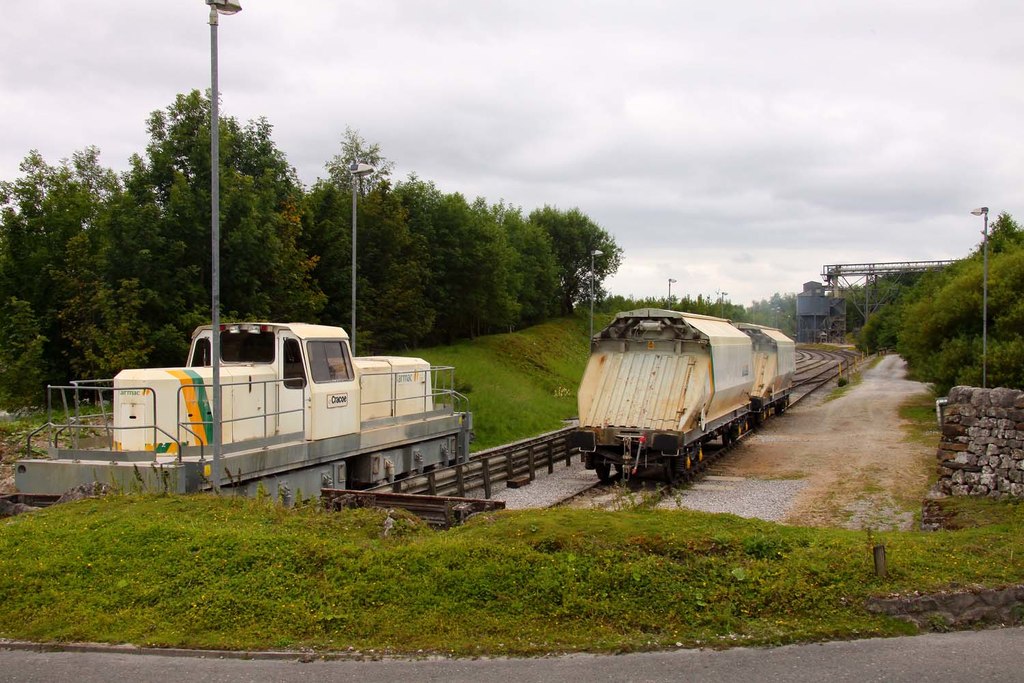
The section of line north of the quarry to the former terminus at Threshfield closed in 1969 and was subsequently lifted, leaving the quarry as the end of the branch. A purpose-built shunting locomotive named Cracoe, a six-wheel diesel-hydraulic, was built for the site in 1994 and has worked the Swinden limeworks since. When reserves began to run low in the early 1990s Tilcon sought to go deeper into the knoll, and the Yorkshire Dales National Park refused it in 1994; a second application, offering to move all crushing and screening plant into the pit, send more stone by rail and eventually leave a landscaped lake, was approved in 1996 on condition of daytime-only working. Some £15 million later, in June 2001, the quarry began blasting into a 37-million-tonne extension with one of the country's most automated plants, fed by a tracked Lokotrack crusher working just behind the face. By then Swinden was operated by Tarmac, following the purchase of Tarmac by Tilcon's parent Anglo American in 2000; a later consent for a further 24 million tonnes, working deeper within the existing boundary, secured the quarry to 2030 in return for Tarmac surrendering and restoring nearby Threshfield Quarry. The quarry is operated today by Tarmac.
Geology
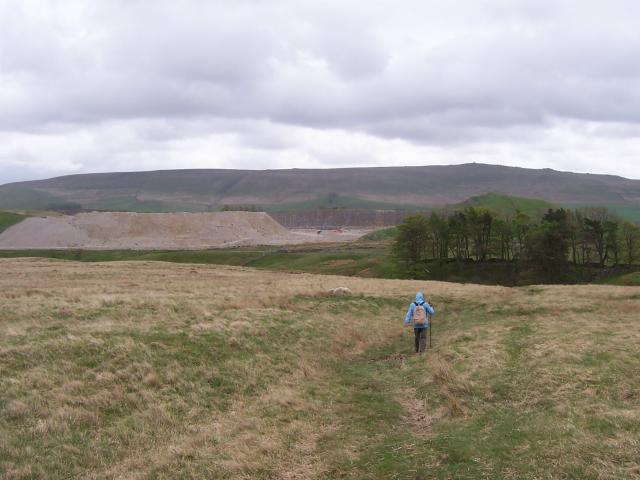
The quarry works the Carboniferous limestone of Wharfedale, on the southern edge of the Yorkshire Dales — the same great limestone mass that produces the pavements and scars of the surrounding national park, here won at industrial scale for aggregate. Its 800-metre oval bowl is cut into a limestone knoll, a steep-sided mound that was once an undersea reef, and the exposed beds are a Site of Special Scientific Interest, noted for their sea-lily fossils.
Geological setting: Sedimentary Beds and Seams (well documented example)
Workings
A large open limestone quarry, rail-connected since 1902 and still despatching a significant tonnage by rail, though there can be up to 42,000 lorry journeys a year on the B6265 as well. It is worked in 20-metre benches across the full width of the pit, blasting once or twice a week, with a tracked mobile primary crusher behind the face feeding conveyors to secondary and tertiary crushers on the quarry floor, and automated road and rail loading. Output is around 2.2 million tonnes a year, about half of it by rail to depots in Leeds, Hull and Dewsbury and to steelmaking. Internal shunting is done by the locomotive Cracoe, built for the site in 1994.
Closure
Still working, operated by Tarmac. Quarrying in the immediate vicinity is recorded from 1793, but the present quarry dates from Spencer's works of 1899 and the railway-driven enlargement of 1902.
What remains
An active rail-connected limestone quarry between Cracoe and Grassington, at the end of the surviving Skipton branch, its plant set down inside the pit so that most of it is hidden from the road. A significant tonnage leaves by rail, and the site is a well-known location among railway photographers under its railway name of Rylstone; the rail loading area doubles as a park-and-ride for Grassington's Christmas festival.
Not applicable — the quarry, its plant and its rail connection are in active use.
Nearby mines
- Beever Mine — 2.6 miles (4.1 km) NE
- Frankland Fold Mine — 4.0 miles (6.4 km) NE
- Hebden Mines — 4.0 miles (6.4 km) NE
- Grassington Moor Mines — 4.3 miles (6.9 km) NE
- Red Scar Mine — 5.6 miles (8.9 km) NE
Straight-line distance, within 9 miles (15 km). Show on the map.
What's uncertain
Points where sources disagree or the record could not be settled; both accounts are kept. All open questions in the archive.
- Aggregates Business names the founding firm J. W. Spencer and Son, where Wikipedia credits the 1899 works to P. W. Spencer. (disputed) 1,3
Recorded claims
Individual factual claims, each attached to the source(s) that support it below. Where sources disagree, both are kept.
- Quarrying in the vicinity dates back to 1793, but the modern works were started by P. W. Spencer in 1899 and greatly enlarged in 1902 with the opening of the adjacent railway. 1
- The 8.75-mile Skipton–Grassington line opened in 1902 with Rylstone as its only other station; the site is known in railway terminology as Rylstone Quarry. 1,2
- The portion of line north of the quarry to the former terminus at Threshfield closed in 1969 and was subsequently lifted, leaving the quarry as the terminus. 1
- A significant tonnage is exported from the site by rail, although there can be up to 42,000 lorry journeys a year on the B6265. 1
- The six-wheel diesel-hydraulic shunting locomotive Cracoe was built for the task in 1994 and has worked the Swinden limeworks since. 1
- Quarrying at Swinden dates back to 1793, by hand with iron splitting tools and hammers; rock was broken into 'foot long' pieces and thrown straight into the kiln until mechanisation with crushers in 1948. 3
- J. W. Spencer and Son is the earliest company name linked to the site; it was bought out in 1965 by the Lime Sand Mortar Group, and Swinden was later owned by Tilling Construction, which became Tilcon in 1970. 3
- Aggregates Business names the founding firm J. W. Spencer and Son, where Wikipedia credits the 1899 works to P. W. Spencer. (disputed) 1,3
- A 1971 British Steel contract brought two new kilns working 24 hours a day; the calcium dust they spread led the High Court in 1983 to order Tilcon to pay £120,000 compensation and costs. 1
- Tilcon's extension application was refused by the national park planning committee in 1994 and approved in 1996 after it offered to move plant into the pit, increase rail use and restore the site as a lake; blasting into the 37-million-tonne extension began in June 2001. 4
- Swinden came under Tarmac after Anglo American, Tilcon's parent, bought Tarmac in 2000. 3,4
- A later consent for a further 24 million tonnes, deepening the quarry within its existing boundary, extended its life to 2030, with Tarmac surrendering and restoring nearby Threshfield Quarry. 3
- The quarry's 800 m oval bowl is cut into a limestone knoll, once an undersea reef, now a Site of Special Scientific Interest protected for its sea lily fossils. 1,4
- The quarry produces about 2.2 million tonnes of Carboniferous limestone a year, around half of it sent by rail. 3
Photographs & further reading
Report on the 1994 refusal, 1996 consent and the automated in-pit crushing plant that opened the extension.
View sourceSite visit covering the quarry's history, ownership chain, working method and later deepening consent.
View sourceThe quarry as a railway location, under the name Rylstone by which the line knows it.
View sourceSources
- (secondary) Swinden Quarry — Wikipedia
- (secondary) Swinden Quarry (Limestone) — Railscot
- (secondary) Tarmac wins public support for expansion — Aggregates Business
- (secondary) Swinden's dream come true — Construction News
Record created: 3 September 2026 · Last researched: 21 September 2026