 MineArchive
Sirhowy Ironworks
| Location | Tredegar, Blaenau Gwent — 51.7828, -3.2436 (exact) |
|---|---|
| Commodity | Iron |
| Type | Iron |
| Worked | 1778–1882 |
| Operators | Samuel Homfray (1778–1799), Abraham Darby & Co (1844–1882) |
Overview
One of the earliest coke-fired ironworks in Gwent, founded in 1778 on the Sirhowy river and grown by the Homfray family into a works of nine blast furnaces before iron smelting ended in 1882; a scheduled ancient monument today, its surviving furnace arches are considered nationally important remains of the early Welsh iron industry.
History
The Sirhowy Ironworks were established in 1778 on a lease taken by the London speculators Thomas Atkinson, William Barrow, Bolton Hudson and John Sealy, with the Homfray brothers involved in setting up what was the first coke-fired furnace built in Gwent — a square furnace of river stone, its bellows worked by hand at first until a waterwheel was set up on the Sirhowy river, roughly doubling weekly output to 4-6 tons. A 20 horsepower Boulton and Watt steam engine was purchased in 1799 to supplement the waterwheels. Samuel Homfray, Richard Fothergill and Matthew Monkhouse went on to form the original Tredegar Iron Company in 1799 under a lease from Sir Charles Morgan, and the same three men, now also directors of the newly incorporated Sirhowy Tramroad Company, built a tramroad at their own expense from the Sirhowy works to Nine Mile Point, west of Risca, from where the Monmouthshire Canal Company's own tramroad continued the journey to Newport; it opened in 1805. Between 1794 and 1818 the works were run by William Borrow, Rev. Matthew Monkhouse and Richard Fothergill, before James Harford's firm, Harford, Partridge and Co of Ebbw Vale, acquired the ironworks in 1818 and ran it in tandem with its Ebbw Vale operation. Following that firm's failure, Abraham Darby and associates bought both works in 1844, by which point Sirhowy carried five blast furnaces.
The works continued to expand under its new owners: by 1869 there were nine blast furnaces on site, served by 300 coke ovens and five blowing engines, alongside four forge trains worked by 80 puddling furnaces converting pig iron to wrought iron, and by 1877 the ironworks was casting more iron than its cast-houses could hold. Iron smelting at Sirhowy finally ended around 1882-83, but the site continued producing coke and lime — latterly supplying the neighbouring Ebbw Vale ironworks — until it closed for good in 1905. The Sirhowy Tramroad itself was later modernised as the Sirhowy Railway, incorporated in 1860 and opened in 1863 along a broadly similar route between Tredegar and Nine Mile Point.
Geology
Sirhowy drew its ore, coal and limestone flux from the South Wales Coalfield's northern outcrop, where Carboniferous coal measures, ironstone bands and limestone occur close together along the Heads of the Valleys — the same combination of raw materials, close to the surface and to each other, that drove the rapid growth of ironworks across Blaenau Gwent and the wider valleys from the late 18th century.
Workings
A coke-fired blast-furnace ironworks, expanded over its working life from a single hand-bellows furnace to nine blast furnaces served by 300 coke ovens and five blowing engines, with four puddling-furnace forge trains converting pig iron to wrought iron on site before it was hauled out by tramroad.
Closure
Iron smelting ceased around 1882-83; the site continued in reduced use producing coke and lime, chiefly for the neighbouring Ebbw Vale ironworks, until finally closing in 1905.
What remains
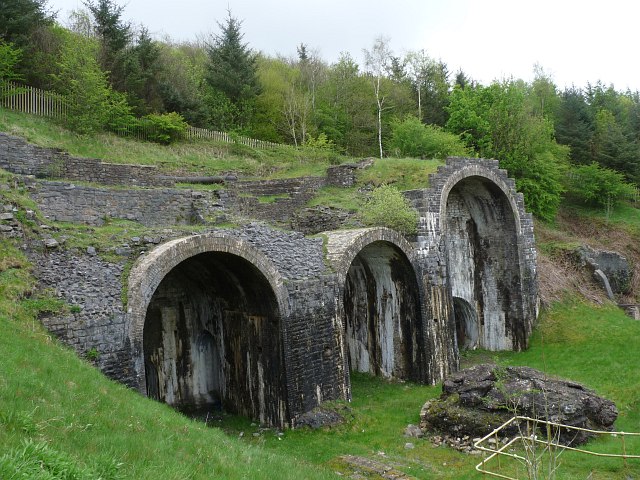
The site was scheduled as an ancient monument on 13 August 1973, its surviving structures considered nationally important for understanding the development of the early Welsh iron industry. Surviving remains include three barrel-vaulted arches that formed part of the retaining wall against which the earliest furnaces were built, the base and 'bear' (solidified iron mass) of a large freestanding furnace, and the remnants of a late-19th-century furnace at the southern end of the site; some structures are separately listed Grade II*.
Barrel-vaulted furnace-retaining arches, a freestanding furnace base and later 19th-century furnace remains survive on the eastern edge of modern Tredegar, at Dukestown.
Nearby mines
- Graham's Navigation Colliery — 0.6 miles (1.0 km) S
- Whitworth Colliery (Tredegar) — 1.3 miles (2.0 km) S
- Ty Trist Colliery — 1.5 miles (2.4 km) S
- Beaufort Iron Works — 2.0 miles (3.1 km) NE
- Troedrhiwgwair Colliery — 2.1 miles (3.3 km) SE
Straight-line distance, within 9 miles (15 km). Show on the map.
Recorded claims
Individual factual claims, each attached to the source(s) that support it below. Where sources disagree, both are kept.
- The Sirhowy Ironworks, founded in 1778 with Homfray family involvement, was the first coke-fired furnace built in Gwent; a waterwheel set up on the Sirhowy river roughly doubled its early weekly output to 4-6 tons. 1,2
- The works were run by William Borrow, Matthew Monkhouse and Richard Fothergill from 1794 to 1818, then by James Harford's Harford, Partridge and Co from 1818, before Abraham Darby and associates bought the works in 1844, by which time it carried five blast furnaces. 1,2
- By 1869 the works held nine blast furnaces served by 300 coke ovens and five blowing engines, with four puddling-furnace forge trains; by 1877 more iron was being cast than the cast-houses could hold. 2
- Iron smelting ended around 1882-83; coke and lime production, latterly supplying Ebbw Vale ironworks, continued until final closure in 1905. The site was scheduled as an ancient monument on 13 August 1973. 1,2
Sources
- (primary) Sirhowy Ironworks, Site of, Tredegar (scheduled monument) — Cadw (Welsh Government historic environment service)
- (secondary) Sirhowy Iron Works — Grace's Guide to British Industrial History
Record created: 26 August 2026 · Last researched: 26 August 2026