 MineArchive
De Lank Quarries
| Also known as | Hantergantick Quarry (De Lank) |
|---|---|
| Location | Hantergantick, St Breward parish, western Bodmin Moor, Cornwall — 50.5466, -4.6817 (exact) |
| Commodity | Granite |
| Type | Stone |
| Worked | 19th century–Still active |
| Maximum depth | Surface quarrying; no depth figure applies. |
| Operators | T. W. Ward & Son Ltd. (1950–?) |
Overview
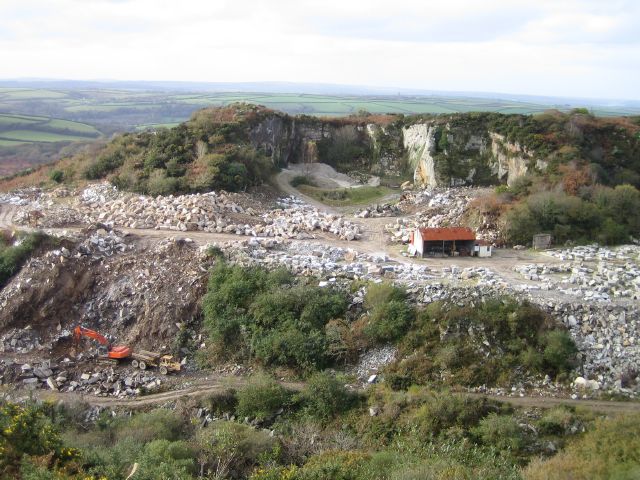
A working granite quarry on the western edge of Bodmin Moor in St Breward parish, and a 54-acre geological SSSI. Its stone is hard, even and unusually sound, which is why it went into structures that had to survive the worst the sea and the city could do to them — the fourth Eddystone Lighthouse of 1882, Bishop Rock, the Thames bridges at Blackfriars, Putney and Tower, the Royal Opera House and Portcullis House.
History
Granite has been St Breward's principal industry for centuries, worked for use across Cornwall and exported well beyond it. De Lank's reputation rests on the quality of its stone: notable structures built from it include the fourth Eddystone Lighthouse of 1882, the Bishop Rock lighthouse, the Thames bridges at Blackfriars, Putney and Tower, the first Severn Road Bridge, the Royal Opera House at Covent Garden and Portcullis House in Whitehall. A slab of De Lank granite forms the base of the reception desk at the Geological Society of London.
From the 1890s until 1950 the quarry was connected to the Bodmin and Wadebridge railway at Wenfordbridge. One of the sidings there ran on a sharp curve across a road and over several fields before dropping to the quarry down a rope-worked incline. Wagons were hauled by horses at first and, between 1926 and 1950, by an 0-4-0 Simplex locomotive. The incline had three rails, the centre rail shared between the up and down lines, and worked on the balance principle, descending loaded wagons hauling the empties back up. Use of the incline and despatch by rail ceased around 1940, though the line was not formally closed until 1950.
Inside the quarry a 2 ft gauge line brought stone to the foot of the incline. A small 0-4-0 petrol locomotive, an Orenstein & Koppel of 1930s vintage, was bought in 1961 from Tregoneeves Quarry near St Austell when that closed, and an 0-4-0 diesel followed in 1963; neither was a success and both were scrapped in December 1965. In the 1950s the quarry was owned by T. W. Ward & Son Ltd. It received its SSSI notification in 1994 and is still working.
Geology
The quarry sits on the edge of the igneous mass that makes up most of Bodmin Moor, with the change to slate country less than half a mile to the west. The bedrock worked is granite, predominantly biotite-bearing, together with aplogranite and some felsite intrusions. It is the evenness and soundness of this granite — coarse, uniform and free of the flaws that spoil dimension stone — that made it worth carrying to Plymouth and London for engineering work rather than merely using locally.
Workings
An open granite quarry taking dimension stone in large blocks. Internal haulage was by a 2 ft gauge line to the head of a rope-worked incline, which dropped to the Wenfordbridge branch on the balance principle — three rails with a shared centre rail, the descending loaded wagons pulling the empty ones up. A turbine house and pipework survive on the site, the quarry having generated its own power from the De Lank river that gives it its name.
Closure
Still in production, supplying dimension granite. Rail despatch ended around 1940 and the Wenfordbridge connection formally closed in 1950, but the quarry itself has continued working.
What remains
An active quarry, and since 1994 also a 54-acre geological Site of Special Scientific Interest. The turbine house and its pipes survive on the site, and the line of the old rope-worked incline down to Wenfordbridge can still be traced.
The turbine house and pipework, and the course of the incline and its tramway connection to Wenfordbridge; the quarry itself is in use rather than ruined.
Nearby mines
- Delabole Slate Quarry — 5.5 miles (8.9 km) N
- Hobbs Hill Tin Mine — 6.4 miles (10.4 km) SE
- Prince of Wales Quarry, Trebarwith — 7.0 miles (11.3 km) N
- Dria Quarry — 7.3 miles (11.7 km) NW
- Carnglaze Slate Caverns — 7.5 miles (12.1 km) SE
Straight-line distance, within 9 miles (15 km). Show on the map.
Recorded claims
Individual factual claims, each attached to the source(s) that support it below. Where sources disagree, both are kept.
- De Lank granite was used for the fourth Eddystone Lighthouse of 1882, the Bishop Rock lighthouse, the Thames bridges at Blackfriars, Putney and Tower, the first Severn Road Bridge, the Royal Opera House and Portcullis House. 1,2
- The quarry lies on the edge of the Bodmin Moor granite, less than half a mile from the change to slate, and works predominantly biotite-bearing granites and aplogranite with some felsite intrusions. 2
- From the 1890s until 1950 the quarry was connected to the Bodmin and Wadebridge railway at Wenfordbridge by a private line and a rope-worked incline; horses hauled the wagons at first, and an 0-4-0 Simplex locomotive between 1926 and 1950. 2
- The incline had three rails with the centre rail shared between the up and down lines, working on the balance principle so that descending loaded wagons hauled the empties back up. 2
- Within the quarry a 2 ft gauge line brought stone to the foot of the incline. An Orenstein & Koppel petrol locomotive bought in 1961 from Tregoneeves Quarry and a diesel acquired in 1963 were both unsuccessful and were scrapped in December 1965. 2
- The quarry received its SSSI notification in 1994 for its geology, covering 54 acres, and remains an active working quarry. 2
- A slab of De Lank granite forms the base section of the reception desk at the Geological Society of London. 2
Photographs & further reading
An account of the quarry's stone and where it went, together with unusually full detail on its railway connection, the balance incline to Wenfordbridge and the locomotives that worked it.
View sourceSets De Lank in the wider Cornish granite industry and lists the lighthouses and bridges its stone went into.
View sourceSources
- (secondary) Ertach Kernow – Granite at the heart of Cornwall's Heritage — Cornwall Heritage Trust
- (secondary) De Lank Quarries — Wikipedia
Record created: 3 September 2026 · Last researched: 3 September 2026