 MineArchive
Prince of Wales Quarry, Trebarwith
| Location | Trewarmett, in the Trebarwith valley near Tintagel, Cornwall — 50.6436, -4.7281 (exact) |
|---|---|
| Commodity | Slate |
| Type | Slate |
| Worked | 1871–1890s |
| Maximum depth | Unknown. |
| Operators | Duchy of Cornwall |
Overview
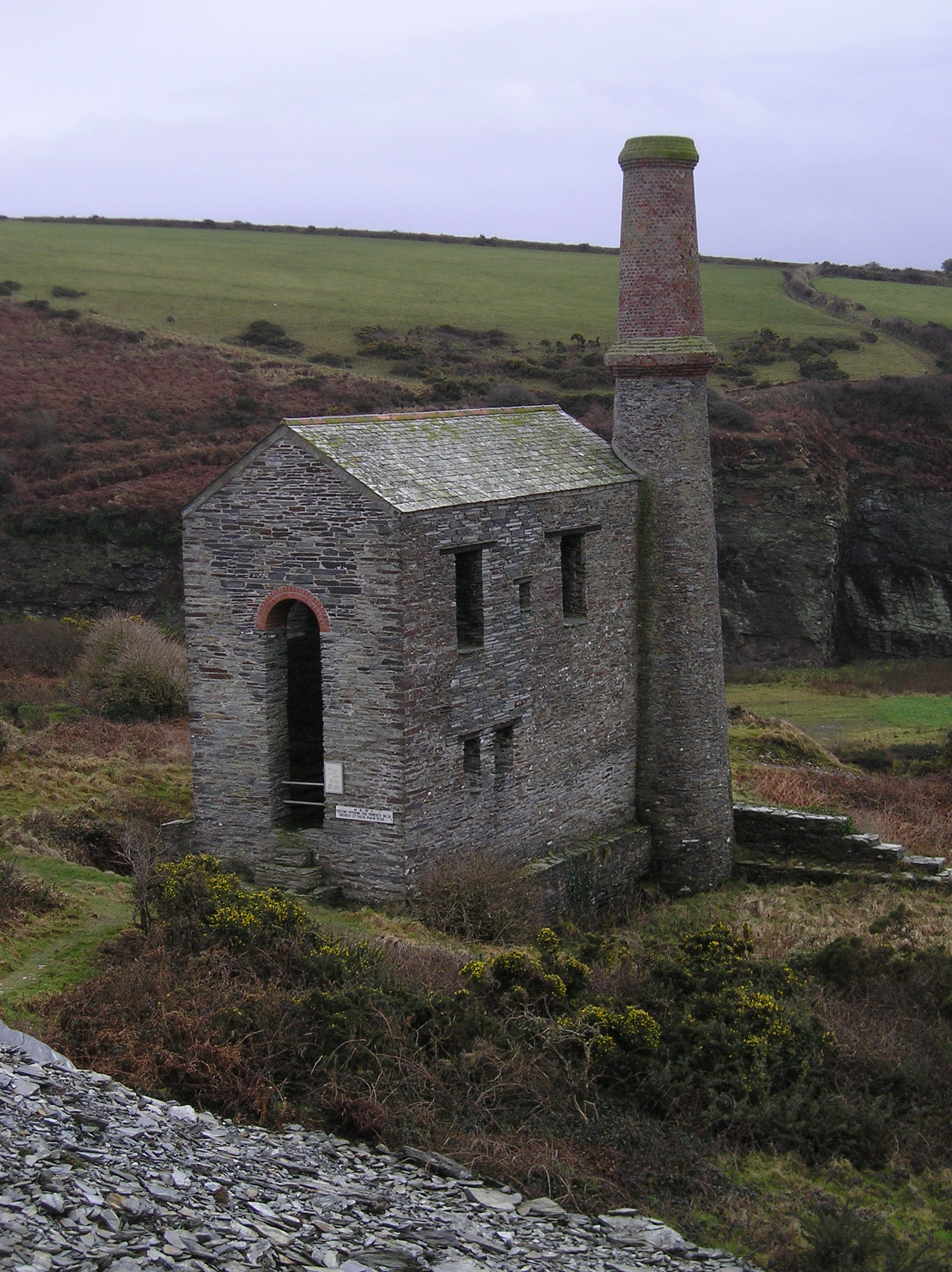
An open slate quarry in the Trebarwith valley below Tintagel, worked from 1871 into the 1890s for the bluish roofing slate of the Penpethy Beds. Its engine house is the only one in north Cornwall built for a beam engine: a fifty-inch engine that drained the pit, hauled blocks up to the splitting floor and pulled trucks across the valley from Bowithick quarry. The pit is now a flooded lake in a country park, and the engine house, restored by volunteers in 1976 after sixty years derelict, passed to Cornwall Heritage Trust in 2026.
History
The quarry opened in 1871 and was given up during the 1890s. Its engine house went up first: most accounts date the building to 1870 and the listing description gives it as completed in 1872, and the beam engine was installed in July 1871 at a cost of £1,590 4s 0d. The engine did two jobs at once, pumping the deep pit and driving a wire ropeway that hauled blocks of slate up to the headframe, where they were sorted ready for splitting, and it also drew trucks over bridges from Bowithick quarry on the far side of the valley. The listing has it pumping until 1890; Bowithick closed about 1913 and the engine itself was cut up for scrap during the First World War, after which the building stood derelict for sixty years. A public meeting at the rural district council offices in Camelford on 11 December 1972, addressed by a member of the Trevithick Society, set up the Prince of Wales Engine House Society to save it. The Manpower Services Commission granted £7,973, five unemployed building workers did the job in eight months, slates and other materials were given and the scaffolding lent, and the restoration was finished in 1976. The Duchy of Cornwall, which owns the land, had not wanted to restore the building but gave the society permission to do so. It was listed Grade II on 10 December 1980. In March 2025 Cornwall Council agreed to transfer it, with four other historic places, to Cornwall Heritage Trust, which announced in June 2026 that it had become the owner.
Geology
The quarry produced a bluish slate from the Upper Devonian Penpethy Beds, used chiefly for roofing. It is one of the inland group of the Tintagel quarries, where the stone is Upper Devonian and Lower Carboniferous slate of a greyish-green colour, the better quality lying nearer sea level.
Geological setting: Slate and Regional Metamorphism (well documented example)
Workings
An open pit, worked by conventional opencast methods like the other inland quarries of the Tintagel group rather than off a cliff face. The engine house stands at the lip of the pit: rectangular in plan with the chimney attached at the lower south-west corner, built of slate rubble with brick dressings and a brick top stage to the stack, and of unusual plan because it served both pumping and winding. A wire ropeway hauled the slate up to the headframe for sorting and splitting, and bridges carried trucks across the valley from Bowithick. Slates from the district were sold by size under names running from Doubles at twelve inches by seven up to Queens at thirty-six by seven, the smallest cut by boys.
Closure
The quarry closed during the 1890s. The listing description has the engine pumping until 1890, and the engine house is thought to have worked on until Bowithick quarry, whose trucks it hauled across the valley, closed about 1913; the engine was scrapped during the First World War.
What remains
The pit is flooded, a small lake with a waterfall falling into it, and the tips have grown over with honeysuckle, gorse, foxgloves, heather, elder, blackberry and sloe; buzzards are among the birds on the site. The quarry is managed as a nature reserve and country park with paths and steps to its features, and the restored engine house can be walked into, the opening where the beam engine stood covered by grilles.
The restored engine house stands with its chimney, the most visible quarry building in the Tintagel area. The flooded pit and the slate tips remain, and an information board here is the only signage at any of the Tintagel slate quarries.
Redevelopment
The site is owned by the Duchy of Cornwall and was leased to North Cornwall District Council as an amenity and wildlife area, becoming a country park. Part of the quarry is now let for holiday accommodation.
Related mines
- Bowithick Quarry — The Prince of Wales beam engine hauled trucks of slate over bridges from Bowithick, on the other side of the Trebarwith valley, and the engine house is thought to have worked on until Bowithick closed about 1913.
Nearby mines
- Bagalow Quarry — 2.1 km W
- Dria Quarry — 2.1 km W
- Bowithick Quarry — 2.3 km W
- Lanterdan Quarry — 2.3 km W
- Tintagel Slate Quarries — 2.3 km W
Straight-line distance, within 15 km. Show on the map.
What's uncertain
Points where sources disagree or the record could not be settled; both accounts are kept. All open questions in the archive.
- Built in 1870 for a fifty-inch Woolf compound beam engine that pumped the pit and hauled slate. (disputed) 1,2
- Completed in 1872 for a fifty-inch Harvey engine that pumped the pit until 1890 and hauled trucks from Bowithick quarry across the valley. (disputed) 3
Recorded claims
Individual factual claims, each attached to the source(s) that support it below. Where sources disagree, both are kept.
- Opened in 1871 and closed during the 1890s. 1
- Built in 1870 for a fifty-inch Woolf compound beam engine that pumped the pit and hauled slate. (disputed) 1,2
- Completed in 1872 for a fifty-inch Harvey engine that pumped the pit until 1890 and hauled trucks from Bowithick quarry across the valley. (disputed) 3
- The beam engine was installed in July 1871 at a cost of £1,590 4s 0d. 1,4
- The engine was removed for scrap during the First World War. 2
- Restored in 1976 by five unemployed building workers in eight months, under a £7,973 grant from the Manpower Services Commission. 4
- The engine house was listed Grade II on 10 December 1980, having formerly been listed as Prince of Wales Engine House, Trewarmett. 3
- Cornwall Council agreed in March 2025 to transfer the engine house to Cornwall Heritage Trust, which announced in June 2026 that it had acquired it. 5,6
- The quarry produced a bluish roofing slate from the Upper Devonian Penpethy Beds. 1
- The engine house is the most visible quarry building among the Tintagel slate quarries, and the quarry is the only one of them with signage for visitors. 7
- The restored engine house can be walked into, the opening that held the beam engine covered by grilles. 8
Photographs & further reading
The Grade II listing description, with the building's fabric, plan and engine, and the grid reference used here.
View sourceHow the engine house was saved from 1972, with the society formed, the grant, the workers and the cost of the original engine.
View sourceA walkers' description of the restored building and the flooded pit as they now are.
View sourceSources
- (secondary) The Prince of Wales Quarry — Wikipedia
- (secondary) Prince of Wales Slate Quarry, Cornwall — Cornwall Calling
- (primary) Engine House at Princess of Wales Quarry, Tintagel: list entry 1143433 — Historic England, via British Listed Buildings
- (secondary) Prince of Wales Engine House: the story of the restoration — Tintagel Web
- (secondary) Cornwall Heritage Trust to safeguard historic sites from Cornwall Council — The Post
- (secondary) Cornwall Heritage Trust acquires iconic Prince of Wales Engine House — Holsworthy Today
- (secondary) Tintagel Slate Quarries — Wikipedia
- (observational) Engine House at the Prince of Wales Quarry — iWalk Cornwall
Record created: 24 September 2026 · Last researched: 24 September 2026