 MineArchive
Tintagel Slate Quarries
| Also known as | Tintagel Coastal Quarries |
|---|---|
| Location | Between Tintagel and Trebarwith Strand, Cornwall — 50.6500, -4.7590 (exact) |
| Commodity | Slate |
| Type | Slate |
| Worked | 15th century–1937 |
| Maximum depth | Cliff-face working to the full height of the cliffs, 60-100 m. |
Overview
The Tintagel slate quarries are a group of workings on the north Cornish coast between Tintagel Castle and Trebarwith Strand, together with several open-cast sites inland. Around eight cliff-edge quarries and two wharfs are now disused; of four inland sites, two still work. The first appears to have been Lanterdan, in the fifteenth century, and the last of the coastal quarries, Long Grass, ceased in 1937. What makes them unusual is the method: the working faces run to the full height of the cliffs, 60 m in the north and 100 m in the south, and the slate had to be raised and lowered by whims turned by horses or donkeys walking in circles on the clifftop. The coastal ground is now owned by the National Trust and crossed by the South West Coast Path.
History
Quarrying here appears to begin at Lanterdan at some point in the fifteenth century, and the coastal quarries ran on into the twentieth: Lambshouse and Gull Point, latterly worked jointly, were abandoned by about 1900, while Long Grass held on until 1937. Lanterdan itself was still in use on the evidence of the 1907 Ordnance Survey map, though by 1883 it employed a single worker, Thomas Sweet. The named coastal quarries are Lanterdan, Dria, Gillow, Long Grass, Lambshouse and Gull Point, Bagalow, Caroline and West Quarry; inland are the Prince of Wales, Bowithick, Trevillet and Trebarwith Road Rustic quarries. Three wharfs served them — Port William, Penhallick Wharf and Tintagel Haven.
Geology
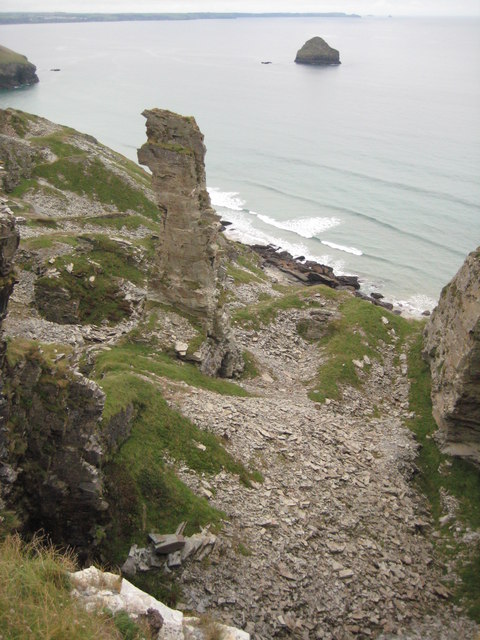
The stone is Upper Devonian and Lower Carboniferous slate of a greyish green colour, used predominantly for roofing, with the rubble going for building. At Lanterdan the slate is described as olive green or blue-black. One practical rule governed the whole coast: the slate closer to sea level is generally of better quality than that higher up, which is why the quarries drove down the cliff face rather than working back from the top, and why a 25 m pinnacle of inferior slate was simply left standing at Lanterdan when the good stone around it had gone.
Geological setting: Slate and Regional Metamorphism (well documented example)
Workings
Two quite different methods were used. The southernmost cliff quarries — the southern end of Caroline, and Lanterdan and West quarries — together with the inland sites, used conventional open-cast extraction. The sea-cliff quarries at Gillow, Long Grass, Lambshouse, Gull Point, Dria, Bagalow and northern Caroline simply cut into slate faces the sea had already exposed. Working those meant clearing the soil, grass and loose stone off the clifftop and dumping it into the sea, establishing a strong point on bedrock a short way back from the edge, and building a whim on the rock immediately above the drop: a wooden frame carrying a pulley, anchored to the strong point and turned by a horse or donkey walking in circles, often blindfolded so as not to be distracted. Trimmed slates were lowered from a timber platform projecting over the cliff edge straight down to cargo ships at the base of the rock.
Closure
The coastal quarries closed piecemeal — Lambshouse and Gull Point by about 1900, Lanterdan in the early twentieth century, and Long Grass, the last of them, in 1937. Two of the four inland quarries remain in operation.
What remains
The coastal quarries are disused and their ground is owned by the National Trust, most of them easily reached from the South West Coast Path. Lambshouse and Gull Point have some of the best-preserved remains of any quarry on this coast, including a cluster of three horse or donkey whims; the best preserved of these, which served Gull Point, still has its mechanism pit and cable tunnels intact. The Prince of Wales Quarry inland has been made into a country park.
The Lanterdan pinnacle, 25 m of inferior slate deliberately left standing, is the most conspicuous survival and reads from a distance like a sea stack. Around Lambshouse and Gull Point are the three whim platforms with the Gull Point mechanism pit and its cable tunnels. Evidence of working runs from the Lanterdan pinnacle to Penhallic Point, where a timber loading platform once projected from the cliff edge.
Related mines
- Dria Quarry — Dria is one of the coastal slate quarries covered by the Tintagel record.
- Lambshouse and Gull Point Quarry — Both quarries are part of the coastal group covered by the Tintagel record.
- Lanterdan Quarry — Lanterdan is the largest of the coastal slate quarries covered by the Tintagel record.
- Long Grass Quarry — Long Grass is one of the coastal slate quarries covered by the Tintagel record.
Nearby mines
- Bagalow Quarry — 0.2 miles (0.3 km) N
- Bowithick Quarry — 0.3 miles (0.5 km) E
- Lanterdan Quarry — 0.4 miles (0.6 km) E
- Dria Quarry — 0.6 miles (1.0 km) SE
- Lambshouse and Gull Point Quarry — 0.6 miles (1.0 km) N
Straight-line distance, within 9 miles (15 km). Show on the map.
Disasters & major incidents
-
Long Grass Quarry cliff fall, Tintagel, 1886
1886 · Collapse / Roof Fall · 3 fatalities
Three men drilling the face of Long Grass Quarry, on the cliffs between Tintagel and Trebarwith in north Cornwall, were carried into the sea in 1886 when the rock they were working snapped off beneath them.
Recorded claims
Individual factual claims, each attached to the source(s) that support it below. Where sources disagree, both are kept.
- The first quarry worked appears to have been Lanterdan, at some point in the fifteenth century; the last of the coastal quarries, Long Grass, ceased operations in 1937. 1
- There are around eight cliff-edge quarries and two wharfs, all now disused, together with four inland sites of which two still operate. 1
- The working faces of the coastal quarries reach the full height of the cliffs — 60 m in the north and 100 m in the south. 1
- On the cliff quarries a whim was built on the rock immediately above the cliff edge: a wooden frame with a pulley, anchored to a strong point set back on bedrock and operated by a donkey or horse walking in circles, often blindfolded to avoid distraction. 1
- Lanterdan is the oldest, largest and most spectacular of the coastal quarries, worked from the fifteenth until the early twentieth century, and is distinguished by a 25 m high pinnacle of inferior slate left standing. It covers a 200 m stretch of coastline, extends up to 80 m inland and reaches around 30 m in height. 2
- In 1883 Lanterdan Quarry employed a solitary worker, Thomas Sweet, and according to the 1907 Ordnance Survey map the quarry was still in use at that date. 1
- The National Trust's record for Lanterdan, at SX 050 870, describes working faces along 200 metres of cliff in at least seven sections, each 15 to 25 metres wide and worked back 50 to 80 metres to heights of 30 metres, in slate from grey-black to olive green, with drill marks on the faces, a whim in the northern section, and stacks of poor stone, buildings, shelters, tramming roads, dumps and a cliff path remaining; Thomas Sweet worked it with one employee in 1896. 3
- In 1886 three men were killed when the rock they were drilling snapped off and carried them into the sea; at Penhallick Point the cliff edge was cut back to a 100-foot vertical face for a wharf, and slate was lowered to boats at Tintagel Cove by derrick, while Long Grass's office, engine and blacksmith's shop is now a youth hostel. 4
Photographs & further reading
Names every quarry and wharf in the group and explains how clifftop quarrying actually worked — the whims, the blindfolded horses, and the timber platforms from which slate was lowered to ships at the foot of the cliff.
View sourceSources
- (secondary) Tintagel Slate Quarries — Wikipedia
- (secondary) Lanterdan Quarry — Wikipedia
- (primary) Lanterdan Quarry, Trebarwith Strand, Tintagel (National Trust heritage record MNA103430) — National Trust
- (secondary) Tintagel Slate Quarries, Cornwall — Cornwall Calling
Record created: 4 September 2026 · Last researched: 24 September 2026