 MineArchive
Carnglaze Slate Caverns
| Also known as | Carnglaze Caverns, Carnglaze Slate Quarry |
|---|---|
| Location | Loveny valley, about 3 km south-east of St Neot, Cornwall — 50.4726, -4.5565 (exact) |
| Commodity | Slate |
| Type | Slate |
| Worked | 1603–1903 (roofing slate) |
| Maximum depth | About 60 m (200 ft) below ground at the lower cavern |
Overview
Cornwall's only underground slate quarry, in the Loveny valley near St Neot, worked at the surface from 1603 and underground from 1800; its caverns held the Royal Navy's rum in the Second World War and opened to visitors in 1973.
History
Carnglaze lies in the Loveny valley about 3 km south-east of St Neot, between Liskeard and Bodmin. Slate was quarried at the surface from 1603 and underground from 1800, and the workings are first mentioned in print in 1833, in the Parochial History of St Neot. The slate is hard and blue, unlike the greyer slates of north Cornwall, and its well-cleaved beds split into thin, light sheets for roofing; it also went into floors and the headstones of the churchyard. Packhorses carried it to quays on the Fowey at St Winnow, near Lostwithiel, and to Polperro and Looe, and brought back lime for the acid moorland soil. The road from St Neot to Twowatersfoot past the quarry was built in 1837.
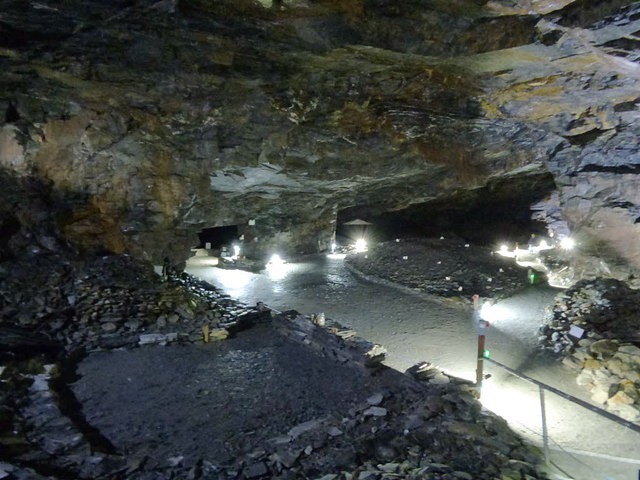
The quarry stopped making roofing slate in 1903 but went on supplying building stone, and in 1937 the dumps inside were turned over for stone, hauled up by an engine whose mounting survives just inside the entrance. The working left three large caverns. In the Second World War the Royal Navy stored its rum in the first, the Rum Store, which became an auditorium in 2001; the lowest holds a lake about 9 metres deep, the setting for the cover of Echo & the Bunnymen's 1984 album Ocean Rain. The caverns opened to the public in 1973 and have been used for concerts and filming.
Geology
Hard, blue, well-cleaved slate; iron oxides stain the walls red, orange and yellow.
Workings
Underground chambers reached by steps; the first is 90 m long, 15 m wide and up to 6 m high, and the lowest holds a lake about 9 m deep.
Closure
Roofing slate ended in 1903; building stone was still taken, and in 1937 the internal dumps were reworked.
What remains
Open to visitors as Carnglaze Caverns; the chambers are used for concerts and events.
Engine-mounting foundations just inside the entrance.
Redevelopment
A visitor attraction since 1973; the Rum Store has been an auditorium since 2001.
Nearby mines
- Hobbs Hill Tin Mine — 1.5 miles (2.5 km) N
- Herodsfoot Mine — 2.4 miles (3.9 km) S
- Craddock Moor Mine — 4.7 miles (7.6 km) NE
- West Caradon Mine — 5.1 miles (8.3 km) NE
- Gonamena — 5.2 miles (8.4 km) NE
Straight-line distance, within 9 miles (15 km). Show on the map.
What's uncertain
Points where sources disagree or the record could not be settled; both accounts are kept. All open questions in the archive.
- The auditorium seats 400. (disputed) 2
- The first chamber can seat 300. (disputed) 1
- The lower cavern is reached by 60 steps and lies about 60 m below the ground above. (uncertain) 3
Recorded claims
Individual factual claims, each attached to the source(s) that support it below. Where sources disagree, both are kept.
- Surface quarrying began in 1603 and underground working in 1800; the first written reference is in the Parochial History of St Neot, 1833. 1
- Carnglaze slate is hard and blue, split into thin sheets for roofing, and went by packhorse to quays on the Fowey at St Winnow. 1
- The quarry ceased producing roofing slates in 1903 but supplied building stone; in 1937 the internal dumps were turned over for stone. 1
- The first cavern, the Rum Store, held the Royal Navy's rum in the Second World War and became an auditorium in 2001. 1,2
- The auditorium seats 400. (disputed) 2
- The first chamber can seat 300. (disputed) 1
- The lowest cavern has a lake, where the cover of Echo & the Bunnymen's Ocean Rain (1984) was shot. 2
- The caverns opened to the public in 1973. 1
- The lower cavern is reached by 60 steps and lies about 60 m below the ground above. (uncertain) 3
Sources
- (secondary) Carnglaze Slate Caverns, Cornwall — Cornwall Calling
- (secondary) Carnglaze Caverns — Wikipedia
- (observational) Carnglaze Cavern - lower level (Geograph 6015421) — Geograph
Record created: 18 October 2026 · Last researched: 18 October 2026