 MineArchive
Gonamena
| Location | Near Minions, Caradon, Cornwall — 50.5044, -4.4489 (approximate) |
|---|---|
| Commodities | Copper, Tin |
| Type | Metal |
| Worked | 1844–1886 (final re-trial) |
| Maximum depth | 158 fathoms (Hingston's Shaft) |
| Operators | West Gonamena Mining Company (1883–1886) |
Overview
Gonamena was a 19th-century copper and tin mine in the Caradon mining district of Cornwall, sandwiched between the far larger South Caradon and West Caradon mines but never itself a commercial success in copper despite promising early tin returns.
History
Gonamena lay half a mile south of Minions on Bodmin Moor, in the valley west of Caradon Hill, flanked by West Caradon Mine to the west and South Caradon Mine to the east. It worked three east-west-trending copper lodes -- Sara's Lode, Taylor's Lode and Gilpin's Lode -- cut by north-south crosscourses, on which two shafts, Hingston's Shaft and Sara's Shaft, were sunk; Hingston's Shaft reached a maximum depth of 158 fathoms. The mine operated from 1844 to 1871, employing up to 94 men, and raised a total of 9,693 tons of copper ore, peaking at 961 tons in 1860 and 1,868 tons in 1869. Its large-scale early tin workings suggest tin was the more successful side of the operation, but copper mining at Gonamena was never a commercial success, and the mine has been characterised as a mediocre performer surrounded by far richer neighbours -- South Caradon was, at its height, one of the largest copper mines in the world. A brief re-trial was made in 1883-86 under the West Gonamena Mining Company, employing 16 men, but raised only 20 tons of ore before work ceased for good.
Geology
Part of the Caradon copper and tin lodes on the eastern flank of Bodmin Moor's granite, the same mineralised system worked at the far larger South Caradon and West Caradon mines.
Workings
Worked three east-west copper lodes (Sara's, Taylor's and Gilpin's) via Hingston's and Sara's shafts, sunk on the crosscourses that disrupted the lodes; underground workings interconnected with the neighbouring South and West Caradon mines.
Closure
A brief re-trial in 1883-86 raised only 20 tons of ore before work ceased.
What remains
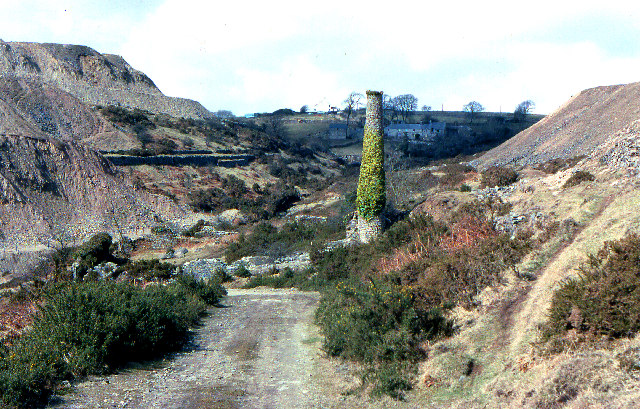
The site's main excavation survives as a substantial surface feature, over 15 metres deep in places and over 100 metres wide, extending up the slopes of Caradon Hill, with the Gonamena incline -- once used to haul ore -- still traceable on the ground.
A mine chimney and extensive spoil tips survive at the site, part of the wider industrial landscape of the former South Caradon Mines complex.
Related mines
- Cheesewring Quarry — The incline at Gonamena carried the quarry's traffic down off the moor from 1846.
Nearby mines
- South Caradon Mine — 0.3 miles (0.5 km) SE
- Craddock Moor Mine — 0.6 miles (0.9 km) W
- Wheal Jenkin — 0.8 miles (1.3 km) N
- Caradon Hill Medieval and Post-Medieval Mines — 0.9 miles (1.5 km) NE
- Marke Valley Mine — 1.4 miles (2.3 km) N
Straight-line distance, within 9 miles (15 km). Show on the map.
Recorded claims
Individual factual claims, each attached to the source(s) that support it below. Where sources disagree, both are kept.
- Between 1848 and 1872 the mine raised a total of 9,693 tons of copper ore, peaking at 961 tons in 1860 and a later peak of 1,868 tons in 1869; a maximum of 94 men were employed. 1
- The mine worked three east-west copper lodes -- Sara's Lode, Taylor's Lode and Gilpin's Lode -- via Hingston's Shaft (158 fathoms deep) and Sara's Shaft, both sunk on north-south crosscourses. 1,2
- A re-trial under the West Gonamena Mining Company between 1883 and 1886, employing 16 men, raised only 20 tons of ore before the mine closed for good. 1
- Two mine plan records survive in the BGS/Mining Remediation Authority catalogue under the name Gonamena (catalogue no. OMR208), independent confirmation of the mine as a distinct, formally catalogued working. 3
Photographs & further reading
A detailed account of Gonamena's shafts, lodes, output figures and workforce, with its relationship to the neighbouring South and West Caradon mines.
View sourceSources
- (secondary) Gonamena Mine, Cornwall — Cornwall Calling
- (secondary) Gonamena — Wikipedia
- (primary) Gonamena (mine plan, catalogue no. OMR208) — BGS / Mining Remediation Authority mine plans catalogue
Record created: 2 September 2026 · Last researched: 2 September 2026