 MineArchive
Cheesewring Quarry
| Location | Stowe's Hill, above Minions, Bodmin Moor, Cornwall — 50.5254, -4.4590 (approximate) |
|---|---|
| Commodity | Granite |
| Type | Quarry |
| Worked | 1845–Early 20th century |
| Maximum depth | Unknown. |
Overview
A granite quarry on Bodmin Moor beside the tor it is named after, rail-connected to the Liskeard and Caradon line, which cut the sleeper blocks for that railway and supplied cladding for Tower Bridge.
History
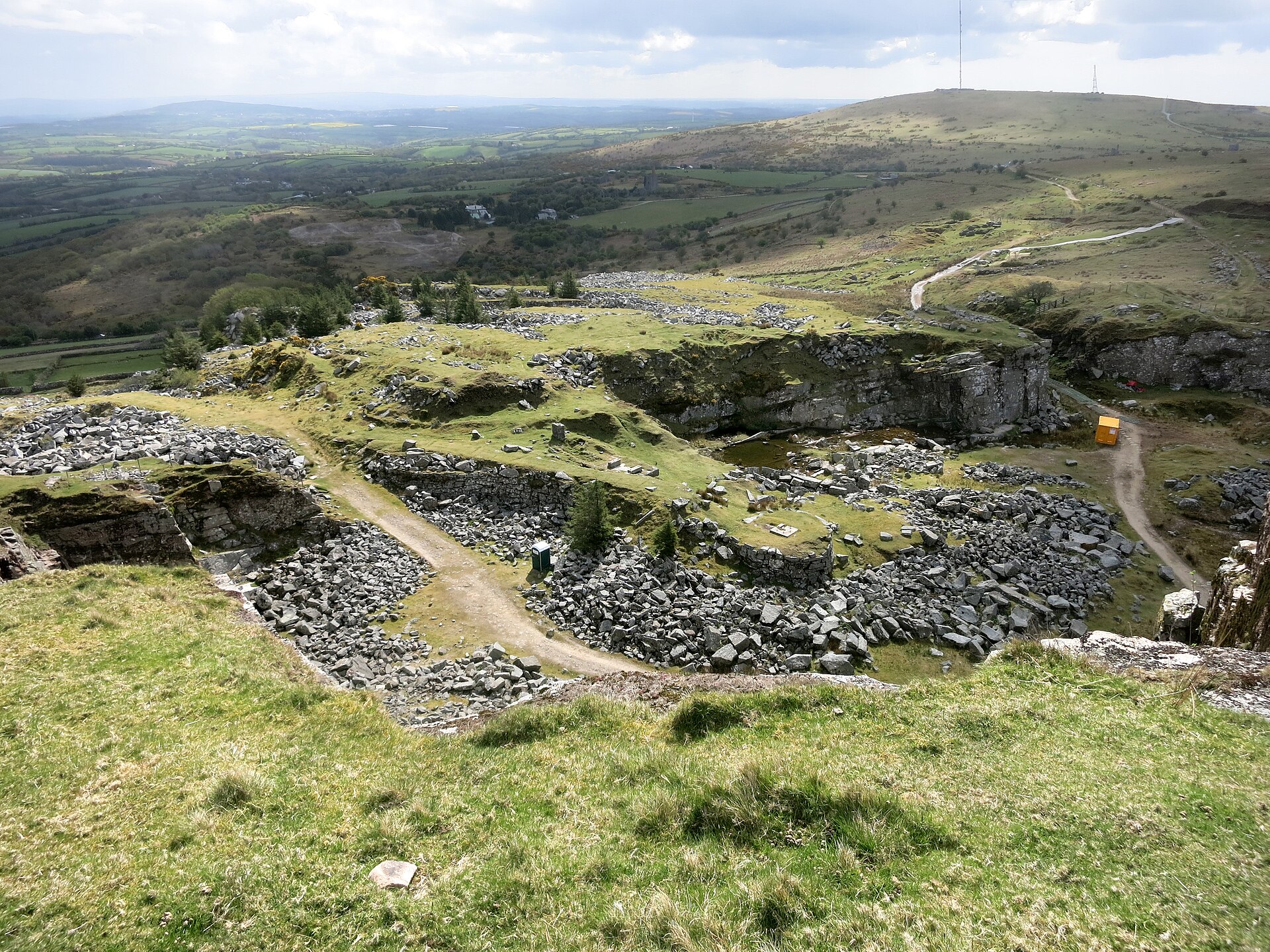
Cheesewring Quarry stands on the eastern flank of Bodmin Moor above Minions, cut into the granite of Stowe's Hill immediately beside the natural tor that gives it its name. The granite is a durable silver-grey stone, and it was much in demand. The quarry belongs to the same burst of industry that opened the copper mines of Caradon Hill. The Liskeard and Caradon Railway was built as a mineral line to take granite, copper and tin from around Minions down to Moorswater and on to Looe harbour; the section from Moorswater to South Caradon mine and up the Gonomena incline to the Cheesewring was completed in 1846, and in 1877 a further line around the Marke Valley side of Caradon Hill connected the quarry with the railway already serving East Caradon mine. A hundred thousand stone sleeper blocks for that railway were themselves cut at the Cheesewring. At its height the quarry had its own row of workmen's cottages as well as its rail connection, and when Black's Guide to the Duchy of Cornwall appeared in 1879 it was still working at full capacity. Granite from here was used as cladding in the building of Tower Bridge in London. The tor above nearly went with the stone. Blasting came so close in the late nineteenth century that the Cheesewring was threatened with collapse, and it survived because local people campaigned to save it; the small masonry props built at its side at the start of the 1900s to hold it up do not actually touch the rock. Daniel Gumb, the stonecutter who died in 1776 and who lived on the moor in a house roofed with a single great slab, left an inscription of 1735 above his door, but the original site of his cave was quarried away and only part of it was later reassembled. Working ended in the early twentieth century.
Geology
The quarry works the granite of the Bodmin Moor pluton, which here weathers at surface into the stacked slabs of the Cheesewring tor: seven courses of rock some thirty-two feet high, the smallest and lightest at the bottom and the thickest, over thirty feet across, on top. The formation is entirely natural, the product of weathering on an exposed summit, though its improbable balance has attracted legend for centuries. The quarried stone is a durable silver-grey granite.
Workings
An open quarry cut into the side of Stowe's Hill beside the tor. It had its own connection to the Liskeard and Caradon Railway, reached by the Gonomena incline from 1846 and by the Marke Valley line from 1877, and a row of workmen's cottages on the site.
Closure
Working continued into the early twentieth century and the quarry was abandoned thereafter, the railway that served it having long outlived the copper mines it was built for.
What remains
The quarry is disused and open moorland, within the Bodmin Moor part of the Cornwall and West Devon Mining Landscape. Its faces are used by rock climbers, and the tor beside it is one of the most visited landmarks in Cornwall.
The quarry faces and spoil survive on the hillside, along with the trackbeds of the mineral railway. Part of Daniel Gumb's cave was reassembled after the original was quarried away, and the masonry props built beside the Cheesewring in the early 1900s still stand.
Redevelopment
The site has not been redeveloped and remains open moor.
Related mines
- Gonamena — The incline at Gonamena carried the quarry's traffic down off the moor from 1846.
- Marke Valley Mine — The 1877 railway around the Marke Valley side of Caradon Hill joined the quarry to the line already serving these workings.
- South Caradon Mine — Served by the same mineral railway; the Moorswater line reached South Caradon and then climbed the Gonamena incline to the quarry in 1846.
Nearby mines
- Marke Valley Mine — 0.3 km E
- Phoenix United Mine — 0.9 km E
- Caradon Hill Medieval and Post-Medieval Mines — 1.7 km SE
- South Caradon Mine — 1.9 km S
- Gonamena — 2.4 km S
Straight-line distance, within 15 km. Show on the map.
Recorded claims
Individual factual claims, each attached to the source(s) that support it below. Where sources disagree, both are kept.
- Granite from Cheesewring Quarry was used as cladding in the construction of Tower Bridge in London. 1,2
- The Liskeard and Caradon Railway reached the Cheesewring by way of the Gonomena incline in 1846, and a second line around the Marke Valley side of Caradon Hill joined it to the East Caradon route in 1877. 3
- A hundred thousand stone sleeper blocks for the Liskeard and Caradon Railway were cut at Cheesewring Quarry. 3
- The quarry had its own row of workmen's cottages and was still working at full capacity in 1879. 4
- Blasting at the quarry threatened the Cheesewring tor with collapse in the late nineteenth century, and it was saved by local campaigning. 2
- The masonry props placed beside the tor at the start of the 1900s do not touch the rock they were built to support. 1
Photographs & further reading
An account of the mineral railway built to carry granite, copper and tin from Minions to Looe.
View sourceA gazetteer entry on the village and the quarry above it, with the 1879 guidebook description.
View sourceSources
- (secondary) The Cheesewring, Minions — Cornwall Guide
- (secondary) Cheesewring — Wikipedia
- (secondary) Liskeard and Caradon Railway — Wikipedia
- (secondary) Minions and the Cheesewring — Cornwall Calling
- (secondary) The Liskeard and Caradon Railway — Cornwall Heritage Trust
Record created: 23 September 2026 · Last researched: 23 September 2026