 MineArchive
Phoenix United Mine
| Also known as | South Phoenix Mine, Wheal Phoenix, Clanacombe Mine, Phoenix and West Phoenix United Mines, Cornwall Great United Mines |
|---|---|
| Location | Minions, Linkinhorne, Bodmin Moor, Cornwall — 50.5257, -4.4463 (approximate) |
| Commodities | Copper, Tin |
| Type | Metal |
| Worked | 1836–1914 |
| Maximum depth | About 216 fathoms (395 m) at the Old Sump shaft; the Prince of Wales Shaft reached 200 fathoms. |
| Operators | James Seccombe (1842–?), Cosmopolitan Proprietary Company Ltd (1907–1914) |
Overview
A copper and later tin mine on the south-eastern edge of Bodmin Moor near Minions, which for a decade after 1852 rivalled South Caradon among Cornwall's greatest copper mines and then, under the engineer William West, became a major tin producer. An Australian company's attempt to revive it through the new Prince of Wales Shaft from 1907 failed by 1914; that shaft's engine house, with its square-based chimney, still stands.
History
The ground was worked as separate small mines, among them Clanacombe, Stowes and Wheal Prosper, before 1836, when they were brought together as Cornwall Great United Mines, which failed. Captain James Seccombe bought the sett in 1842, and in 1844 a new company renamed it Wheal Phoenix. Copper sales began by 1848 and 132 people worked there by 1851; in 1852 a rich copper lode was struck, and for the next ten years Phoenix rivalled South Caradon. By the 1860s the copper was running out. The consulting engineer, William West, could not persuade the other adventurers to try for tin, so in 1864 he bought a controlling share and re-equipped the mine for it himself. By 1865 it employed 320 men, 60 women and 80 boys, and nearly 600 people by 1869; in 1870 it had 144 heads of stamps and took in the old Stowes mine to the west, the company becoming Phoenix and West Phoenix United. West Phoenix was fully absorbed in 1875 by one account and 1886 by another, after which the mine was worked as Phoenix United. Ore went out, and coal came in, on the Liskeard and Caradon Railway. By the Northern Mine Research Society's figures the mine produced 84,538 tons of copper between 1848 and 1889 and 15,996 tons of tin between 1853 and 1898. Falling metal prices ended that working: the mine was abandoned in 1898 and its machinery put up for sale. In 1907 the Australian Cosmopolitan Proprietary Company took the lease and began the Prince of Wales Shaft, named after the Prince of Wales, the mine's mineral lord. On 10 June 1909 the Prince and Princess of Wales visited, and the Princess named and started the new 80-inch pumping engine, the last large Cornish pumping engine designed, built and erected in Cornwall; by then about 150 people were employed. The tin lay deeper, and perhaps further east, than the shaft could reach: it went down 200 fathoms but raised only 95 tons of black tin in seven years, and by July 1914 the company had spent all its capital.
Geology
The main lode was unusual in carrying a copper lode and a tin lode side by side, the result of two episodes of mineralisation along an ancient fault. Because of the varying downthrow, the walls alternate between granite and killas: near the surface the granite formed the footwall and most of the copper was found there, while at depth the granite was on the hanging wall and tin predominated. Much of the country rock here has been eroded away, so granite is exposed at the surface, unlike at South Caradon.
Geological setting: Veins and Lodes (well documented example)
Workings
Shafts including Seccombe's, the Old Sump, Anne's, Hamilton's, Stowe's, West's and, from 1907, the Prince of Wales Shaft, worked by steam engines for pumping, winding and stamping: a 36-inch pumping engine on Sump shaft in 1843, a 60-inch on Seccombe's in 1862, a 36-inch on Hamilton's in 1869 and the 80-inch on Prince of Wales Shaft in 1907, with whim engines on Seccombe's and Stowe's. There were 144 heads of stamps by 1870, and West Phoenix alone at one time had eight engine houses.
Closure
The 19th-century mine closed in 1898, abandoned as tin and copper prices fell and its machinery sold. The Cosmopolitan Proprietary Company's revival through the Prince of Wales Shaft from 1907 found too little tin, and the company ran out of capital in July 1914. Rumours at the time blamed German ownership for the closure, but the ore reserves were simply not where they were expected.
What remains
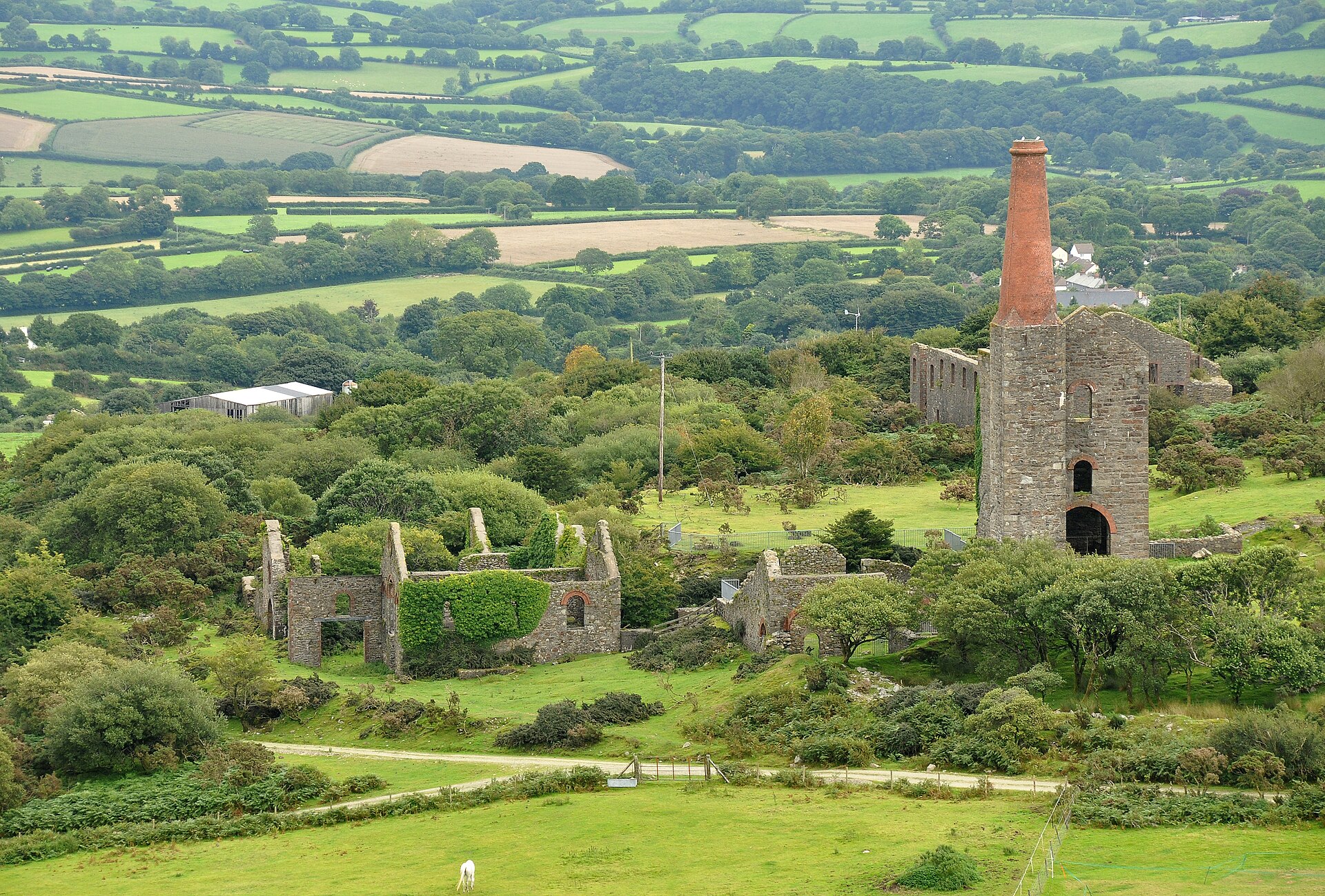
Most of the dumps and engine houses were removed at closure, but the Prince of Wales Shaft complex of 1907 survives and is listed Grade II; a 1988 report shows it before it was consolidated and made safe for visitors, and photographs from 2007 to 2010 show the engine house, its square-based chimney and the ruined boiler and stamps buildings. Buddles, leats and reservoirs remain lower down. The mine is a Site of Special Scientific Interest, notified in 1996 over 29.8 hectares owned by the Duchy of Cornwall, for the rare mosses and liverworts that grow on its metal-rich waste, including Cornish path moss, known from only one other site in the world; greater horseshoe bats roost in the old adits in winter.
The Prince of Wales engine house and chimney, boiler house and stamps building of 1907, with buddles, leats and reservoirs and the metal-rich waste ground of the SSSI.
Redevelopment
None: the site is a conserved ruin and a Site of Special Scientific Interest within a Special Area of Conservation.
Nearby mines
- Marke Valley Mine — 0.6 km W
- Caradon Hill Medieval and Post-Medieval Mines — 1.1 km SE
- South Caradon Mine — 1.9 km S
- Gonamena — 2.4 km S
- Kit Hill Mine — 6.3 km E
Straight-line distance, within 15 km. Show on the map.
People
- James Seccombe · proprietor, from 1842 — via the operator record
- William West (1801–1879) · engineer, from 1864 — Consulting engineer who bought a controlling share in 1864 and turned the mine over to tin.
What's uncertain
Points where sources disagree or the record could not be settled; both accounts are kept. All open questions in the archive.
- West Phoenix Mine was included in the sett in 1875, after which the mine was worked as Phoenix United. (disputed) 4,5
- Phoenix took over West Phoenix completely in 1886, working under the name Phoenix United again. (disputed) 2
- Seccombe's shaft was 125 fathoms deep, the Old Sump 216 fathoms, Anne's 112 fathoms and Hamilton's 40 fathoms. (uncertain) 6
Recorded claims
Individual factual claims, each attached to the source(s) that support it below. Where sources disagree, both are kept.
- The mine was first worked in 1836 as Cornwall Great United Mines, having previously been worked separately as Clanacombe, Stowes and Wheal Prosper. 1,2,3
- James Seccombe bought the mine in 1842 and renamed it Phoenix Mine or Wheal Phoenix in 1844. 1,4
- A rich copper lode was struck in 1852, and for ten years Phoenix rivalled South Caradon as one of Cornwall's greatest copper mines. 4,5
- In 1864 William West bought a controlling share and equipped the mine for tin; by 1865 it employed 320 men, 60 women and 80 boys, and nearly 600 by 1869. 1,4
- West Phoenix Mine was included in the sett in 1875, after which the mine was worked as Phoenix United. (disputed) 4,5
- Phoenix took over West Phoenix completely in 1886, working under the name Phoenix United again. (disputed) 2
- Phoenix United produced 84,538 tons of copper in 1848-1889 and 15,996 tons of tin in 1853-1898. 4,6
- The Cosmopolitan Proprietary Company began the Prince of Wales Shaft in 1907; it reached 200 fathoms but produced only 95 tons of black tin in seven years, and the mine closed in 1914. 6,2,5,3
- On 10 June 1909 the Prince and Princess of Wales visited, and the Princess named and started the last large Cornish pumping engine designed, built and erected in Cornwall. 6,7
- The main lode carried a copper lode and a tin lode side by side; copper predominated near surface where granite formed the footwall, tin at depth where it formed the hanging wall. 4
- Seccombe's shaft was 125 fathoms deep, the Old Sump 216 fathoms, Anne's 112 fathoms and Hamilton's 40 fathoms. (uncertain) 6
- The mine is a 29.8-hectare SSSI notified in 1996, owned by the Duchy of Cornwall and noted for rare bryophytes including Cornish path moss. 1
Photographs & further reading
NMRS's history of the Phoenix mines, with output figures and photographs of the engine houses.
View sourceA history of the mine with a list of its pumping, winding and stamps engines.
View sourceSources
- (secondary) Phoenix United Mine — Wikipedia
- (secondary) Phoenix United — Explore Cornwall
- (observational) Phoenix United Mine, Minions, Bodmin Moor Cornwall - 1988 — Derelict Places
- (secondary) Wheal Phoenix — Northern Mine Research Society
- (secondary) Phoenix United — Buddlepit Mine Database
- (secondary) South Phoenix Mine, Caradon — Cornwall Calling
- (observational) Phoenix United Mine (photographs 2007-2009) — PhotoFile Cornwall
- (primary) BGS mine plans: Phoenix United, Hamilton's, Seccomb's, Stowe's, West's — British Geological Survey
Record created: 18 September 2026 · Last researched: 18 September 2026