 MineArchive
Stowe's Mine
| Also known as | Stowes Mine, Stowe's Section |
|---|---|
| Location | Stowe's Hill, north of Minions, Bodmin Moor, Cornwall — 50.5233, -4.4548 (approximate) |
| Commodity | Tin |
| Type | Metal |
| Worked | Before 1730–1914 |
| Maximum depth | 112 fathoms (205 m), at Anna's shaft |
| Operators | Cornwall Great United Mining Association (1836–?) — worked Stowe's as Wheal Julia, with Greenhills, Wheal Prosper and Wheal Jenkin |
Overview
A tin mine on Stowe's Hill above Minions, worked from before 1730 in a string of short-lived ventures and last as a section of Phoenix United, which gave it up for good in 1914.
History
The first records of mining here are at "Stowe's Ende", where the old men followed a lode up the hill. The mine is old: it had the only Newcomen engine in east Cornwall, erected in 1730. In 1824 it was combined with Wheal Jenkin and an engine installed, but the venture ran at a loss and stopped after a year. In 1836 it was taken into Cornwall Great United Mines under the name Wheal Julia, with Greenhills, Wheal Prosper and Wheal Jenkin, to be worked as one tin mine; it too ran into debt and closed.
From 1842 Stowe's was worked as part of Wheal Phoenix, but this section made no profit and was abandoned two years later while the rest of the sett carried on. Little happened until 1870, when Phoenix United took it up, and for once it paid, though pumping the whole sett soon grew expensive. A fire in the miners' dry in 1888 added to the cost, and by the 1890s the section had closed. Abandonment plans of 1881 and March 1898 cover it with the Phoenix workings.
Phoenix United retried the whole sett between 1907 and 1914, putting a horizontal 120 horsepower compressor engine and concrete whim mountings at Stowe's shaft, with most of the pumping to be done from the new Prince of Wales shaft. As sampling went on it became clear that the old men had stripped the ore far more thoroughly than anyone had thought, and the mine closed for the last time.
Geology
A tin lode running up Stowe's Hill, first followed from surface by the old men.
Workings
Shafts named Stowe's (80 fathoms), Old Stowe's, Jope's (also called Moon's or New Engine), Anna's (112 fathoms), Redburrow, Hard, Harriet's, Mary's and Tom's. Engines: a Newcomen engine of 1730, a 22- or 25-inch rotative engine, an engine house of 1824, a stamps engine of 1836, and in the last working a horizontal 120 horsepower compressor engine and whim mountings. A tramway linked the section to Phoenix United.
Closure
Sampling during the 1907-1914 reworking found that the old men had already taken most of the ore, and the section closed for good.
What remains
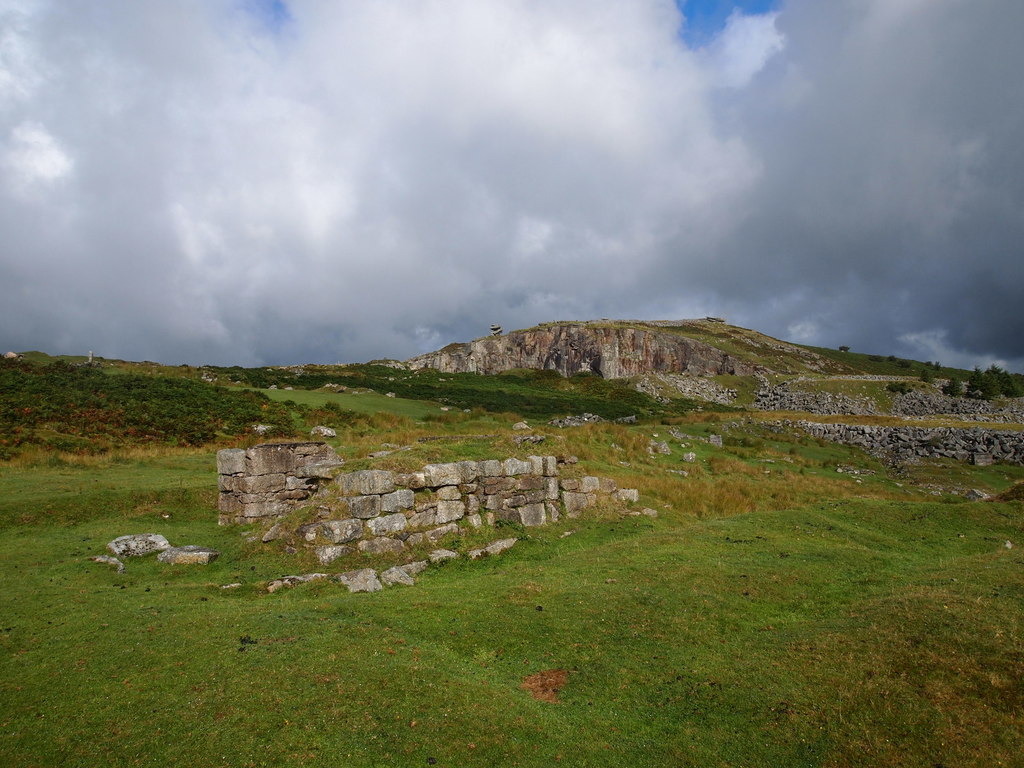
Little remains beyond large craters and the concrete machinery bases of the last working.
Large craters over the old workings, concrete bases for the whim and compressor engine, the remaining walls of some buildings and the outline of the tramway from Phoenix United.
Related mines
- Phoenix United Mine — Stowe's was taken into Phoenix United in 1870 and worked as its Stowe's section until 1914; the two share the 1898 abandonment plan.
- Wheal Jenkin — Stowe's and Wheal Jenkin were worked together under one engine in 1824 and again as part of Cornwall Great United Mines in 1836.
Nearby mines
- Marke Valley Mine — 0.1 miles (0.2 km) N
- Cheesewring Quarry — 0.2 miles (0.4 km) NW
- Phoenix United Mine — 0.4 miles (0.7 km) NE
- West Sharp Tor Mine — 0.6 miles (1.0 km) N
- Wheal Jenkin — 0.6 miles (1.0 km) SE
Straight-line distance, within 9 miles (15 km). Show on the map.
Recorded claims
Individual factual claims, each attached to the source(s) that support it below. Where sources disagree, both are kept.
- Stowe's had the only Newcomen engine in east Cornwall, erected in 1730. 1
- In 1836 it became part of Cornwall Great United Mines as Wheal Julia, with Greenhills, Wheal Prosper and Wheal Jenkin. 2,1
- Stowe's was worked with the Phoenix mines; its workings appear on the Phoenix abandonment plans of 1881 and 1898. 3,1,4
- Anna's shaft reached 112 fathoms and Stowe's shaft 80 fathoms. 1
- Phoenix United reworked the sett from 1907 to 1914 and installed a 120 horsepower compressor engine at Stowe's shaft. 1
Photographs & further reading
The mine's history from the old men to the 1907-1914 reworking, with its shafts, engines and surviving remains.
View sourceSources
- (secondary) Stowe's Mine — Explore Cornwall
- (observational) Phoenix United Mine, Minions, Bodmin Moor Cornwall - 1988 — Derelict Places
- (primary) BGS mine plans: Phoenix United, Hamilton's, Seccomb's, Stowe's, West's — British Geological Survey
- (primary) Mine plan: Phoenix, Stowe's, Wheal Prosper (tin and copper ores, abandoned 1881) — British Geological Survey (Mining Remediation Authority mine plans catalogue)
Record created: 2 November 2026 · Last researched: 2 November 2026