 MineArchive
Marke Valley Mine
| Location | Linkinhorne, north side of Caradon Hill, Cornwall — 50.5250, -4.4550 (approximate) |
|---|---|
| Commodities | Copper, Tin |
| Type | Metal |
| Worked | 1828–1890 |
| Maximum depth | Salisbury Shaft reached 148 fathoms (about 271m) |
| Operators | Marke Valley Consols Mines Ltd (1881–1890) |
Overview
A substantial copper and tin mine on the north side of Caradon Hill, worked from 1828 to 1890 and — once its own branch of the Liskeard and Caradon Railway finally reached it in 1877 — the second-largest copper producer in the whole Caradon district behind only its famous neighbour South Caradon.
History
The first attempt to work Marke Valley, on the north side of Caradon Hill in the parish of Linkinhorne, came in 1828 with a 52ft waterwheel erected to pump the Old Engine shaft — an arrangement that proved unsuccessful. A proper company, the Marke Valley Tin and Copper Mine, was formed in 1837 to develop the sett on the customary Cornish cost-book system, with 9,000 shares and a 21-year lease at a royalty of one-eighteenth. Steam replaced waterpower from 1843, when a 36-inch pumping engine and a whim (winding engine) taken from the nearby Danescombe Mine were installed, and the mine deepened steadily through the 1840s and 50s. Its most substantial engine arrived in 1855-56: a 70-inch pumping engine built at William West's St Blazey foundry, erected on Salisbury Shaft, followed in 1859 by a 33-inch engine doing double duty for winding, stamping and crushing.
For decades the mine's output was hampered by poor transport links — ore had to be carted some distance to reach the Liskeard and Caradon Railway, which had served the district's other mines since 1844 — and it was not until 1877 that a dedicated branch was finally built round the Marke Valley side of Caradon Hill, connecting the mine directly to the railway network and the port at Looe. Output had been modest in the mine's early decades but improved substantially thereafter, making Marke Valley the second-best copper producer in the entire Caradon mining district, behind only South Caradon itself. By 1883, however, the original Marke Valley workings were exhausted and abandoned, with operations shifting west into the neighbouring Wheal Jenkin ground, which was amalgamated with the adjoining West Rosedown Mine at the same time. Reconstituted in 1881 as Marke Valley Consols Mines Ltd under secretary John Harding, manager James Seccombe and chief agent James Stenlake, the combined concern worked on until 1890, when the mine finally closed and its equipment was sold off; across its working life from 1844 to 1890 it had raised some 393 tons of black tin and around 128,500 tons of copper ore averaging about 5.5% metal content.
Geology
Marke Valley worked three principal lodes — Old Sarum, Marke's and Rosedown among the main ones named, alongside Fisher's, Sara Maria and Cottage — running broadly east-west through killas (metamorphosed slate) close to its contact with the Bodmin Moor granite, cut across by north-south quartz cross-courses, the same structural setting that made the wider Caradon district one of Cornwall's richest copper-mining areas in the mid-19th century.
Workings
A deep shaft mine developed through five principal shafts — Salisbury (148 fathoms), Old Engine (112 fathoms), Fawcett (100 fathoms), New (20 fathoms) and Child's (10 fathoms) — pumped and wound in its later years by a 70-inch Cornish engine on Salisbury Shaft and a 33-inch combined winding, stamping and crushing engine, with ore hauled out from 1877 by a dedicated branch of the Liskeard and Caradon Railway.
Closure
The original Marke Valley workings were abandoned in 1883 as operations shifted west into the neighbouring Wheal Jenkin and West Rosedown ground; the combined mine, reconstituted as Marke Valley Consols Mines Ltd in 1881, finally closed in 1890 with no subsequent attempt made to rework the lodes.
What remains
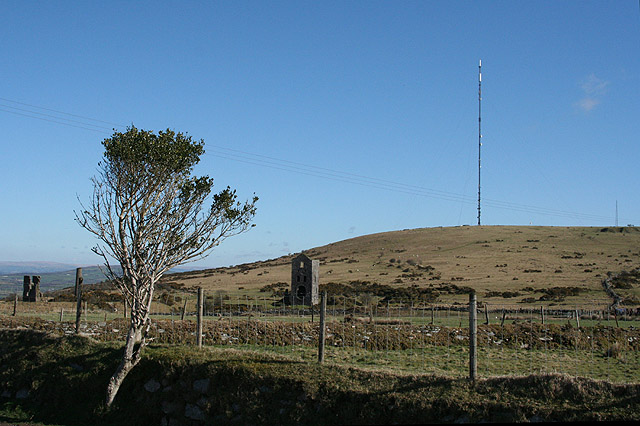
The Salisbury Shaft's pumping and winding engine houses, their boiler-house chimneys and the freestanding chimney between them are Grade II listed. Surviving structures include the Salisbury engine house and chimney, the tall separate stack that served the 70-inch engine, and the chimney and boiler-house footprint of the 33-inch engine — though structural remains are deteriorating. Open, unfenced shafts and unstable engine houses survive across the site, which lies on access land.
Ruined engine houses and chimneys at Salisbury Shaft, open shaft mounds and spoil survive across the site on the north side of Caradon Hill; the site is accessible under right-to-roam access land.
Related mines
- Cheesewring Quarry — The 1877 railway around the Marke Valley side of Caradon Hill joined the quarry to the line already serving these workings.
- Danescombe Mine — Danescombe's steam whim was sold to Marke Valley at Linkinhorne when the Danescombe company was wound up in 1842; Danescombe is named on the Marke Valley record.
Nearby mines
- Cheesewring Quarry — 0.2 miles (0.3 km) W
- Phoenix United Mine — 0.4 miles (0.6 km) E
- Caradon Hill Medieval and Post-Medieval Mines — 0.9 miles (1.4 km) SE
- Gonamena — 1.4 miles (2.3 km) S
- South Caradon Mine — 1.6 miles (2.6 km) S
Straight-line distance, within 9 miles (15 km). Show on the map.
Shafts on the site are open and unfenced and the engine houses are structurally unstable — this entry describes history and general location only, not an access guide.
Recorded claims
Individual factual claims, each attached to the source(s) that support it below. Where sources disagree, both are kept.
- An unsuccessful 1828 waterwheel-pumped attempt was followed by the Marke Valley Tin and Copper Mine company's formation in 1837; steam replaced waterpower from 1843, and a 70-inch Cornish pumping engine by William West of St Blazey was erected on Salisbury Shaft in 1855-56. 1
- A dedicated branch of the Liskeard and Caradon Railway reached Marke Valley in 1877; output subsequently made it the second-best copper producer in the Caradon district, behind only South Caradon. 2
- The mine was developed through five shafts, the deepest, Salisbury, reaching 148 fathoms, working principal lodes named Old Sarum, Marke's and Rosedown among others. 1
- The original Marke Valley workings were abandoned in 1883 in favour of the neighbouring Wheal Jenkin and West Rosedown ground; reconstituted as Marke Valley Consols Mines Ltd in 1881 under secretary John Harding, manager James Seccombe and chief agent James Stenlake, the mine closed in 1890 having produced 393 tons of black tin and around 128,500 tons of copper ore (about 5.5% metal content) since 1844. 2,1
Sources
- (secondary) Marke Valley Mine — Explore Cornwall
- (secondary) Marke Valley Mine, Cornwall — Cornwall Calling
Record created: 26 August 2026 · Last researched: 26 August 2026