 MineArchive
Gale and Gaveller
| Also known as | Gale (the plot of mineral rights itself), Gaveller, Deputy Gaveller, Galee (the holder of a gale) |
|---|---|
| Dialect | Forest of Dean |
| Category | Law & Custom |
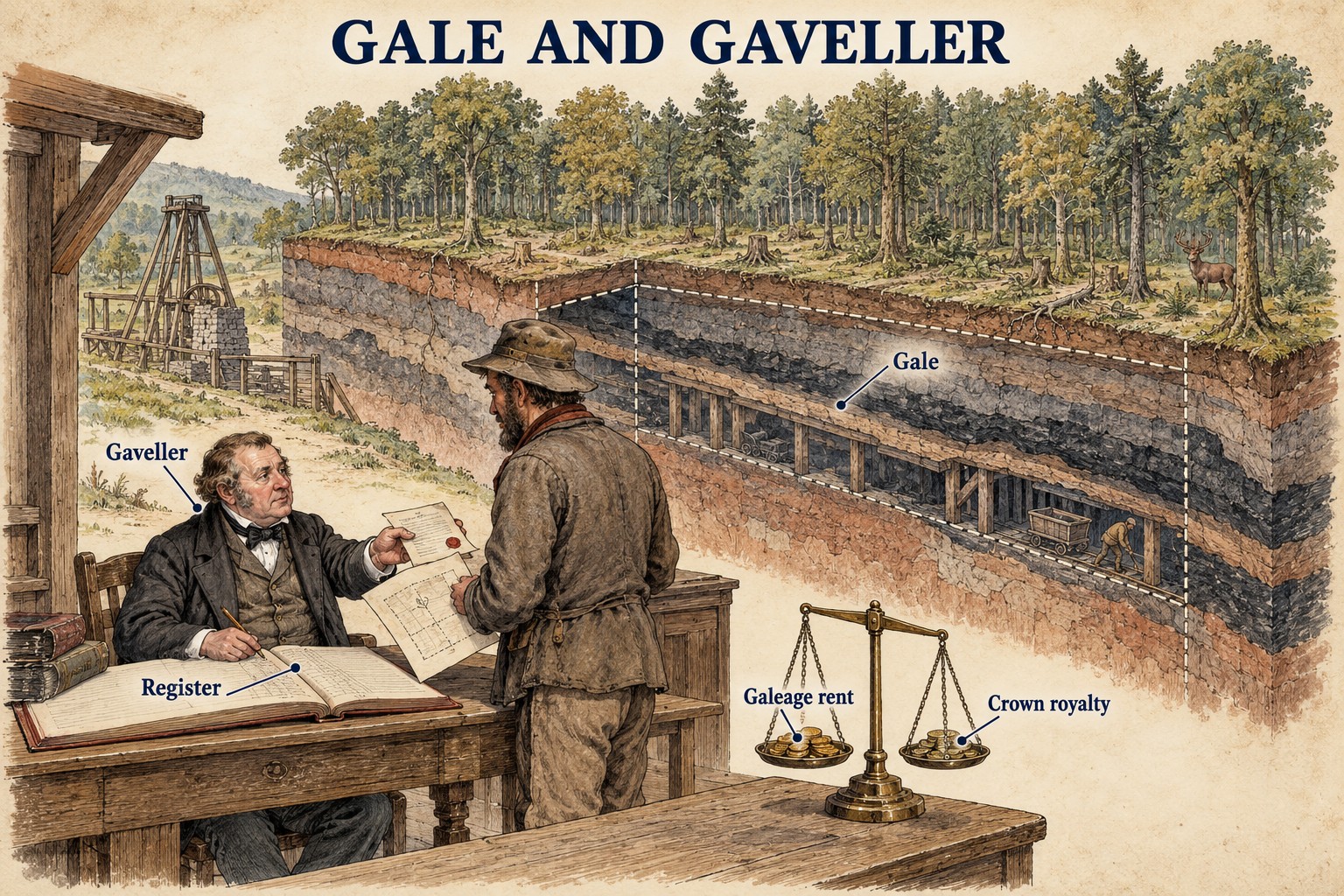
The Forest of Dean's own system of mineral tenure. A gale is a defined plot of underground mineral rights granted to a free miner; the Gaveller is the Crown officer who grants it, registers who may hold one, and collects the royalties.
Historical usage
The custom is medieval and the machinery is Victorian: the Dean Forest (Mines) Act 1838 put the whole arrangement on a statutory footing, defining a free miner as a man of 21 or over who had worked a year and a day in a coal or iron mine within the Hundred of St Briavels, and requiring the Gaveller to keep a register of them. It runs to this day — the Deputy Gaveller still keeps the register and still collects royalties on worked gales. The archive's own Forest records show it in operation: Hopewell's gale was first granted around 1824 to the freeminer George Powell, Cannop Colliery was built on deep gales bought from another company, and the Doward workings are known partly from maps held by the Deputy Gaveller.
How it worked
A registered free miner applied to the Gaveller for a gale, and what he received was a defined underground area with a licence to work coal, iron ore, stone or other minerals in it, in return for a galeage rent and a royalty to the Crown. The 1838 Act set limits: no miner could hold more than three working gales at once, gales could be transferred by deed or will, and rents and royalties were reviewable every twenty-one years, by arbitration if the parties disagreed. Failure to work a gale according to the rules risked forfeiture. The Gaveller's functions passed to the Forestry Commissioners in 1924.
Why it was used
It is the survival of a bargain rather than a design: the Crown owned the Forest, the miners had an ancient customary right to work it, and the gale system is the form that compromise took once someone tried to write it down. Nothing like it exists anywhere else in Britain.
Risks & limitations
A gale is only as useful as the qualification behind it, and the qualification is the problem: it depends on there being a working mine in the Hundred for a would-be free miner to serve his year and a day in. As Dean's deep mining has declined, the right has become progressively harder to acquire, which is why the free miners' position has been raised in Parliament more than once.
Regional variation
Wholly particular to the Forest of Dean and the Hundred of St Briavels. The Derbyshire lead field had its own equally distinctive system — the Barmote Court, meers and the lot and cope — but the two are separate customs, not variants of one.
Related terminology
Abandonment Plan, Barmote Court, Coal, Free Miner, Iron, Liberty, Meer, Mineral Royalty, Sett (Mining Lease)
Mines associated with this term
5 examples chosen from 23 linked records — the term page is not an index.
- Eastern United Colliery — Forest of Dean (well documented example)
Named 5 times in this record, first in the summary: “…into the hillside by two sloping 'dipples' rather than a shaft. Its gale was one of the seven created by the Dean Forest (Mines) Act of 1904…” - Addis Hill Colliery — Gloucestershire (well documented example)
Named 13 times in this record, first in the summary: “A Forest of Dean gale on the eastern side of the coalfield near Cinderford, confirmed to…” - All Profit Colliery — Gloucestershire (well documented example)
Named 11 times in this record, first in the summary: “A small Forest of Dean gale on Nofold Green near Cinderford, granted to Thomas Brain of…” - Carnon Mine — Cornwall (well documented example)
Named in this record’s history: “…the streambed beneath, employing some 150 workers, until a severe gale combined with an exceptionally high tide breached the dam in 1812…” - Great Carnon Stream Works — Cornwall (well documented example)
Named 3 times in this record, first in the summary: “…grains and occasional nuggets of alluvial gold, before a severe gale and exceptionally high tide breached the dam in 1812 and ended the…”
Disasters associated with this term
Included only where MineArchive's own research gives a reasonable evidential basis, with the nature of the relationship stated — not every disaster where this term might plausibly apply.
- Lower Duffryn Colliery explosion, 1858 (contextual relationship)
Named in this record’s narrative: “…his son William, twelve; the door boys Edwin Strong, ten, and George Gale, fifteen, and Henry Salmon, a collier of ten, were among them. Large…”
Sources
- (primary) Dean Forest (Mines) Act 1838 — legislation.gov.uk
- (secondary) The Deputy Gaveller and his role in Forestry England — Forest of Dean Heritage Open Days
Record created: 25 August 2026 · Last researched: 25 August 2026