 MineArchive
Barmote Court
| Dialect | Derbyshire |
|---|---|
| Category | Law & Custom |
A local court unique to the Derbyshire lead-mining field, established to administer the customary mining law of the district — granting the right to work a vein, settling disputes between miners, and collecting the lead duties owed to the field's mineral lords.
Historical usage
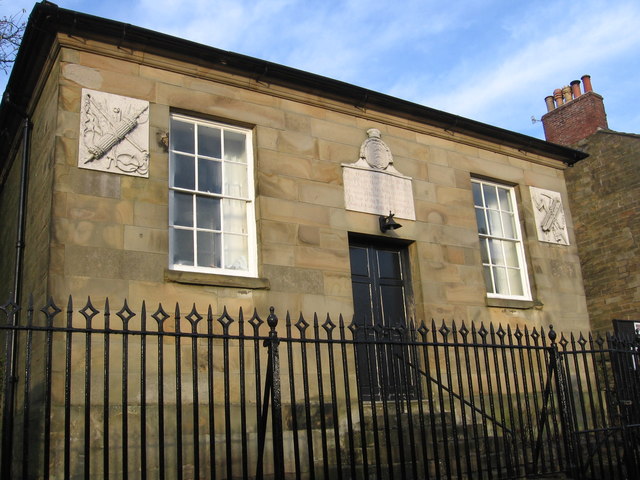
Barmote courts were formally recognised by a royal inquisition held at Ashbourne in 1288, which codified an 'immemorial' custom already giving free miners the right to dig for lead anywhere in the King's Field — the Crown's mineral land — except under churches, gardens, orchards and highways. Seven barmote districts eventually covered the Derbyshire orefield. The system was placed on a modern statutory footing by the High Peak Mining Customs and Mineral Courts Act 1851 and the Derbyshire Mining Customs and Mineral Courts Act 1852, which fixed the customs the courts would enforce and swept away other claimed local variations. Most barmote jurisdictions lapsed as Derbyshire lead mining collapsed through the 19th and 20th centuries; the Great Barmote Court for the Wapentake of Wirksworth is the sole survivor, still meeting today and generally reckoned the oldest industrial court still sitting in England.
How it worked
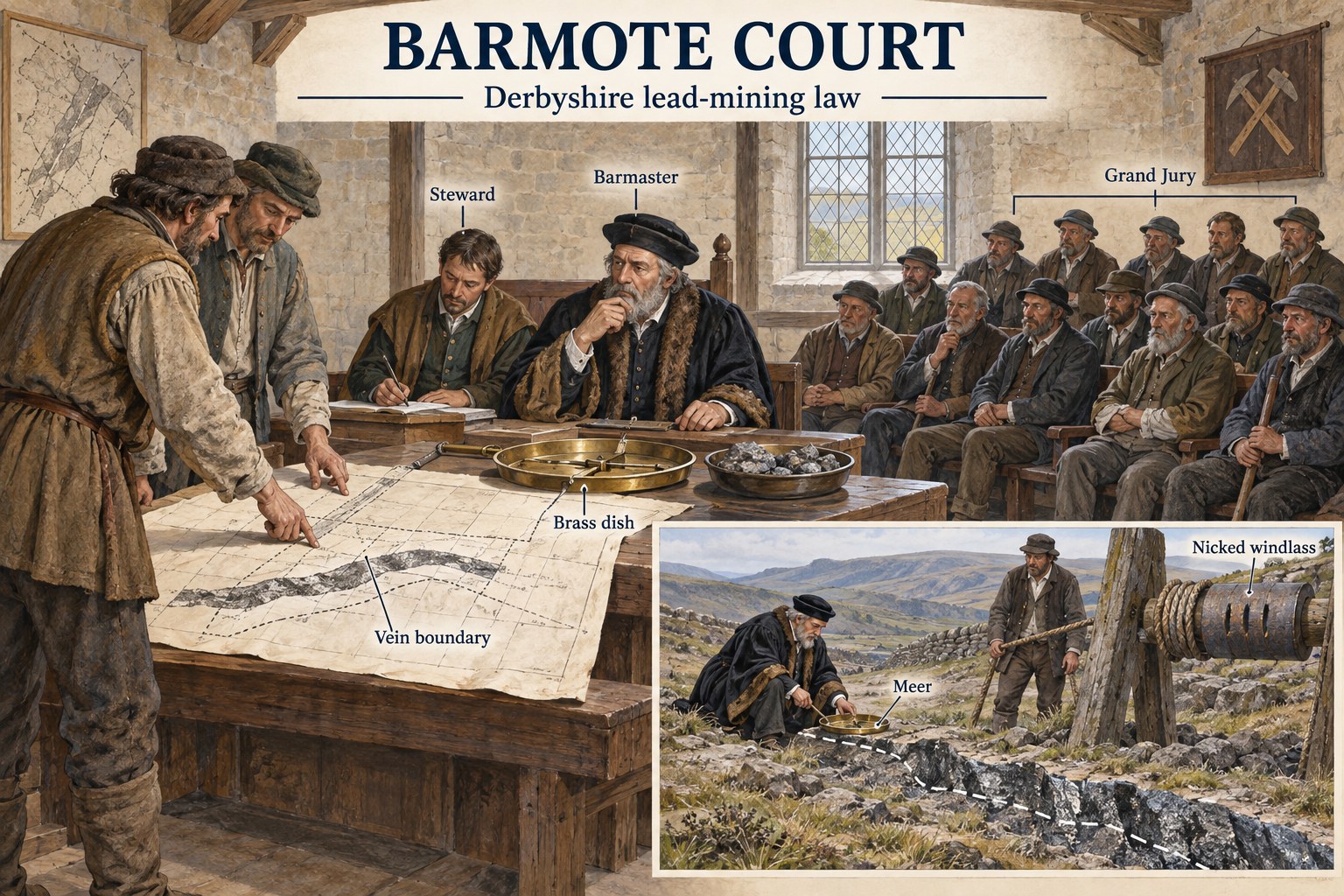
The court was run by a Barmaster, appointed on behalf of the mineral lord (historically the Duchy of Lancaster in the Wirksworth field), assisted by a Steward and a Grand Jury of twelve local men. A prospector who found a workable vein could claim a 'meer' — a fixed length of that vein, measured out by the Barmaster with the field's official brass standard dish (the Wirksworth dish dates to 1513) — by paying a token due, traditionally a dish of ore, to the mineral lord. The Barmaster also policed working mines: an idle mine's windlass could be 'nicked' (notched) as a warning, and after three such notices without work resuming, the meer could be forfeited and reassigned to a new claimant. The court's jury heard and settled disputes over vein boundaries and rival claims, including — before it lapsed — many of the boundary fights that were otherwise settled by miners themselves, sometimes violently.
Why it was used
Ordinary land law gave a Derbyshire landowner no automatic right to the lead beneath their own soil: by ancient custom the King's Field was open to any free miner willing to work it, so a separate, specialist court and code were needed to allocate claims, resolve overlapping rights and keep the lead duties flowing to the mineral lord — functions no ordinary manorial or county court was equipped to perform.
Risks & limitations
Where no barmote court had jurisdiction, or where a claim's boundaries were genuinely contested and the process was slow, disputes could still spill over into direct conflict between rival groups of miners working the same vein — see Magpie Mine, below, for a case that ended in three deaths and a manslaughter trial.
Regional variation
Barmote courts were specific to the Derbyshire lead field's own customary law and had no direct equivalent in Cornish tin and copper mining, where mineral rights instead belonged to the landowner and mines were financed and managed under the very different cost book system. The nearest Cornish parallel — the Stannary Courts, administering the ancient tin trade's own separate law and privileges — arose from a comparably old royal charter but operated on quite different principles suited to a landowner-rights system rather than a free-mining one.
Related terminology
Barmaster, Free Miner, Gale and Gaveller, Medieval, Mineral Royalty, Stannary
Mines associated with this term
5 examples chosen from 8 linked records — the term page is not an index.
- Eldon Hill Crushing Circle — Derbyshire (well documented example)
Named in this record’s history: “…like all Derbyshire lead mining, under the jurisdiction of the Barmote Courts. The circle, about 7 metres in diameter with the remnant of its edge…” - Gautries Rake — Derbyshire (well documented example)
Named in this record’s history: “…already being worked in the 17th century: a dispute heard in the Barmote Court in 1671 concerned a mine 'on the Sun side of Cawthridge', presumably…” - Moss Rake — Derbyshire (well documented example)
Named in this record’s history: “Moss Rake is documented in Barmote Court records from as early as 1617, when a dispute over the vein was…” - New Rake Lead Mines — Derbyshire (well documented example)
Named in this record’s history: “…As with the district's other rakes, mining here was governed by the Barmote Courts, with individual miners or small companies working relatively short…” - Oxlow Rake Lead Mines — Derbyshire (well documented example)
Named in this record’s history: “…as across the Derbyshire orefield, under the jurisdiction of the Barmote Courts, with individual groups of miners or small companies each working…”
Disasters associated with this term
Included only where MineArchive's own research gives a reasonable evidential basis, with the nature of the relationship stated — not every disaster where this term might plausibly apply.
- Magpie Mine suffocation of three Maypitt miners (contextual relationship)
The fatal 1833 dispute arose from unresolved rival claims to the Great Redsoil vein — the class of dispute barmote courts were set up to adjudicate.
Sources
- (primary) Barmote Courts — Duchy of Lancaster
- (secondary) Barmote Court — Peak District Online
- (secondary) Barmote court — Wikipedia
- (secondary) Moot Hall, Wirksworth — Wikipedia
- (secondary) The Great Barmote Court - Wirksworth's lead mining heritage — Great British Life
Record created: 21 August 2026 · Last researched: 21 August 2026