 MineArchive
Moss Rake
| Location | Bradwell Moor, Derbyshire — 53.3336, -1.7539 (approximate) |
|---|---|
| Commodities | Lead, Calcite |
| Type | Metal |
| Worked | At least 1617–Early 1970s |
| Operators | Moss Rake Mining and Lead Smelting Company (?–1895), Jack and Stan Eidson (?–1972) |
Overview
A two-and-a-half-mile lead vein on Bradwell Moor in the Peak District, worked for lead from at least the 17th century and later, after lead working ended, quarried for calcite by the Eidson family until the early 1970s.
History
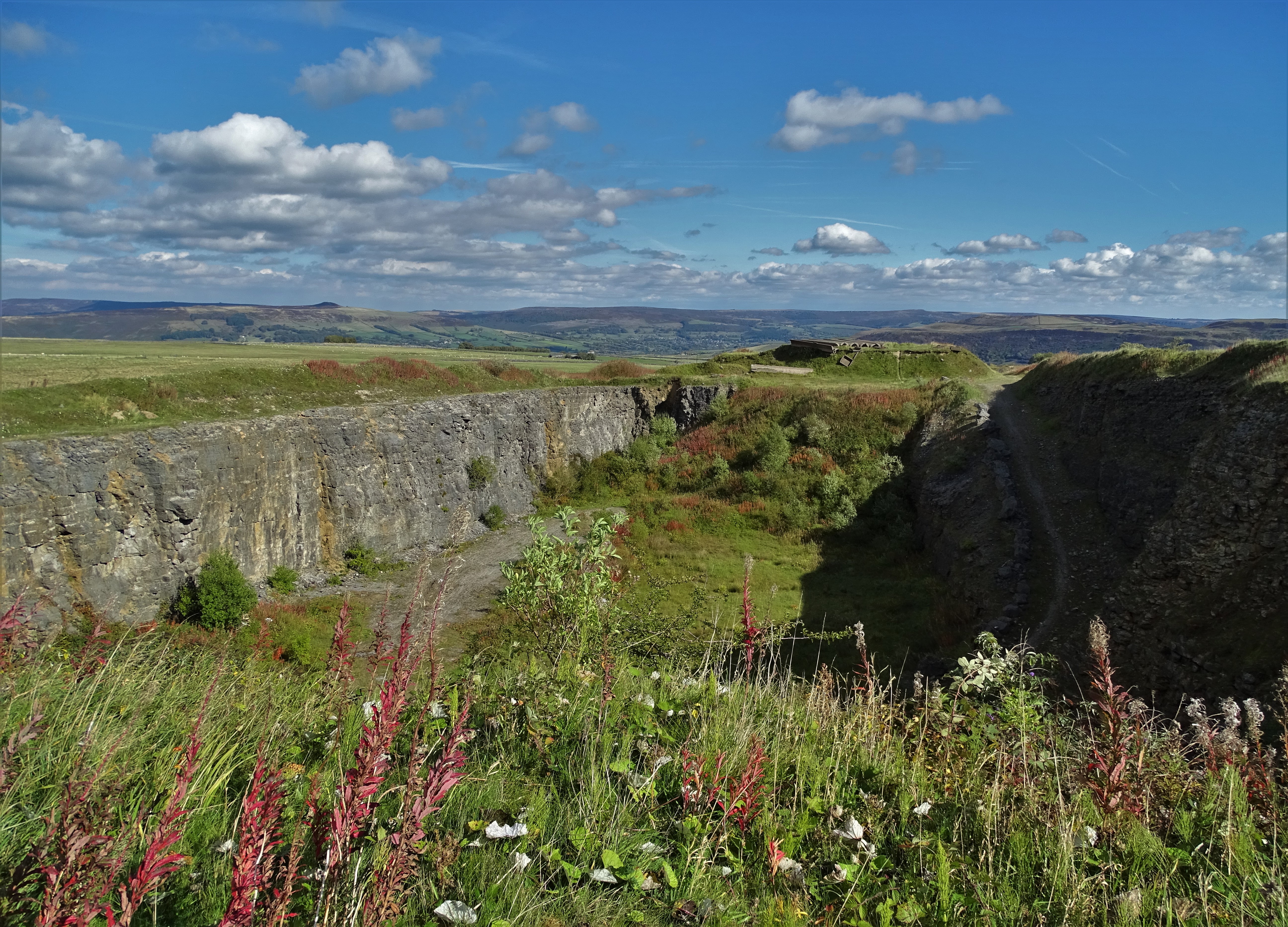
Moss Rake is documented in Barmote Court records from as early as 1617, when a dispute over the vein was referred to arbitration, and mining continued intermittently for lead through the 17th and 18th centuries -- Botham Grove at Outland Head was at work by 1673, and in 1694 a ventilation fan was installed at nearby Moorfurlong Mine, the earliest documented use of mine ventilation recorded anywhere in the Derbyshire orefield. In the latter part of the 19th century, the Moss Rake Mining and Lead Smelting Company -- also known as the Bradwell Co-operative Mining Company -- drove a long level (the Co-op Level) westward along the vein and installed a steam winding and pumping engine at a shaft at Outland Head, intending to work the vein at greater depth; the venture failed by the start of 1895, with a reported loss of £6,000 to its investors. After lead working ceased, the rake was later quarried for calcite by brothers Jack and Stan Eidson; Stan, who lived on site in a large Nissen hut, was injured in a stone fall around 1968 and sold his share to Jack, and the site closed following Jack's death in the early 1970s.
Geology
Moss Rake is a major lead-bearing vein running east-northeast across Bradwell Moor for around two and a half miles, terminating on its western range where it meets the Peak Forest dolerite sill near Stonebrack cottage.
Workings
Worked by numerous small, separately-named mines strung along the vein's length -- including Botham Grove, Hartle Dale Old Rake workings and Moss Rake Head Mine (later Hugh Grove) -- rather than as a single continuous operation, typical of Peak District rake mining; a 19th-century attempt to unify deeper working under the Co-op Level ultimately failed.
Closure
Lead working had ended by the mid-19th century, after which the site passed to calcite quarrying; that phase ended in the early 1970s after the deaths/departure of its last operators, the Eidson brothers.
What remains
A 2026 visit found almost all trace of the site's associated buildings gone, with only a single structure surviving on Cement Lane, possibly a former substation or explosives store; the quarry workings themselves remain visible and are now used by rock climbers.
Related mines
- Hill's Venture Lead Mine — Hill's Venture lies at the western end of the same four-mile Moss Rake vein, where it terminates against the Peak Forest Sill dolerite intrusion.
Nearby mines
- Pin Dale Lead Side Veins — 0.5 miles (0.8 km) NW
- Dirtlow Rake Mine — 1.0 miles (1.5 km) NW
- New Venture Lead Mine — 0.9 miles (1.5 km) N
- Silence Mine — 1.1 miles (1.8 km) E
- Hollandtwine Mine — 1.6 miles (2.5 km) W
Straight-line distance, within 9 miles (15 km). Show on the map.
Recorded claims
Individual factual claims, each attached to the source(s) that support it below. Where sources disagree, both are kept.
- Moss Rake is documented in Barmote Court records from 1617; a ventilation fan installed in 1694 at nearby Moorfurlong Mine is the earliest documented use of mine ventilation recorded anywhere in the Derbyshire orefield. 1
- The Moss Rake Mining and Lead Smelting Company (Bradwell Co-operative Mining Company) drove the Co-op Level westward and installed a steam winding/pumping engine at Outland Head, but the venture had failed by early 1895 with a reported £6,000 loss to investors. 1
- Brothers Jack and Stan Eidson quarried Moss Rake for calcite; Stan sold his share to Jack after a stone-fall injury around 1968, and the site closed following Jack's death in the early 1970s. 2
Photographs & further reading
Sources
- (primary) A History and Gazetteer of the Lead Mines within Bradwell Liberty (Bulletin 17-5) — Peak District Mines Historical Society / J.H. Rieuwerts
- (observational) Moss Rake, Bradwell, Derbyshire, March 2026 — Derelict Places
Record created: 29 August 2026 · Last researched: 29 August 2026