 MineArchive
Liberty
| Category | Law & Custom |
|---|
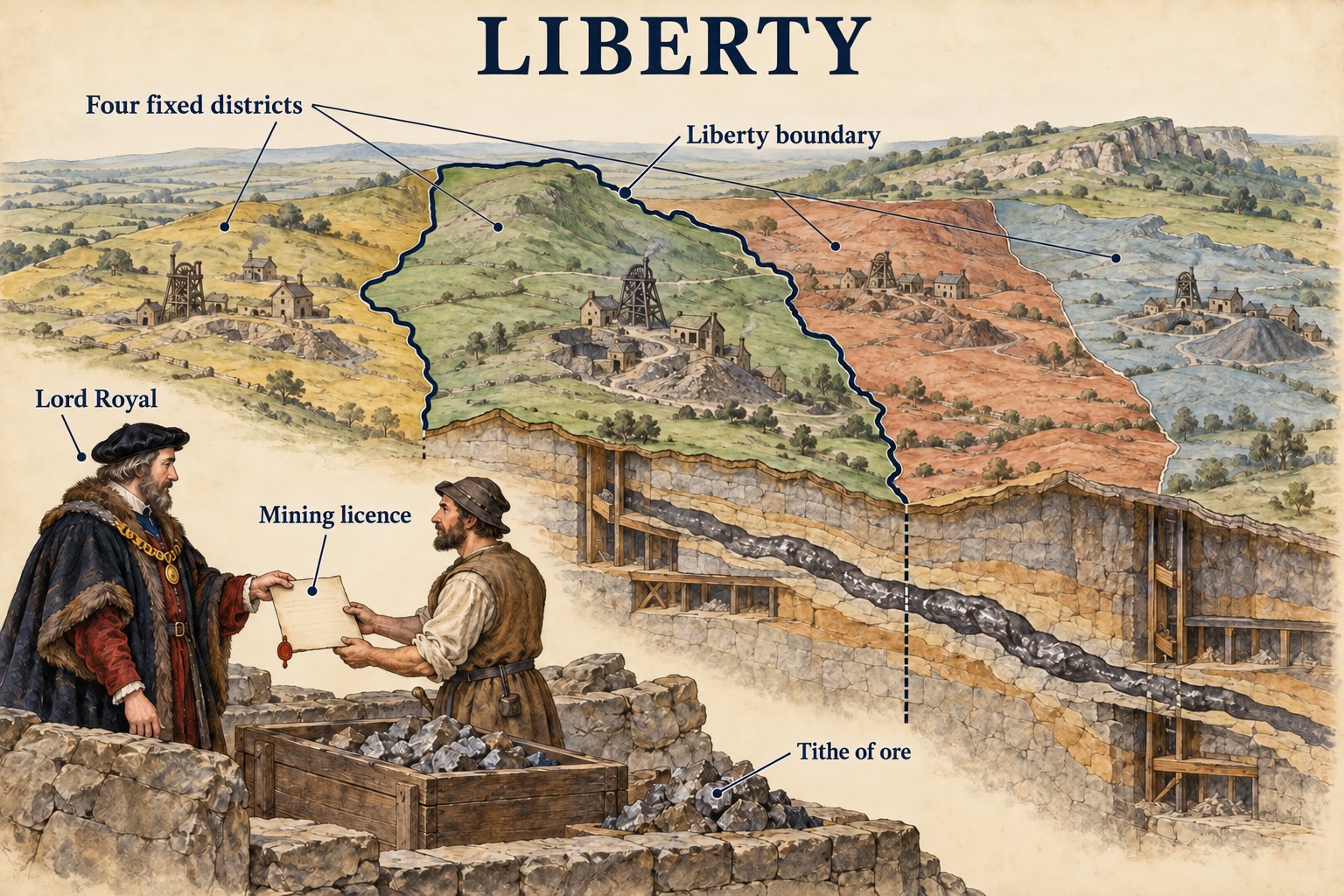
A defined lead-mining district on the Mendip Hills of Somerset, held under the customary mining law and licensing authority of a particular lord — the Mendip equivalent of Cornwall's Stannary or Derbyshire's Barmote Court system, though organised around fixed geographic 'liberties' rather than a single county-wide jurisdiction.
Historical usage
By the end of the medieval period the Mendips were organised into four liberties, or mineries — Wells, Chewton, Harptree and West (Charterhouse) — each under the authority of a Lord Royal who issued licences to mine within their liberty and to whom working miners paid tithes. St Cuthbert's, at Priddy, fell within the West liberty, historically controlled by the Bishop of Bath and Wells, distinct from the neighbouring Chewton liberty held by the Waldegrave family. Edward I granted the Prior at Charterhouse the right to work the mines there in 1283, and the Bishop of Bath's own mining rights were confirmed by royal grant in the 12th century; Witham Priory also held mining rights on the Mendips from the 13th century.
How it worked
Anyone wishing to work lead within a given liberty needed a licence from that liberty's lord, and paid a tithe on the ore raised in return — a system of customary mining law and revenue collection functionally similar to Cornwall's stannary courts or Derbyshire's barmote courts, but built around a small number of named, geographically fixed districts rather than one unified regional jurisdiction.
Why it was used
The liberty system let a small number of landowning authorities control and profit from mining across the Mendips without themselves working every mine directly, licensing independent miners to do the actual digging in exchange for a share of what they raised — much the same basic bargain struck by mineral lords everywhere in medieval and early modern English mining, adapted here to the specific geography of four defined Mendip districts.
Risks & limitations
Because each liberty had its own lord and its own boundary, a vein that happened to run across a liberty boundary could create real disputes over whose licence, and whose tithe, actually applied to it — a structural weakness shared with every fixed-boundary mineral-rights system, including the county-wide but still boundary-dependent stannary and barmote systems elsewhere in Britain.
Related terminology
Mines associated with this term
5 examples chosen from 11 linked records — the term page is not an index.
- Andrews House Colliery — County Durham (well documented example)
Named in this record’s history: “…of Whitehouse near Winlaton granted the Grand Allies partnership liberty to work the coal in those estates, with way-leave for wagonways not…” - Arbourseats Veins and Nay Green Mine — Derbyshire (well documented example)
Named twice in this record, first in the history: “…joins Cressbrook Dale at its eastern end, all lie within Litton Liberty -- though during the 17th century most Litton miners actually worked…” - Chewton Mineries — Somerset (well documented example)
The mine's own recorded summary explicitly describes Chewton as a lead 'liberty' controlled by the Waldegrave family, distinct from the neighbouring St Cuthbert's liberty. - Dovegang Mine — Derbyshire (well documented example)
From 1638 to 1654 the Dovegang formed its own separate mining liberty — 200 acres on Cromford Moor with its own jurisdiction over who could work there. - Elswick Colliery — Tyne and Wear (well documented example)
Named in this record’s history: “…again in 1378; Christopher Mitford held leases in the 1530s, with liberty to take timber from Elswick woods for shoring; and the Anderson…”
Sources
- (primary) Priddy — BGS - Foundations of the Mendips
- (secondary) Lead Mines — Chewton Mendip History
Record created: 22 August 2026 · Last researched: 22 August 2026