 MineArchive
Show Cave
| Category | Later Uses & Research |
|---|
A former mine or natural cave opened to the paying public as a tourist attraction, typically once its mineral had been worked out or ceased to be profitable — one of the most common 'second lives' a British metal mine could go on to have.
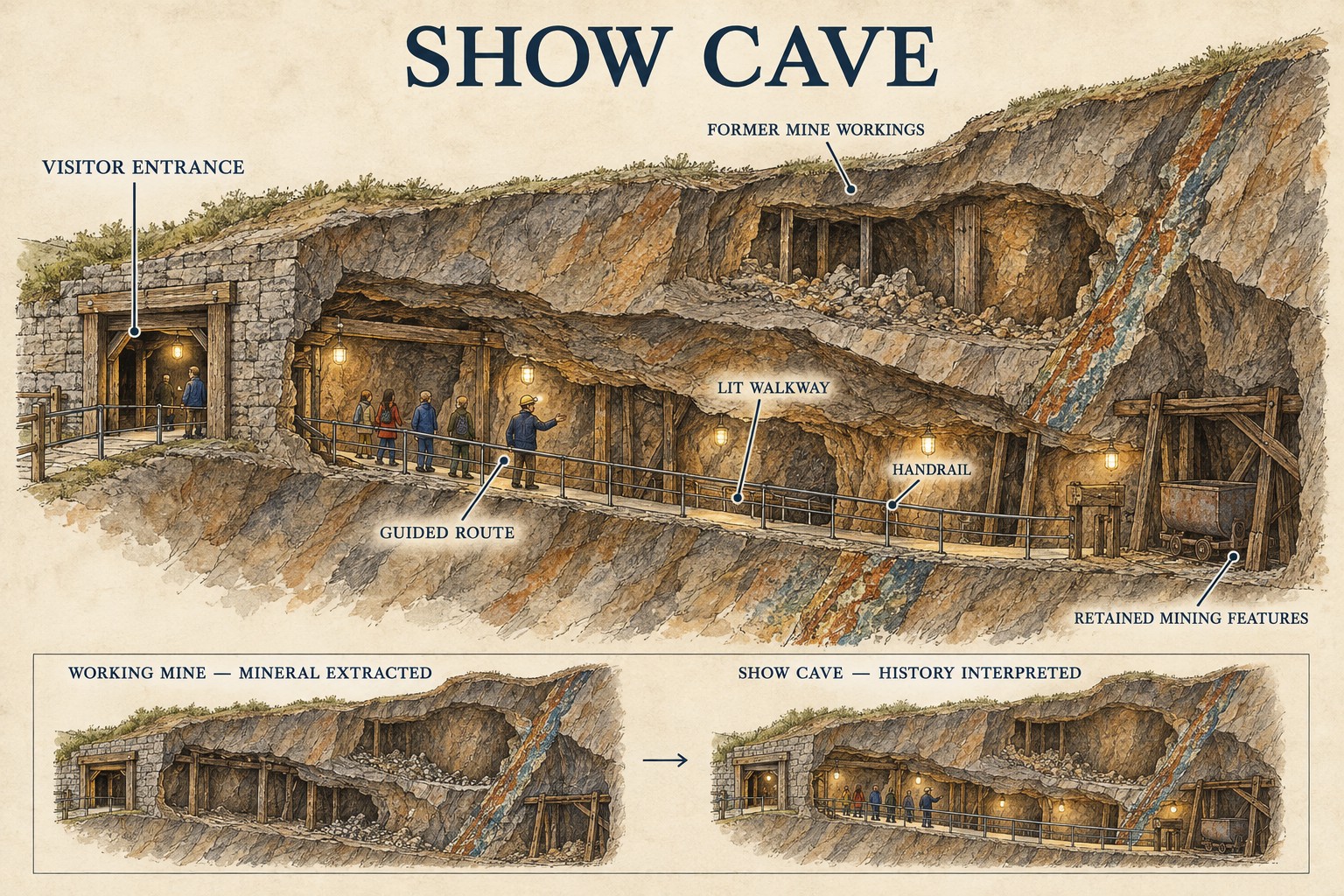
Historical usage
The practice of turning a worked-out mine or cave into a paid visitor attraction is genuinely old in Britain: cave tourism around Matlock Bath in Derbyshire was already well established by 1810, when the Great Rutland Cavern opened to visitors, and several more caverns in the area followed over the next few decades. The Great Masson Cavern, a former lead and fluorspar mine, opened to the public in 1844 and is often credited as Britain's first properly commercial show cave, though it was in truth one of several already operating in the same small area rather than a genuine first. The pattern repeated wherever a mine's mineral ran out but its underground scenery, engineering or historical interest remained: Speedwell Cavern in Derbyshire began taking visitors by boat through its flooded lead-mining adit almost as soon as the mine itself failed in 1790, and Clearwell Caves in the Forest of Dean, worked for iron ore and ochre pigment for millennia, now welcomes visitors through the same passages its miners once dug.
How it worked
A show cave typically retains the underground passages, chambers and, sometimes, machinery of the original mine largely as mining left them, with the addition of safe walkways, lighting, handrails and a guide to lead visitors through and narrate the site's history — occasionally, as at Speedwell, retaining an original working feature such as a flooded adit and boat journey as the visitor experience itself.
Why it was used
Converting a mine to a show cave let its owners recover some value from a site whose mineral wealth had run out, using the underground workings and their genuine mining history as the attraction rather than anything still being extracted; it also gave many otherwise inaccessible or forgotten mines a reason to be maintained, explored and interpreted rather than simply sealed and abandoned.
Risks & limitations
Not every worked-out mine has the scenery, safety profile or accessibility to make a viable show cave, and running one as a visitor attraction brings its own ongoing costs — lighting, path maintenance, staffing and public safety compliance — quite different from, and in some ways more demanding than, running a working mine ever was.
Regional variation
Particularly associated with the limestone districts of Derbyshire's Peak District, where several former lead and fluorspar mines around Castleton and Matlock Bath became show caves from the early 19th century onward, though the pattern recurs wherever a mine's underground workings survive intact enough to be safely opened to the public.
Related terminology
Mines associated with this term
5 examples chosen from 12 linked records — the term page is not an index.
- Braichgoch Slate Mine — Gwynedd (surviving physical example)
Part of the underground workings run as King Arthur's Labyrinth, a boat-ride show cave, with Corris Mine Explorers showing the working levels alongside it. - Blue John Cavern — Derbyshire (well documented example)
The mine's own recorded history explicitly describes it continuing to operate as a show cave and small-scale working mine. - Clearwell Caves — Gloucestershire (well documented example)
The mine's own recorded history explicitly describes the caverns reopening to the public as a show cave in 1968. - Cumberland Mine — Derbyshire (well documented example)
Named 9 times in this record, first in the summary: “Cumberland Mine, on the hillside above Matlock Bath, was opened as a show cave in 1780 and, after a royal visit, became known as the Royal…” - Faucet Rake — Derbyshire (well documented example)
Named in this record’s summary: “…between about 1780 and the mid-19th century, incorporating the show cave Oxlow Cavern among its workings.”
Sources
- (secondary) Great Masson Cavern — Wikipedia
- (secondary) Show cave — Wikipedia
Record created: 23 August 2026 · Last researched: 23 August 2026