 MineArchive
Wheal Jane acid mine water discharge, 1992
An estimated 50,000 m³ of acidic mine water burst from the flooding, abandoned Wheal Jane workings and turned the Carnon River and Fal estuary ochre-yellow — one of the most notorious mine-water pollution incidents in British history, and one still being actively treated more than three decades later.
| Date | 13 January 1992 |
|---|---|
| Mines involved | Wheal Jane, Nangiles Mine (related workings) |
| Region | Cornwall |
| Primary type | Flooding / Inundation |
| Associated types | Collapse / Roof Fall |
| Fatalities | 0 (An environmental incident with no reported human casualties.) |
| Injuries | None reported to people; the discharge killed fish and contaminated wildfowl in the affected watercourses. |
| Context | During closure/abandonment (Underground mining had already ceased in 1991; the discharge happened during the post-closure period as the abandoned, unpumped workings flooded.) |
Cause
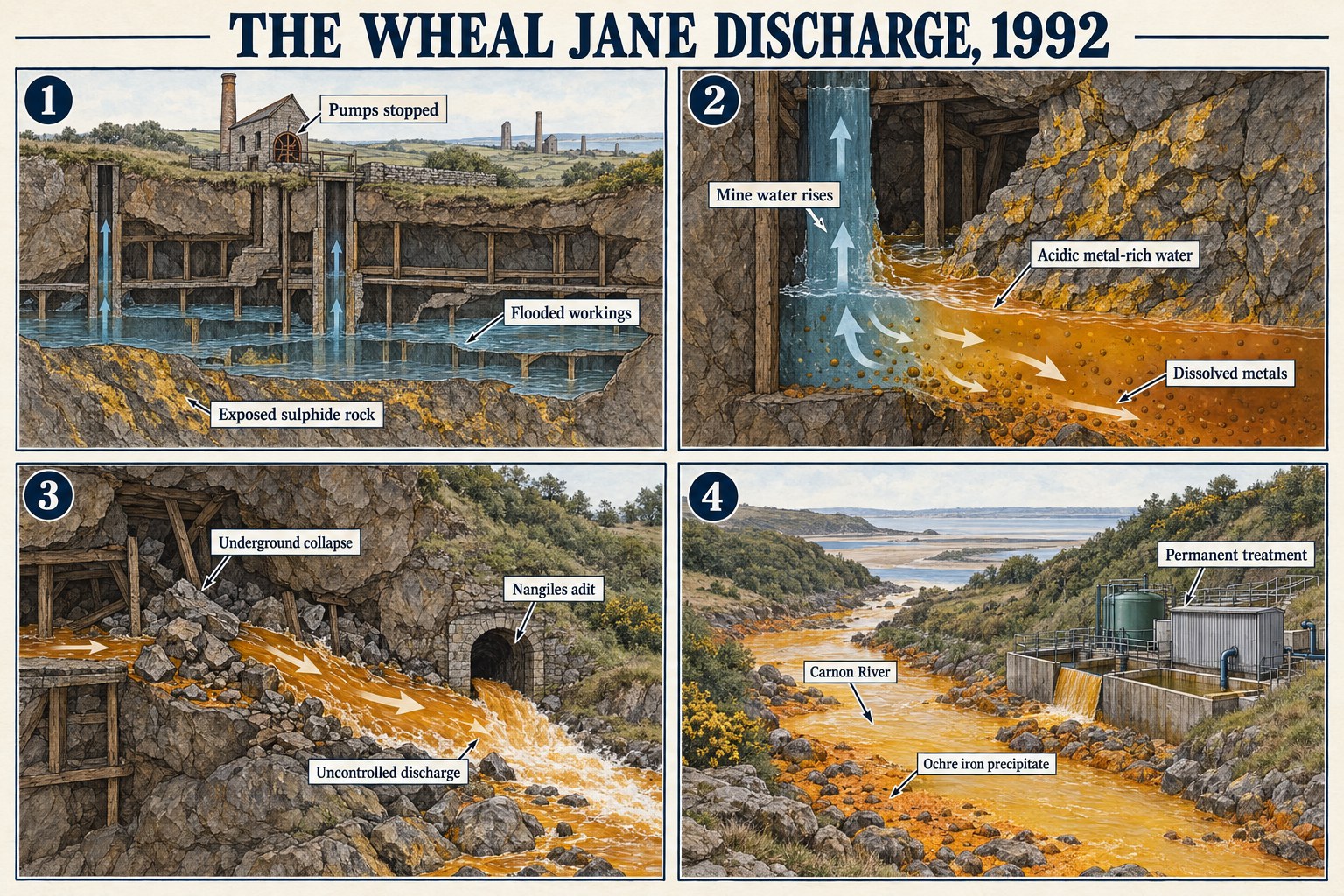
Underground pumping had stopped when the mine closed in 1991, and interim treatment of the rising water was itself suspended on 4 January 1992 for safety reasons. An unexpected underground collapse on 13 January then released the accumulated, untreated acidic water in a single uncontrolled surge.
Contributing factors
Once dewatering stopped, groundwater rose through the abandoned workings, picking up metal-rich waste and oxidising exposed rock faces, turning the impounded water highly acidic (pH 3.1) and rich in dissolved iron, zinc, cadmium and arsenic well before the collapse released it.
What happened
Wheal Jane's underground workings ceased regular pumping when the mine closed in 1991 as tin prices collapsed. Left unpumped, the workings flooded, and the rising water picked up metal-rich waste and oxidised exposed rock, becoming highly acidic and laden with dissolved metals. An interim treatment arrangement was itself suspended on 4 January 1992 for safety reasons; an unexpected underground collapse on 13 January then released roughly 50,000 m³ of this untreated, pH 3.1 acid mine water through the Nangiles adit over about 24 hours. The discharge flowed down the Carnon River, through Restonguet Creek and Carrick Roads, and into the Fal estuary, turning the watercourse a vivid ochre-yellow as suspended iron hydroxide precipitated out — an extremely visible event that drew national and international media attention and is described in more than one source as the largest water-pollution incident of its kind in UK history.
Investigation & inquiry
The National Rivers Authority (NRA), which had already been monitoring the risk of a discharge following the mine's closure, moved in quickly and set up a project to ameliorate the effects on the Carnon River and Fal estuary. The incident, and the wider question of responsibility for pollution from abandoned, privately owned mines, was raised in the House of Lords on 5 February 1992; the government confirmed the scale of metal contamination across the wider tin-mining region as "a very large problem" but declined to hold a public inquiry, saying the underlying issues were "not new". Health authorities tested the estuary's shellfish beds and declared them safe after continuous monitoring.
Legal & regulatory aftermath
Responsibility for funding the response fell mostly to the NRA rather than the mine's then-owner (Carnon Consolidated Company), reflecting the practical limits of the "polluter pays" principle where a mine's current owner has no real connection to, or resources from, its mining history. The Department of the Environment began wider policy work on abandoned-mine pollution as a result.
Changes to practice & legislation
Emergency pumping and treatment measures put in place in 1992 developed progressively into a permanent water-treatment plant, including passive wetland treatment methods; by 2002 the treatment programme had cost more than £20 million, and treatment continues indefinitely, since the flooded workings will never be pumped dry and reworked.
Recorded claims
Individual factual claims, each attached to the source(s) that support it below. Where sources disagree, both are kept.
- On 13 January 1992, an estimated 50,000 m³ of acidic mine water (pH 3.1) escaped through the Nangiles adit over roughly 24 hours, discolouring the Carnon River and flowing into the Fal estuary via Restonguet Creek and Carrick Roads. 1,2
- Interim treatment of the rising, unpumped mine water had been suspended on 4 January 1992 for safety reasons; an unexpected underground collapse on 13 January then released the water in an uncontrolled surge. 3
- The National Rivers Authority took the lead in funding and coordinating the response, and the incident was raised in the House of Lords on 5 February 1992, where the government acknowledged widespread metal contamination across the tin-mining region but declined to hold a public inquiry. 3
- By 2002 the water-treatment programme responding to the 1992 incident had cost more than £20 million; treatment at the site continues on an ongoing basis. 1
Related terminology
Mining terms this disaster is structurally linked to, with the nature of the relationship.
- Arsenic (contextual relationship)
The impounded water had turned acidic enough (pH 3.1) to strip arsenic and other metals out of the abandoned workings long before the collapse released 50,000 m³ of it into the Carnon River. - Care and Maintenance (direct cause)
The discharge followed the cessation of pumping after closure — the failure mode care and maintenance exists to prevent. - Iron (contextual relationship)
Dissolved iron is what gave the discharge its colour and much of its notoriety, picked up as groundwater rose through metal-rich waste and oxidising rock faces once dewatering stopped. - Ochre (contextual relationship)
Ochre here was the pollution, not the product: iron oxide precipitating out of the acid mine water stained the Carnon River and the Fal estuary ochre-yellow, and the site is still treated decades on. - Wheal (contextual relationship)
A Cornish 'Wheal' name attached to one of Britain's most notorious mine-water pollution incidents — the same naming tradition as the county's tin mines, three decades into ongoing treatment. - Zinc (contextual relationship)
Named in this record’s contributing factors: “…impounded water highly acidic (pH 3.1) and rich in dissolved iron, zinc, cadmium and arsenic well before the collapse released it.”
Sources
- (secondary) Wheal Jane — Wikipedia
- (secondary) Soil & Water Contamination: Wheal Jane Incident — UKEssays (summarising published environmental studies)
- (primary) Wheal Jane Tin Mine: Pollution — Hansard, House of Lords
Record created: 20 August 2026 · Last researched: 20 August 2026