 MineArchive
Foxes Bridge Colliery
| Also known as | Fox’s Bridge Colliery, Foxes Bridge Colliery Company Limited |
|---|---|
| Location | Cinderford, Forest of Dean, Gloucestershire — 51.8189, -2.5261 (approximate) |
| Commodity | Coal |
| Type | Coal |
| Worked | 1855–10 August 1930 |
| Maximum depth | 851 ft (259 m) to the Churchway High Delf Seam in the Land Pit |
| Operators | Foxes Bridge Colliery Company Limited (1888–1930), Henry Crawshay & Co. Ltd (1904–1930) |
Overview
Foxes Bridge worked the Supra-Pennant coals north of Cinderford through two shafts, the Land and Deep Pits, from the middle of the nineteenth century until 1930. At its height it was among the biggest and most productive pits in the Forest of Dean, raising close to 127,000 tons in 1880 and 500 tons a day in 1906, and employing more than 600 people. Water was its constant problem and finally its undoing: a feeder broke into the Deep Pit shaft in 1924, and when Crump Meadow Colliery next door closed in 1929 its water began working through into the Foxes Bridge workings. The Forestry Commissioners, who took the Crown royalties from the gale, declined either to stop the water or to compensate the company, and the colliery stopped work on 10 August 1930.
History
The gale was granted around 1826 to William Montague of Gloucester, with a third share to Moses Teague, a Cinderford free miner who was also a partner with the South Wales ironmaster William Crawshay in the Cinderford Iron Company and at Lightmoor Colliery; between 1838 and 1841 it became subject to a royalty claim by Edward Protheroe. Work on the original site, south of the eventual colliery near the Cinderford–Speech House road, began in 1855, but the shafts were flooded before any coal could be won and the site was abandoned — a blow to the Forest of Dean Central Railway, then under construction with Foxes Bridge as its intended terminus, which never reached it. A fresh start was made about three-quarters of a mile further north.
By 1868 Protheroe’s interest had passed to Osman Barrett, who with Henry Crawshay obtained a Crown licence to build a tramroad down to the Great Western’s Forest of Dean branch at Bilson; the rope-worked incline down to Bilson yard was probably built under it. A connection to the Severn and Wye’s Mineral Loop followed when that opened in April 1872. In 1870 the colliery was reported to have raised more than 50,000 tons. Ownership passed through Barrett to Charles A. Goold by December 1881, and in January 1888 a limited company, the Foxes Bridge Colliery Co. Ltd, was formed with a capital of £121,000; its promoters — Goold, the manager Arnold Thomas, William Crawshay, John Richardson of Swansea, Charles Wilson, Joseph Bennett and Winter Morgan — held 95 per cent of the shares between them. In 1892 a further £12,000 was raised on debentures to buy part of the Lightmoor gale, coal that could be worked more cheaply from Foxes Bridge than from Lightmoor itself. An indenture of May 1904 conveyed the colliery and parts of the Lightmoor and Soundwell gales to Henry Crawshay & Co., though the Foxes Bridge company remained; Potts Mining Register recorded 555 employed below ground and 86 on the surface in 1908.
The last twenty years were a running fight with water. In 1907 the company asked the Crown for permission to fill the old Laymoor Quarry, from which water was entering the workings, and spent some time arguing about who should pay for it. In 1919 the managements of Foxes Bridge and Lightmoor jointly bought Trafalgar Colliery, not to work it but to stop it ceasing to pump and drowning them both. In June 1924 a feeder broke into the Deep Pit shaft at a depth of 382 feet, running at some 410 gallons a minute; the company approached the Forestry Commission for a loan of £20,000, arguing that 750 jobs at Foxes Bridge and, if it flooded, 900 at Lightmoor, 400 at New Fancy and 150 at Crump Meadow depended on it. The Commission agreed with the case but not the remedy, pointing out that finding the money would mean cutting about 2,000 acres from its planting programme and that the company had been paying dividends. By 1928 the colliery was pumping an estimated 63 million gallons a year and had twice come within eighteen inches of being overcome; over the preceding two years it had averaged two and a half working days a week.
Geology
Foxes Bridge worked the upper part of the Upper Coal Measures — the Supra-Pennant Group of the Forest of Dean basin — taking the Twenty Inch, Lowery, Starkey, Rocky and Churchway High Delf Seams. The Churchway High Delf, the lowest of them, was reached at 851 feet in the Land Pit. The Forest of Dean coalfield sits in a shallow syncline, and its house-coal collieries all shared the same difficulty: the workings drain into one another, so that a pit which stops pumping floods its neighbours. That geometry, more than any exhaustion of the coal, is what closed Foxes Bridge.
Geological setting: Anticlines and Synclines (historical documentary reference), Sedimentary Beds and Seams (well documented example)
Workings
Two shafts, known as the Land Pit and the Deep Pit. Winding was by beam engine — a 30-inch engine in use by 1873 and a 60-inch Cornish high-pressure engine by 1880. Cages were not fitted at first: an accident report of August 1873 records ten men at a time being raised and lowered in carts free to swing about in the shaft, and it was that death which forced cages to be provided, once the winding engines had been altered to take them. Coal left the site by a rope-worked incline down to the Great Western’s Bilson yard and, from 1872, by a branch from the Severn and Wye Mineral Loop serving the screens, with wagon turntables between the two. Sidings remodelled around 1895 gave accommodation for eighty wagons. Tipping space ran short on the west of the Mineral Loop by 1902, and the company obtained permission to bridge the railway and tip to the east.
Closure
Crump Meadow Colliery closed in 1929 and its water began working through into Foxes Bridge. The company put its case to Parliament through the local member in June 1930: dismantling was under way, the Forestry Commissioners stood to lose around £1,000 a year in royalties, and if Foxes Bridge closed the water would go on to flood further collieries. The Parliamentary Secretary’s reply was unyielding — the Commissioners knew of no dismantling beyond the lifting of a few tram lines, put their loss at £700 a year, held that the quantity of water was relatively small and could and should have been dealt with by the company in the ordinary course of management, and were under no liability either to prevent it or to pay compensation. The company was already being voluntarily wound up. Work ceased on 10 August 1930. A report in the Daily Express that September described a dispute between the Government and an old-established colliery company over a few thousand pounds threatening to throw a thousand miners into permanent unemployment.
What remains
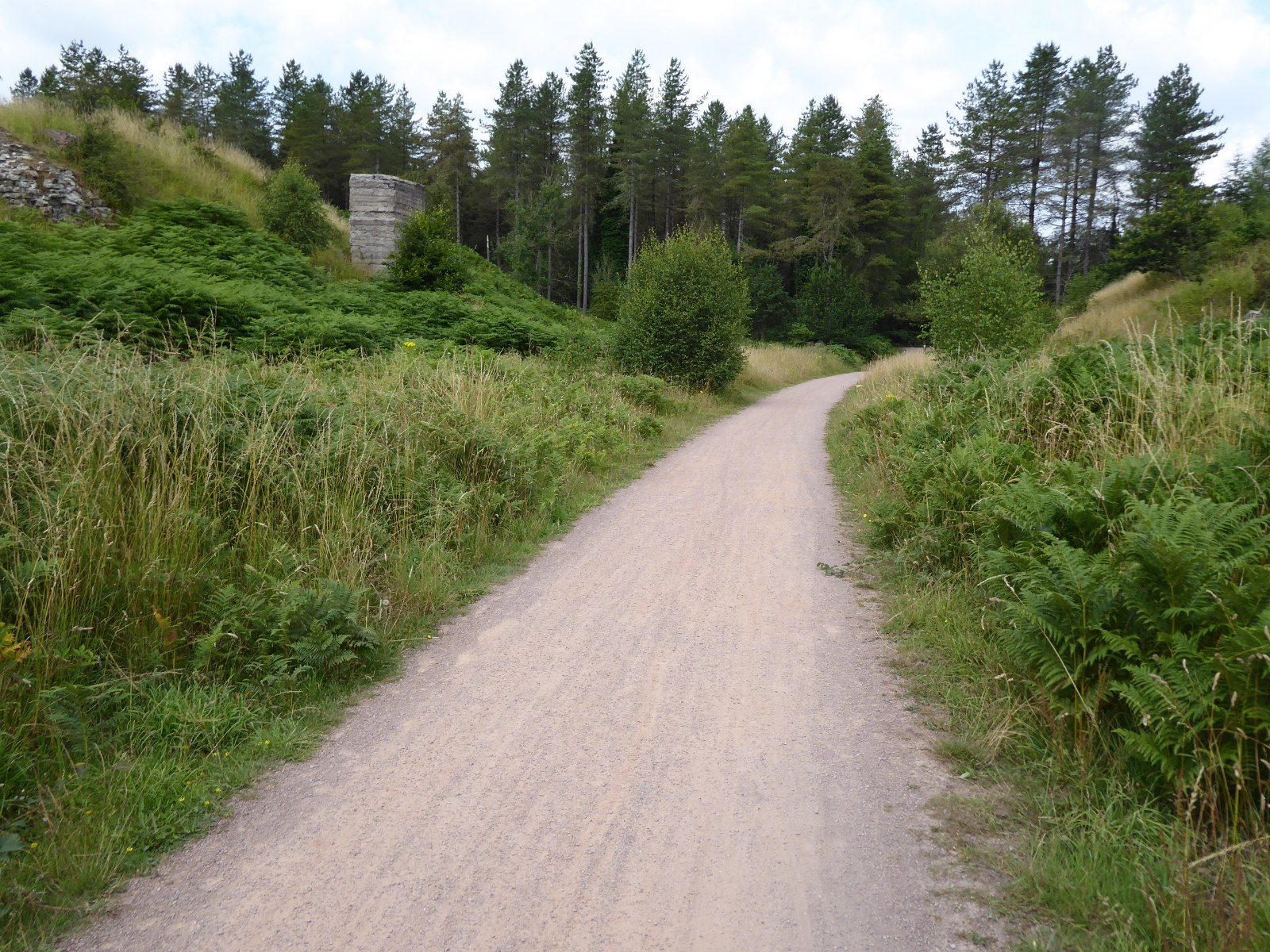
Cleared. A visitor in June 2020 found the tip largely levelled and the site given over to forest, with the former railway now a cycleway through it and odd pieces of concrete left — one prominent surviving block apparently part of the overhead tramway that fed the loading screens. An information board on the cycleway marks the spot.
Some concrete and stone walls and foundations survive, including what may be a loading wharf. Much of the tip has been levelled, the waste taken away for brickmaking.
Related mines
- Lightmoor Colliery — Under common Crawshay ownership from 1904; Foxes Bridge bought part of the Lightmoor gale in 1892 because that coal could be worked more cheaply from its own shafts, and the two collieries bought Trafalgar jointly in 1919 to keep it pumping. The Forestry Commission was warned in 1924 that if Foxes Bridge flooded, Lightmoor would follow.
- Trafalgar Colliery — Bought jointly by the managements of Foxes Bridge and Lightmoor in 1919, not to work but to stop it ceasing to pump and drowning both of their workings.
Nearby mines
- Northern United Colliery — 0.6 miles (1.0 km) N
- All Profit Colliery — 1.3 miles (2.1 km) N
- Haywood Colliery — 1.3 miles (2.1 km) NE
- Eastern United Colliery — 1.5 miles (2.4 km) SE, Forest of Dean
- Trafalgar Colliery — 1.8 miles (3.0 km) E, Forest of Dean
Straight-line distance, within 9 miles (15 km). Show on the map.
Disasters & major incidents
-
Foxes Bridge Colliery shaft accident
28 May 1893 · Winding / Shaft Accident · 3 fatalities
Three shaftmen repairing a pump 150 yards down the Foxes Bridge shaft were killed when the bridle chains of the cage they were riding snapped and it fell; a fourth man saved himself by clutching the shaft guides.
What's uncertain
Points where sources disagree or the record could not be settled; both accounts are kept. All open questions in the archive.
- Accounts differ on when the northern colliery was begun. The Forest of Dean Local History Society dates the new sinking to 1855, after an original colliery of about 1837 near the Speech House was never completed; the Lightmoor Press history has work starting on the southern site in 1855, the shafts flooding before coal could be won, and the move north made by 1869. (disputed) 1,3
Recorded claims
Individual factual claims, each attached to the source(s) that support it below. Where sources disagree, both are kept.
- Foxes Bridge was one of the largest collieries in the Forest of Dean, producing 126,978 tons of coal in 1880 and 500 tons a day in 1906. 1
- Two shafts, the Land and Deep Pits, worked the Twenty Inch, Lowery, Starkey, Rocky and Churchway High Delf Seams of the Supra-Pennant Group, the last reached at 851 ft in the Land Pit. 1,2
- Accounts differ on when the northern colliery was begun. The Forest of Dean Local History Society dates the new sinking to 1855, after an original colliery of about 1837 near the Speech House was never completed; the Lightmoor Press history has work starting on the southern site in 1855, the shafts flooding before coal could be won, and the move north made by 1869. (disputed) 1,3
- The colliery closed in 1930 because of water entering from Crump Meadow Colliery, which had closed the previous year. 1,4
- Answering in the Commons on 23 June 1930, the Parliamentary Secretary stated that the Forestry Commissioners put their loss of rent or royalties at about £700 a year, considered the quantity of water relatively small and one the company could and should have dealt with, and were under no liability to prevent the flooding or to compensate the company. 4
- In June 1924 a feeder of water broke into the Deep Pit shaft at a depth of 382 feet at approximately 410 gallons a minute; by 1928 the colliery was pumping an estimated 63 million gallons a year. 3
- The managements of Foxes Bridge and Lightmoor bought Trafalgar Colliery jointly in 1919 to protect their own workings from Trafalgar’s water should it cease pumping. 1,3
- An accident report of August 1873 records that cages were not in use at Foxes Bridge and that ten men at a time were raised and lowered in carts free to swing in the shaft; cages were required to be provided as a result. 3
- The BGS mine-plans catalogue holds a Mining Remediation Authority abandonment plan titled 'Foxes Bridge' (catalogue SWR654, Rockey, dated 1930). 5
Photographs & further reading
The fullest account of the colliery’s ownership and railway connections, from the c.1826 gale to William Montague and Moses Teague through the 1888 limited company to the twenty-year fight with water that ended it.
View sourceThe Forest of Dean Local History Society’s compilation of fatal accidents from the mine inspectors’ reports, colliery by colliery; the Foxes Bridge section names twenty-six men killed between 1863 and 1918 and gives the inspector’s account of each death.
View sourceSources
- (secondary) Foxes Bridge Colliery — Forest of Dean Local History Society
- (primary) Miners Memorial Project: Fatalities in Coal Mines — Forest of Dean Local History Society
- (secondary) Foxes Bridge — Forest of Dean Coal Mining — Lightmoor Press
- (primary) Foxes Bridge Colliery, Cinderford (HC Deb 23 June 1930 vol 240 cc802-3) — Hansard, UK Parliament
- (primary) BGS / Mining Remediation Authority mine plans: FOXES BRIDGE — British Geological Survey / Mining Remediation Authority
- (observational) Remains of Foxes Bridge Colliery (photographed 2 June 2020) — John Winder, Geograph Britain and Ireland
Record created: 6 September 2026 · Last researched: 6 September 2026