 MineArchive
Dog Delf Colliery
| Also known as | Dog Delf No. 2 |
|---|---|
| Location | Moseley Green, near Yorkley, Gloucestershire — 51.7740, -2.5348 (approximate) |
| Commodity | Coal |
| Type | Coal |
| Worked | 1872–1899 (gale forfeited) |
| Maximum depth | Unknown. A stone shaft and a level. |
| Operators | Henry Phipps (1872–1883), T. Hodgkinson (1891–1899) |
Overview
A small Forest of Dean gale at Moseley Green, near Yorkley, granted to Henry Phipps of Yorkley on 2 August 1872 to get coal in the Dog Delf vein and returned under his name in the official 1880 list of collieries at work. The gale ran to ninety-four acres of what the record itself calls a thin irregular seam. It was surrendered in 1883, re-granted in 1886, and passed through half a dozen hands in the next decade — James Jones to Bernard Edwards, to Albert Jones, to T. Hodgkinson, who was bankrupt by 1893, registered as sole owner in 1897, and bankrupt again. The gale was forfeited in 1899. A Dog Delf No. 2 survived on paper until 1926, when it too was forfeited.
History
The gale was granted on 2 August 1872 to Henry Phipps of Yorkley to get coal in the Dog Delf vein, and it is under his name that the official list of collieries at work in 1880 returns the pit: "Dog Delf, Yorkley, H. Phipps". Richard Ellway of Pillowell applied for a re-grant in October 1885 on an application dated 28 March 1876; the gale is described there as situate at Moseley Green, ninety-four acres, thin irregular seam. Land was leased in connection with Dog Delf south of the Moseley Green tunnel in 1879.
By August 1884 the neighbouring Little Brittan was being worked from the same level — or possibly shaft — as Dog Delf, Dog Delf having been surrendered the year before and the leased land transferred to Little Brittan. The gale was granted again on 19 February 1886, and then moved almost continuously: three-quarters conveyed from James Jones to Bernard Edwards in May 1889, a threatened surrender that October, a conveyance to Albert Jones in November, and an advertisement in August 1890 offering Dog Delf No. 2 for sale, applications to Albert Jones of Long Row, Ruspidge. T. Hodgkinson was registered sole owner in August 1891 and bankrupt by September 1893.
He was registered as owner again in April 1897, and his own account of the venture survives in the gaveller’s papers: "I had two partners… I expended £76 in surface equipment, in addition to opening up the stone shaft and exposing the seam at depth." By the end of December 1897 he had gone bankrupt again some eighteen months earlier, and the gale was forfeited on 23 January 1899. Dog Delf No. 2 lingered on the register until 23 January 1926, when it was marked for forfeiture in its turn.
Geology
The Dog Delf vein, on the eastern side of the Forest of Dean basin near Moseley Green. The gaveller’s own description of the gale — ninety-four acres, thin irregular seam — is the whole geological verdict, and explains the ownership history better than anything else could: a seam too thin and too broken to repay the capital anybody put into it, over an area large enough to keep tempting people to try.
Geological setting: Sedimentary Beds and Seams (well documented example)
Workings
A stone shaft and a level, on the evidence of Hodgkinson’s own account of opening up the shaft and exposing the seam at depth, and of the 1884 note that the neighbouring Little Brittan was worked from the same level or shaft. Surface equipment amounted to £76 of Hodgkinson’s money. A Dog Delf No. 2 existed separately and outlived the original gale on the register by nearly thirty years.
Closure
Dog Delf was surrendered in 1883 and re-granted in 1886, and the gale was finally forfeited on 23 January 1899 after its last registered owner, T. Hodgkinson, went bankrupt for the second time. Dog Delf No. 2 was marked for forfeiture on 23 January 1926 — exactly twenty-seven years later to the day.
What remains
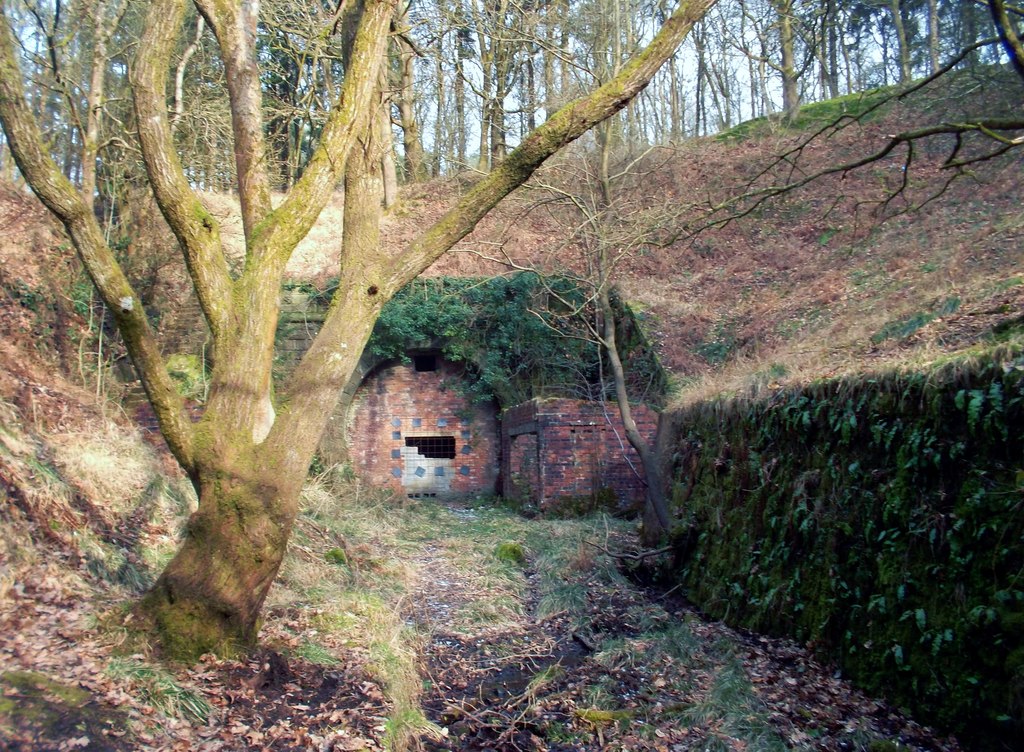
Nothing is known to survive on the ground. Moseley Green is now open forest, crossed by tracks and by the Severn and Wye Railway’s Moseley Green tunnel, beside which land was leased for the colliery in 1879.
Nothing specific to the colliery is known. The Moseley Green tunnel, south of which the colliery’s leased land lay, survives.
Nearby mines
- New Fancy Colliery — 0.7 miles (1.1 km) NW
- Brookall Ditches Colliery — 0.9 miles (1.5 km) W
- Princess Royal Colliery — 1.3 miles (2.0 km) SW, Forest of Dean
- Eastern United Colliery — 2.1 miles (3.3 km) NE, Forest of Dean
- Hopewell Colliery — 2.1 miles (3.5 km) NW
Straight-line distance, within 9 miles (15 km). Show on the map.
Recorded claims
Individual factual claims, each attached to the source(s) that support it below. Where sources disagree, both are kept.
- The official list of collieries at work in 1880 returns the pit as "Dog Delf, Yorkley, H. Phipps". 1
- The gale was granted on 2 August 1872 to Henry Phipps of Yorkley to get coal in the Dog Delf vein; a re-grant application recorded in October 1885 describes it as situate at Moseley Green, ninety-four acres, thin irregular seam. 2
- Dog Delf was surrendered in 1883 and the land leased in connection with it transferred to Little Brittan, which by August 1884 was being worked from the same level or shaft; the gale was granted again on 19 February 1886. 2
- Three-quarters of the gale was conveyed from James Jones to Bernard Edwards in May 1889, then to Albert Jones that November; Dog Delf No. 2 was advertised for sale in August 1890; T. Hodgkinson was registered sole owner in August 1891 and bankrupt by September 1893. 2
- Hodgkinson recorded in April 1897 that he had had two partners and had expended £76 in surface equipment, in addition to opening up the stone shaft and exposing the seam at depth; by the end of that year he had been bankrupt for some eighteen months. 2
- The gale was forfeited on 23 January 1899, and Dog Delf No. 2 was marked for forfeiture on 23 January 1926. 2
Photographs & further reading
A page of abstracts from the gaveller’s records that reads as a short history of failure: the 1872 grant, the surrender, the re-grant, five changes of hand in a decade, two bankruptcies and the 1899 forfeiture — with Hodgkinson’s own account of the £76 he spent.
View sourceSources
- (secondary) List of coal mines UK 1880 — Coalmining History Resource Centre
- (secondary) Dog Delf — Forest of Dean Coal Mining — Lightmoor Press
- (observational) Moseley Green Tunnel (photographed 9 February 2012) — Des Blenkinsopp, Geograph Britain and Ireland
- (secondary) A History of the County of Gloucester: Volume 5, Bledisloe Hundred, St Briavels Hundred, the Forest of Dean — Industry — Victoria County History / British History Online
- (secondary) Forest of Dean coal mines — index of named collieries — torrens.org
Record created: 6 September 2026 · Last researched: 6 September 2026