 MineArchive
Glensanda Quarry
| Location | Morvern peninsula, on Loch Linnhe opposite Lismore, Highland — 56.5671, -5.5376 (exact) |
|---|---|
| Commodity | Granite |
| Type | Quarry |
| Worked | 1986–Still active |
| Maximum depth | Not a depth in the mining sense: the working face is cut downwards into a mountain from about 500 m above sea level, and the glory hole shaft that carries the stone into the mountain is 1,000 ft (300 m) deep. |
| Operators | Foster Yeoman Ltd. (1982–2006), Aggregate Industries (2006–?) |
Overview
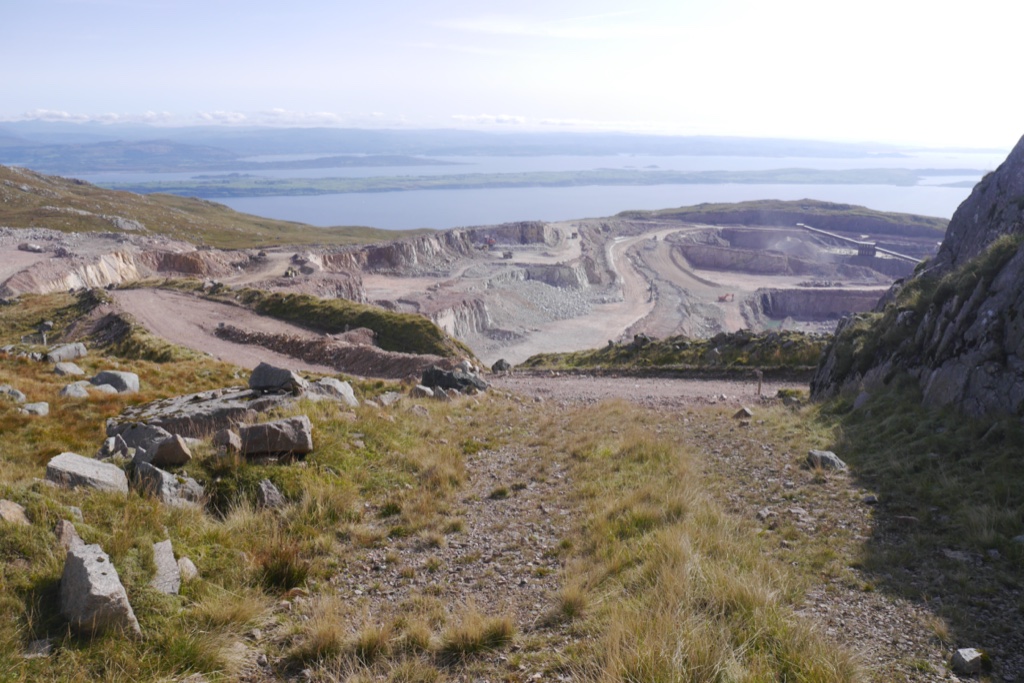
A granite superquarry on the Morvern peninsula, begun in 1986 and still working — the largest of its kind in Europe. It has no road: everything leaves by sea from its own deep-water berth on Loch Linnhe, and the workforce arrives by boat. The quarry is deliberately hidden, cut into the back of Meall na h-Easaiche a mile inland and 500 m up, and the stone reaches the shore by falling 300 m down a 'glory hole' shaft into a conveyor tunnel driven through the mountain.
History
In 1976 the UK government commissioned Sir Ralph Verney to report on the shortage of aggregates for construction. The resulting Verney report identified the case for coastal superquarries in remote places from which stone could be shipped rather than trucked, and led John Yeoman, chairman of the Somerset quarrying firm Foster Yeoman, to look for a site. In 1982 he bought the 2,400-hectare Glensanda estate in Argyll from Patricia Strutt, adding the neighbouring Kingairloch estate in 1989.
The quarry went into operation in 1986, the first shipload of granite leaving for Houston, Texas on 5 August that year. Extraction by the glory hole and conveyor method began in June 1989. Foster Yeoman was acquired by the Holcim group in 2006 and the quarry is now operated by its Aggregate Industries subsidiary.
By 1998 around 160 people worked at Glensanda, living on site or commuting by boat from Barcaldine near Oban, with exports going to Amsterdam, Hamburg, Rostock, Świnoujście and the Isle of Grain. The site is now a designated UK port with its own harbour master and customs clearance, and among the largest UK ports by tonnage exported.
Geology
The quarry works the granite of Meall na h-Easaiche, part of the Strontian granite complex of the Morvern peninsula. The rock is hard, uniform and largely unweathered, which is what makes it valuable as high-specification aggregate rather than as building stone; reserves are put at more than 700 million tonnes, enough for a century or more of working at present rates.
Workings
The quarry is sited about a mile inland and 1,600 ft (500 m) above sea level, cut down into the mountain so that nothing is visible from the coast. Each blast brings down roughly 70,000 tonnes of granite, taken by dump truck to a primary crusher that reduces it to lumps no more than nine inches across. A conveyor carries the crushed stone to a heap covering the 'glory hole' — a vertical shaft 1,000 ft (300 m) deep and 10 ft (3 m) across, kept permanently full of rock. At its foot, deep inside the mountain, the stone transfers to a horizontal conveyor running through a tunnel about a mile long to a second crusher on the shore, where ships load at 6,000 tonnes an hour. There is a processing plant, a small airstrip, a deep-water berth taking ships up to 120,000 tonnes and a small harbour for the workers' ferry from Port Appin.
Closure
Still in production. Aggregate Industries states planning permission to produce up to 15 million tonnes a year against reserves of more than 700 million tonnes; reserves have been estimated to last until about 2100, by which time the excavation will have cut a new corrie roughly 1½ miles square and 400 ft deep.
What remains
A working quarry on private land, accessible only by boat, operating 24 hours a day year-round with a workforce of around 200. It holds a Biodiversity Benchmark award and has funding approved to plant over 60 hectares of native woodland; a monument of national significance stands on the site.
Not applicable — the quarry, processing plant, jetty and harbour are all in active use.
Nearby mines
- Lochaline Mine — 9.2 miles (14.8 km) W
Straight-line distance, within 9 miles (15 km). Show on the map.
Recorded claims
Individual factual claims, each attached to the source(s) that support it below. Where sources disagree, both are kept.
- The 1976 Verney report into the shortage of construction aggregates led John Yeoman of Foster Yeoman to the idea of a remote coastal superquarry shipping stone by sea; he bought the 2,400-hectare Glensanda estate in 1982 and the Kingairloch estate in 1989. 1
- The quarry went into operation in 1986, the first shipload of granite leaving for Houston, Texas. 2,1
- Extraction using the glory hole and conveyor method began in June 1989: a vertical shaft 300 m deep and 3 m across, kept permanently full of rock, feeds a conveyor running about a mile through the mountain to the shore. 1
- Around 6 million tonnes of granite are exported annually, loading at 6,000 tonnes an hour into ships of up to 120,000 tonnes at the site's own deep-water berth. 3,2
- Aggregate Industries states reserves of more than 700 million tonnes with planning permission to produce up to 15 million tonnes a year; reserves have been estimated to last to about 2100. 3,1
- The site has no road connection: it is a designated UK port with its own harbour master and customs clearance, and the workforce reaches it by a private ferry across Loch Linnhe from Port Appin. 3,2
Photographs & further reading
The operator's own account of the site, giving current reserves, production consent, workforce and the port and ferry arrangements that make a roadless quarry work.
View sourceGlensanda treated as what it also is — a private commercial port, with its ownership, tonnages and the dedicated bulk carriers that serve it.
View sourceSources
- (secondary) Glensanda — Wikipedia
- (secondary) Glensanda — Ports.org.uk
- (primary) Glensanda coastal quarry — Aggregate Industries
- (observational) Glensanda Quarry — Buddlepit Mine Database
Record created: 3 September 2026 · Last researched: 3 September 2026