 MineArchive
Barnack Quarries
| Location | Barnack, near Stamford — just across the Lincolnshire border in Cambridgeshire/City of Peterborough, Cambridgeshire — 52.6290, -0.4120 (approximate) |
|---|---|
| Commodity | Limestone |
| Type | Stone |
| Worked | Roman period–c. 1500 (stone exhausted) |
| Maximum depth | Shallow open pits only — no deep or underground working |
| Operators | Peterborough Abbey (?–1500) |
Overview
A Jurassic limestone quarry worked from Roman times until it was exhausted around 1500, its stone building Peterborough and Ely Cathedrals — and, remarkably, the worked-out pits themselves are now one of Britain's most important wildflower nature reserves.
History
Barnack stone was being quarried by the Roman period, but its most intensive working came in the Middle Ages, when the quarries were the prized possession of Peterborough Abbey. The abbey licensed other religious houses to extract stone for their own building projects, including Ramsey, Bury St Edmunds, Sawtry and Crowland abbeys, which were frequently in dispute with each other and with Peterborough over access and rights — in 1150 the monks of Ramsey paid an annual rent of 3,000 eels to Peterborough for leave to quarry there, and Sawtry Abbey dug its own canal, Monks Lode, to reach the quarries, crossing Ramsey Abbey's land and triggering further disputes. Peterborough and Ely Cathedrals were both built largely of Barnack stone, and it was shipped as far as London for major building projects, among the earliest English stones to be moved that distance by water. By around 1500 the economically useful stone had been exhausted; some Cambridge colleges later built with Barnack stone reclaimed from earlier structures rather than freshly quarried material.
Geology
Barnack lies on the Lincolnshire Limestone Formation, a Jurassic oolitic limestone laid down around 150 million years ago in a shallow tropical sea. The quarries actually yielded two distinct kinds of stone: the common variety, 'Barnack Rag', is a hard, coarse, richly shelly limestone that could be dressed into ashlar or used as rubble walling but does not cut cleanly in every direction; a much more limited, finer-textured oolitic freestone was also present, reserved for detailed carving such as window tracery and mouldings where Barnack Rag's coarser texture would not hold fine detail.
Workings
The medieval quarries were worked as shallow open pits dug downward rather than as galleries or shafts — aerial photography shows the small, individually modest scale of each pit, in contrast to the huge continuous excavations of later stone industries at Portland or Bath. Cut blocks were hauled by sledge to the nearby River Welland, then loaded onto barges and taken down the Welland and Nene and across the Fenland waterway network to reach distant building sites, including London.
Closure
By approximately 1500 all the economically useful stone within reach of the medieval workings had been removed, and quarrying at Barnack effectively ended; there is no record of any significant later reopening or industrial-era working on the site.
What remains
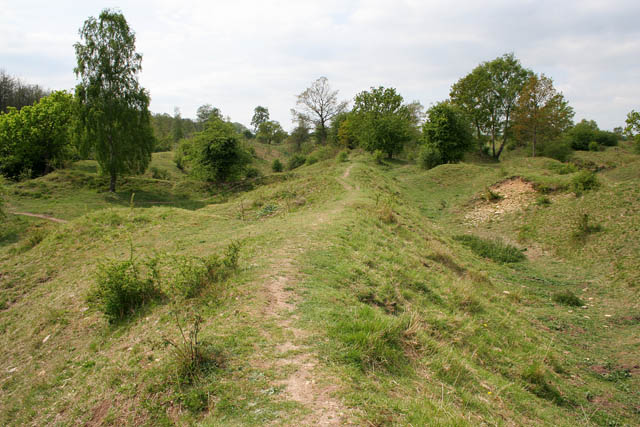
The abandoned pits gradually grassed over, and centuries of undisturbed, nutrient-poor limestone grassland developed across the old quarry spoil, now supporting one of Cambridgeshire's most important surviving wildlife habitats — around half of the county's remaining limestone grassland, rich in orchids and other wildflowers. The site is protected as the Barnack Hills & Holes National Nature Reserve, a Site of Special Scientific Interest and a Special Area of Conservation, and is managed today partly by autumn grazing with up to 300 sheep to prevent coarser vegetation from crowding out the grassland flora.
The undulating 'hills and holes' landscape itself is the direct surviving footprint of the medieval quarry pits — no structures or machinery remain, but the pitted ground is essentially unchanged since quarrying stopped, making the site an unusually legible record of pre-industrial stone extraction.
Nearby mines
- Collyweston Slate Mines — 2.7 miles (4.4 km) SW, Northamptonshire
- Ketton Quarry — 6.6 miles (10.6 km) W, Rutland
- Clipsham Quarry — 8.6 miles (13.9 km) NW, Rutland
Straight-line distance, within 9 miles (15 km). Show on the map.
Recorded claims
Individual factual claims, each attached to the source(s) that support it below. Where sources disagree, both are kept.
- Barnack stone was quarried by the Roman period and worked intensively through the Middle Ages, with all economically useful stone exhausted by around 1500. 1
- The quarries were the prized possession of Peterborough Abbey, which licensed other monastic houses to extract stone; in 1150 Ramsey Abbey paid an annual rent of 3,000 eels to Peterborough for quarrying rights. 2,3
- Barnack yielded two distinct stone types: the common, hard, richly shelly 'Barnack Rag', used for ashlar and rubble walling, and a limited, finer-grained oolitic freestone reserved for detailed carving such as window tracery. 4
- The worked-out quarry pits, known as the Hills and Holes, developed into wildflower-rich limestone grassland and are now protected as a National Nature Reserve, Site of Special Scientific Interest and Special Area of Conservation, holding around half of Cambridgeshire's surviving limestone grassland. 1
Sources
- (secondary) Barnack Hills & Holes National Nature Reserve — Wikipedia
- (secondary) Barnack stone, one of the earliest stones to be shipped to London — Building London
- (secondary) Village History — Barnack & Pilsgate Parish Council
- (primary) Barnack Rag Stone — Archaeology Data Service
- (primary) Cambridgeshire: Building Stones of England — Historic England
Record created: 22 August 2026 · Last researched: 22 August 2026