 MineArchive
Ketton Quarry
| Also known as | Ketton Quarries, Ketton Cement Works Quarry |
|---|---|
| Location | East of Ketton, near Stamford, Rutland — 52.6390, -0.5680 (exact) |
| Commodity | Limestone |
| Type | Quarry |
| Worked | From the 16th century–Still active |
| Maximum depth | The worked section is about 45 metres of Jurassic strata, of which 21.5 metres is the main limestone. |
| Operators | Ketton Portland Cement Company (1929–1986) |
Overview
A working Jurassic limestone quarry in Rutland with two distinct histories. Ketton stone — a cream to pale yellow oolite — has been used as a freestone since the sixteenth century and built much of Cambridge, most of it going to buildings outside Rutland. Since 1929 the same ground has fed a cement works, the quarry supplying both the limestone and the clay from a single worked section. The older workings and spoil heaps are now a 115.6-hectare Site of Special Scientific Interest and one of the largest areas of semi-natural limestone grassland in the county.
History
Ketton stone was being used as a building stone by the sixteenth century, and its reputation was made elsewhere: a cream to pale yellow or pink oolitic freestone, it went chiefly to buildings outside Rutland, and above all to Cambridge, where it faces many of the colleges. The industrial chapter began with a builder. Frank Walker, of Sheffield, bought 1,174 acres of Ketton parish in 1921 — mostly old quarries and clay pits — and in 1925 set up a concrete block business as Walkers Ketton Stone Company. By 1927 he was raising capital for a cement works, and the Ketton Portland Cement Company was incorporated in August 1928. The reason for building here was simple: limestone and clay both lay in the company’s own quarries. Production began in July 1929 with one small wet kiln, and by the end of that year 140 men and two women on the permanent payroll had produced and despatched 8,500 tonnes of cement. The works has run without a break since. It was owned by Thomas W. Ward and Co. until 1981 and then by Rio Tinto Zinc; it carried Castle Cement branding from 1986 to 2009, and passed to Hanson after HeidelbergCement acquired the group in 2007. Clinker production to 2022 was about 62 million tonnes, the second largest total of any British cement plant.
Geology
A full section of Middle Jurassic strata, worked from the top down. The quarry face carries, in order: up to 4 metres of Great Oolite Limestone (Blisworth Limestone Formation, 165–166 million years); 12.5 metres of Great Oolite Clay (Rutland Formation, 166–168 million years) — the clay used in the cement; 21.5 metres of yellow Inferior Oolite limestone (Lincolnshire Limestone Formation, Upper and Lower members, 168–172 million years) — the main limestone; 3 metres of Upper Lias Shale; and 4.5 metres of Upper Lias Ironstone. Having the limestone and the clay in one face is why the cement works stands where it does. The exposure is nationally important in its own right. The site is a Geological Conservation Review site, described by Natural England as a critical site of considerable importance for lithostratigraphic and facies analysis in the Bathonian rocks of southern Britain.
Workings
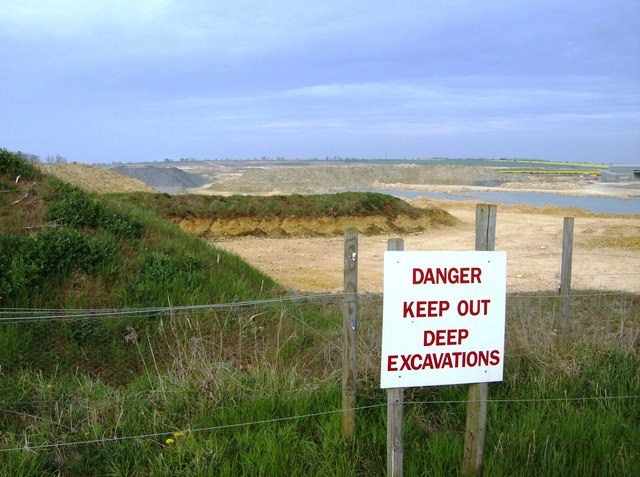
An open quarry worked in a single deep section that takes the whole Jurassic sequence, the clay and the limestone both going to the works. Ketton stone for building is taken as freestone from the oolitic beds. The older workings to the west have been abandoned and grassed over; parts of the site remain working quarry with no public access.
Closure
The quarry has not closed. Clinker manufacture at Ketton has been continuous since 1929, and the works remains one of the largest in Britain by cumulative output.
What remains
Partly a working quarry and partly a nature reserve. Ketton Quarries is a 115.6-hectare biological and geological Site of Special Scientific Interest east of the village, notified in 1986; 27.5 hectares of it are managed as a nature reserve by the Leicestershire and Rutland Wildlife Trust, reached from Pit Lane. The older workings and spoil heaps form one of the largest areas of semi-natural limestone grassland and scrub in the county. Other parts are still being quarried and are closed to the public.
The abandoned quarry faces and spoil heaps of the older workings, now grassland and scrub within the nature reserve, and the exposures for which the site is a Geological Conservation Review locality.
Related mines
- Clipsham Quarry — Both work the Lincolnshire Limestone in Rutland, eight miles apart, and both send freestone to the same buildings — Clipsham to King’s College Chapel and Ketton to many of the other Cambridge colleges. The link is the same formation and the same trade, not shared workings or ownership.
- Collyweston Slate Mines — Both work the Lincolnshire Limestone Formation within a few miles of Stamford — Ketton the oolitic freestone beds, Collyweston the narrow beds of the Lower Lincolnshire Limestone Member that frost splits into roofing slates. The same formation put a wall stone and a roof stone within carting distance of each other, which is why so many buildings around Stamford are made of both.
- Weldon Stone Quarries — Two Lincolnshire Limestone freestone quarries within a dozen miles, both supplying the Cambridge colleges from the fourteenth century onwards — Weldon into King’s College Chapel and the University Library, Ketton into many of the college fronts.
Nearby mines
- Collyweston Slate Mines — 4.5 miles (7.3 km) SE, Northamptonshire
- Clipsham Quarry — 5.5 miles (8.8 km) N
- Barnack Quarries — 6.6 miles (10.6 km) E, Cambridgeshire
- Rutland Ironstone Quarries — 6.6 miles (10.6 km) NW
- Cottesmore Ironstone Quarry — 6.8 miles (11.0 km) NW
Straight-line distance, within 9 miles (15 km). Show on the map.
Recorded claims
Individual factual claims, each attached to the source(s) that support it below. Where sources disagree, both are kept.
- Ketton stone is a Jurassic oolitic limestone, cream to pale yellow or pink in colour, used as a building stone since the 16th century and named after the village of Ketton in Rutland. It was used as freestone, mostly in buildings outside Rutland, particularly in Cambridge, where it was used in many of the colleges. 1
- Frank Walker, a Sheffield builder, bought 1,174 acres of Ketton parish in 1921, most of it old quarries and clay pits; he established Walkers Ketton Stone Company in 1925 and by 1927 was raising capital for a cement works. The Ketton Portland Cement Company was incorporated in August 1928 and the plant began production in July 1929. 2
- By the end of 1929 the 140 men and two women on the permanent payroll had produced and despatched 8,500 tonnes of cement. 2
- The quarry contains, from top to bottom, Great Oolite Limestone (Blisworth Limestone Formation, 165–166 Ma) up to 4.0 m in places; Great Oolite Clay (Rutland Formation, 166–168 Ma) 12.5 m — the clay used; yellow Inferior Oolite Limestone (Lincolnshire Limestone Formation) 21.5 m — the main limestone used; Upper Lias Shale 3 m; and Upper Lias Ironstone 4.5 m. 3
- Clinker manufacture at Ketton has been operational from 1929 to date, with approximately 62 million tonnes produced to 2022 — the second largest cumulative total of any British cement plant. 3
- The works was owned by the Ketton Portland Cement Co. Ltd from 1929 to 1986, itself owned by Thomas W. Ward and Co. Ltd until 1981 and then by Rio Tinto Zinc. It carried Castle Cement branding between 1986 and 2009 and became Hanson following HeidelbergCement’s acquisition of the group in 2007. 3,2
- Ketton Quarries is a 115.6-hectare biological and geological Site of Special Scientific Interest east of Ketton, notified in 1986, and a Geological Conservation Review site; 27.5 hectares are managed by the Leicestershire and Rutland Wildlife Trust. 4
- The site provides an extensive exposure of the Middle Jurassic Bathonian age, dating to around 167 million years ago, and is described by Natural England as "a critical site of considerable importance for lithostratigraphic and facies analysis in the Bathonian rocks of southern Britain". The older workings and spoil heaps are one of the largest areas of semi-natural limestone grassland and scrub in the county. 4
Photographs & further reading
The technical record of the works and its quarry: the full Jurassic section worked, which beds supply the limestone and which the clay, the ownership chain from 1929, and the cumulative clinker output.
View sourceThe SSSI and Geological Conservation Review site: its area and notification, the Bathonian exposure it protects, and the limestone grassland that has grown over the older workings.
View sourceSources
- (secondary) Ketton stone — Wikipedia
- (secondary) Ketton Cement Works — Wikipedia
- (secondary) Cement Kilns: Ketton — Dylan Moore, cementkilns.co.uk
- (secondary) Ketton Quarries — Wikipedia
- (secondary) Ketton Portland Cement Co — Grace’s Guide to British Industrial History
Record created: 8 September 2026 · Last researched: 8 September 2026