 MineArchive
Clipsham Quarry
| Also known as | Clipsham Medwells Quarry, Clipsham Old Quarry |
|---|---|
| Location | Clipsham, near Stamford, Rutland — 52.7180, -0.5560 (approximate) |
| Commodity | Limestone |
| Type | Quarry |
| Worked | From 1363–Still active |
| Maximum depth | An open quarry worked in benches; no shaft depth applies. |
| Operators | Clipsham Quarry Company, Stamford Stone Company |
Overview
Quarries around the Rutland village of Clipsham, working a white to cream oolitic limestone of the Upper Lincolnshire Limestone Formation. The earliest recorded use is for Windsor Castle between 1363 and 1368, and the stone is in King’s College Chapel, York Minster and the Examination Schools at Oxford. Its reputation was made in the twentieth century for a different reason: it was chosen to replace the failing Anston limestone on the Houses of Parliament, and has been the stone reached for ever since when another limestone has decayed. It is still quarried.
History
The quarries at Clipsham have been worked since at least the Middle Ages, and the earliest recorded use of the stone is for Windsor Castle between 1363 and 1368 — although the London Stone is made of it and dates back at least to about 1100. Clipsham stone is in King’s College Chapel at Cambridge, the Examination Schools at Oxford and York Minster. What made its modern reputation was somebody else’s failure. Anston limestone from Yorkshire had been carefully selected for the Houses of Parliament and proved unsuitable for the highly acidic conditions of Victorian London. In the 1920s Clipsham was deemed a suitable match in colour to the Anston and better able to bear the worst that London’s acid fogs could throw at it, and through the middle years of the twentieth century the failed Anston was gradually replaced with it. The quarry was expanded in the 1930s at the government’s request to supply the restoration of the river front at Westminster; the war interrupted the work and it was not finished until the 1960s. That established Clipsham as the stone of choice whenever a limestone failure needs to be put right. Why it never became a famous stone in its own right, like Portland or Bath, is a question the trade has asked. There was no great city near enough to be built of it — Peterborough had Stamford stone closer to hand, and Leicester, Nottingham and Cambridge all had their own sources — so it lacked a showcase. It was also hard: the hardest of all the Lincolnshire limestones, and so more difficult to work than its neighbours until mechanical excavation, sawing and shaping arrived. And the transport was poor; stone did not travel far by road until well into the twentieth century.
Geology
The Upper Lincolnshire Limestone Formation. Clipsham stone is a white to cream, fine-grained oolitic limestone containing ooliths and bioclasts, known in the trade as Clipsham Sugar Limestone for the small size of its ooliths. It is of the same broad family as Portland and Bath stone — all oolites — but harder than any of the limestones quarried around it, which is both the reason it lasts in polluted air and the reason it was slow to be adopted. Its chemistry means it absorbs pollution far more slowly than the stones it has been used to replace.
Workings
Open quarries around the village, worked for freestone. The workings were extended in the 1930s at the government’s request to meet the demand from Westminster, and after the Second World War the Attlee government took as much stone as the quarry could produce to rebuild the bombed Chamber of the House of Commons. Quarrying at Clipsham was filmed in 1927. Working continues today at more than one site, including Clipsham Medwells.
Closure
The quarries have not closed. Clipsham stone is still produced, and remains the stone commonly specified where an earlier limestone has decayed and needs replacing.
What remains
Still worked. Clipsham Old Quarry, north of Pickworth, is a disused part of the complex and is a biological and geological Site of Special Scientific Interest, notified with Pickworth Great Wood.
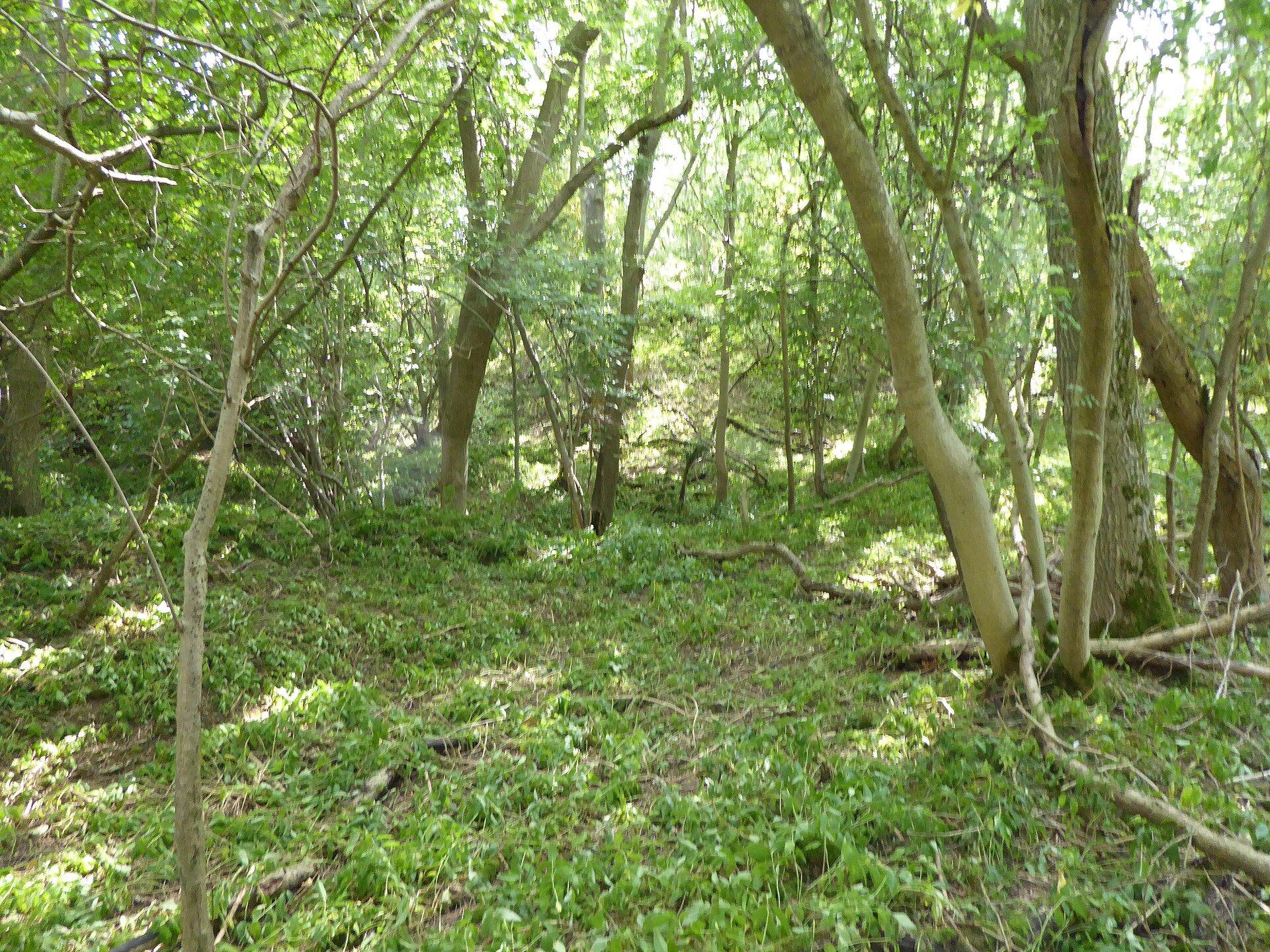
The abandoned faces of Clipsham Old Quarry, now within the Clipsham Old Quarry and Pickworth Great Wood SSSI, alongside the working quarries.
Related mines
- Ketton Quarry — Both work the Lincolnshire Limestone in Rutland, eight miles apart, and both send freestone to the same buildings — Clipsham to King’s College Chapel and Ketton to many of the other Cambridge colleges. The link is the same formation and the same trade, not shared workings or ownership.
- Weldon Stone Quarries — Both work the Upper Lincolnshire Limestone eight miles apart and were compared directly in the trade: Weldon stone is softer than Clipsham and consequently cheaper to work, which is why the two went to different jobs — Weldon into bulk college and cathedral work, Clipsham where durability in polluted air mattered.
Nearby mines
- Cottesmore Ironstone Quarry — 4.5 miles (7.3 km) W
- Rutland Ironstone Quarries — 4.6 miles (7.4 km) W
- Ketton Quarry — 5.5 miles (8.8 km) S
- Collyweston Slate Mines — 8.2 miles (13.2 km) SE, Northamptonshire
- Barnack Quarries — 8.6 miles (13.9 km) SE, Cambridgeshire
Straight-line distance, within 9 miles (15 km). Show on the map.
What's uncertain
Points where sources disagree or the record could not be settled; both accounts are kept. All open questions in the archive.
- The London Stone is made of Clipsham stone and dates back at least to about 1100. (uncertain) 1
Recorded claims
Individual factual claims, each attached to the source(s) that support it below. Where sources disagree, both are kept.
- The earliest recorded use of Clipsham stone was for Windsor Castle between 1363 and 1368. 1
- The London Stone is made of Clipsham stone and dates back at least to about 1100. (uncertain) 1
- Clipsham stone, part of the Upper Lincolnshire Limestone Formation, can be found in many of Britain’s most famous buildings including King’s College Chapel, Cambridge, the Examination Schools in Oxford, York Minster, and in repairs to the Houses of Parliament. 1
- Anston limestone from Yorkshire was originally selected for the Houses of Parliament but proved unsuitable for the highly acidic conditions created by sulphur emissions in London. In the 1920s Clipsham stone was deemed a suitable match in colour to the Anston but better able to bear the worst of London’s acidic fogs, and through the middle years of the 20th century the failed Anston was gradually replaced by Clipsham. 2
- Clipsham has a reputation for being the hardest of all the Lincolnshire limestones, which meant it was more difficult to process than the surrounding resources until mechanical excavation, sawing and shaping arrived. 2
- Clipsham never achieved the widespread reputation of the Portland and Bath stones, in part because there was no major city near enough to the source to be built of it: Peterborough had Stamford stone closer to hand, and Leicester, Nottingham and Cambridge were served by their own local stone. 2
Photographs & further reading
A trade assessment of the stone: why it was brought in to replace the failing Anston at Westminster, what makes it durable in polluted air, and why a stone this good never became a household name.
View sourceThe village article’s account of the quarries and the buildings the stone is in, from Windsor Castle in the 1360s to the Houses of Parliament.
View sourceSources
- (secondary) Clipsham — Wikipedia
- (secondary) Great British Stone: Clipsham — Barry Hunt, Natural Stone Specialist
Record created: 8 September 2026 · Last researched: 8 September 2026