 MineArchive
Godstone Mine
| Also known as | Godstone Hill Quarries, Godstone Firestone Mine, Godstone Main Series, Godstone Hill Quarry, Godstone Caves |
|---|---|
| Location | Godstone Hill, Surrey — 51.2645, -0.0653 (approximate) |
| Commodities | Firestone, Hearthstone |
| Type | Stone |
| Worked | Late 17th century–By the 1950s |
| Maximum depth | The galleries were reported in 1939 to lie eighty to two hundred feet below the surface; headroom through the workings is four to five feet. |
| Operators | Clayton estate |
Overview
An underground firestone and hearthstone quarry in the Upper Greensand beneath Godstone Hill, worked from the seventeenth century and reworked for hearthstone in the nineteenth. Second-hand plate rails from the Croydon, Merstham and Godstone Iron Railway were relaid in its haulage roads and survive in place.
History
The workings under the North Downs at Godstone, locally called caves, are underground stone quarries in the bed of sandstone that forms part of the Upper Greensand, lying directly beneath the chalk. The Upper Greensand of east Surrey has been worked for building stone since Roman times, with its heyday in the medieval centuries, but the Godstone quarries do not seem to have been developed significantly until the late seventeenth century. What is now called Godstone Main Series is an amalgamation of four or five distinct quarries: the southern series, the oldest, began in the mid eighteenth century as three separate firestone quarries known today as Sawmills, Roman Road and Jones, and in the early to mid nineteenth century the workings were pushed much further on a post-industrial scale, opening Road Quarry and the Main Series itself. The quarries were part of the Clayton estate and provided the family a useful income. They were worked on the pillar and stall system, by which up to eighty per cent of the stone could be and was removed at Reigate, Merstham, Chaldon and Godstone alike.
Firestone was a building material and also a refractory, standing high heat well enough to be used in furnaces, which is what gave it the name. It has no grain and can be cut in any direction, a freestone; before the railways it was the best stone obtainable in the south east without heavy transport costs. Quarrying reached its peak in the nineteenth century, when cast-iron plateways were laid in, probably because of the extent of the workings and the increasing weight of the blocks. Rails were fitted into the ruts that dragged carts had already worn in the stone floor, and the carts were then drawn by teams of usually three horses, whose gouges and wear marks can still be seen where harnesses caught the corners of the haulage routes. Demand for firestone faded once better stone could be brought cheaply from further away, and quarrying for it ended around 1900.
As firestone declined in the later nineteenth century it was replaced in part by hearthstone mining — a reworking of the inferior beds and the firestone waste for a quite different purpose. A fashion had developed in the middle of the century for whitening stone hearths, doorsteps and window ledges by rubbing hearthstone into them, which dried to a chalky white, and the Surrey mines supplied many hundreds of thousands of tons of it to retailers of household materials such as Blanchards of south-east London. The Godstone Hill workings were then turned over to growing mushrooms, French growers holding the site from about 1890 until the First World War, after which nearly every available square foot of floor was in use for mushroom beds until the 1930s. Compost was laid in long ridge beds, the walls were limewashed to disinfect the galleries, doors and barriers controlled the ventilation and pipes carried water to keep the beds moist. In February 1939 the Caterham air-raid-precautions committee put to the Home Office a scheme to house some thousands of Londoners at Godstone in wartime with shelter in the quarries, then thought to run some eight miles and to lie eighty to two hundred feet down; the passages were charted and their springs tested and passed fit to drink. The site was considered as a munitions store during the war and tidied up for it, with a narrow gauge railway installed in readiness, but was never used officially. Working had ceased by the 1950s.
Geology
The stone worked is a bed of sandstone in the Upper Greensand of the Cretaceous, lying directly beneath the chalk of the North Downs. The same formation across east Surrey yielded the building stone known as Reigate stone or firestone, worked between Reigate and Godstone; the softer hearthstone found in the inferior beds of the same sequence was worked later. A fossil of Cretaceous age survives in part of the quarry ceiling, the only one of any significant size yet found in the Godstone quarries.
Geological setting: Sedimentary Beds and Seams (well documented example)
Workings
Underground quarries on the pillar and stall system, by which up to eighty per cent of the stone could be removed. Godstone Main Series is an amalgamation of four or five distinct quarries: the older southern series, now called Sawmills, Roman Road and Jones, and the later Road Quarry and Main Series. Other quarries lie below Godstone Hill, including Marden. In about the mid nineteenth century cast-iron plate rails were fitted into the ruts that dragged carts had worn in the stone floor along the main haulage routes, and carts were drawn by teams of usually three horses. Two basic types of plate rail are present, light ones with curved flanges and heavy ones with straight flanges, further subdivided by earlier classifications; a fragment marked CM&G proved that some came second-hand from the Croydon, Merstham and Godstone Iron Railway. Sections of plateway track remain in place, making this one of the few underground sites in Britain with in situ plateways. A narrow gauge railway was installed during the Second World War for a munitions store that never came.
Closure
Quarrying for firestone continued until about 1900, when more durable stones brought from further afield and the rise of brick removed the demand; hearthstone working carried the quarries on, and mines further east supplied it into the 1940s and 1950s. The Godstone Hill workings themselves had been given over to mushroom growing by the early twentieth century, and stone working had stopped by the 1950s.
What remains
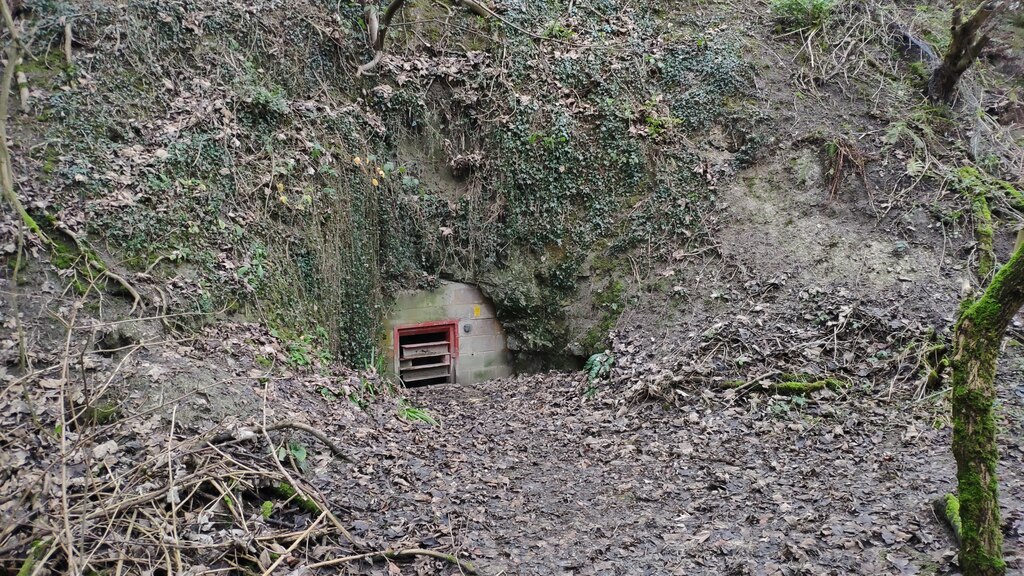
Dry and in good condition, with a great deal surviving of both the quarrying and the later uses: doorways, water routes and mushroom beds in situ, graffiti left by the mushroom growers and by later visitors, and the plateway track. Headroom is four to five feet throughout. The entrances have long been sealed. The site is gated and looked after by the Wealden Cave and Mine Society, and is used by hibernating bats.
Little at the surface beyond the sealed-off entrances on the wooded slopes of Godstone Hill; four entrances were known in 1939. The workings lie around the junction of what are now the M25 and the A22.
Redevelopment
None underground. At the surface the ground above the workings is wooded, and the M25 and A22 now meet above them.
Related mines
- Merstham Chalk Mines — Two of the four main Upper Greensand firestone districts of east Surrey, worked on the same pillar and stall system and studied together; both had plate rails from the Croydon, Merstham and Godstone Iron Railway, and Peter Burgess's study of those rails covers the two side by side.
Nearby mines
- Merstham Chalk Mines — 5.8 km W
- Nutfield and Redhill Fuller's Earth Mines — 7.2 km W
- Reigate Caves — 10.0 km W
Straight-line distance, within 15 km. Show on the map.
Recorded claims
Individual factual claims, each attached to the source(s) that support it below. Where sources disagree, both are kept.
- The workings are underground stone quarries in a bed of sandstone forming part of the Upper Greensand of the Cretaceous, which lies directly beneath the chalk. 1
- Quarrying started at Godstone sometime in the seventeenth century, and the Godstone quarries do not seem to have been developed significantly until the late seventeenth. 2,1
- Godstone Main Series is an amalgamation of four or five distinct quarries: the southern series, the oldest, began in the mid eighteenth century as three separate firestone quarries now called Sawmills, Roman Road and Jones, and in the early to mid nineteenth century Road Quarry and the Main Series itself were opened on a far larger scale. 3
- The quarries were worked on the pillar and stall system, by which up to eighty per cent of the stone could be, and was, removed at Reigate, Merstham, Chaldon and Godstone. 2
- Firestone was quarried partly as a building stone and partly for use in furnaces, standing high heat well; it has no grain and can be cut in any direction, making it a freestone, and before the railways it was the best stone obtainable in the south east without heavy transport costs. 3
- The quarries were part of the Clayton estate and provided the Clayton family a useful income over the years. 1
- Quarrying reached its peak in the nineteenth century, when the introduction of cast-iron plateways was deemed necessary, probably on account of the extent of the workings and the increasing weight of the stone blocks removed. 2
- Plate rails were fitted into the ruts that dragged carts had already worn into the stone floor, and the carts were then pulled by teams of usually three horses, whose contact with the corners of the haulage routes left gouges and wear marks still visible. 4
- A fragment of plate rail found in the Godstone quarries and clearly marked CM&G provided the proof that former Croydon, Merstham and Godstone Iron Railway rails were used there — which earlier studies by Bean and Osborne had concluded there was no evidence for. 2
- Old plate rails from the Croydon, Merstham and Godstone tram road, which ran from 1805 to about 1830, were relaid within the quarry for haulage, making this one of the few underground sites remaining in the United Kingdom with in situ plateways. 3
- Quarrying for firestone continued until about 1900, when more durable stones from further afield and bricks removed the demand, but some workings continued for several more decades supplying hearthstone. 1
- In the middle of the nineteenth century a fashion developed for whitening stone hearths, doorsteps and window ledges by rubbing hearthstone into them, leaving a chalky white deposit as it dried; the Godstone mines, with others in Surrey, supplied many hundreds of thousands of tons of it to retailers of household materials such as Blanchards of south-east London. 1
- From around 1890 until the First World War the site was used by French mushroom growers, who left their mark; until the 1930s nearly every available square foot of floor space was used to grow mushrooms, in long compost ridge beds, with the walls limewashed to disinfect the galleries and pipes installed to keep the beds moist. 3,1
- In February 1939 the Caterham air-raid-precautions committee submitted to the Home Office a scheme to house some thousands of Londoners at Godstone in wartime with underground shelter in the quarries, then thought to be about eight miles in length and eighty to two hundred feet below the surface; the passages were being explored and charted and several underground springs had been analysed and passed as fit to drink. 1
- During the Second World War the quarry was considered as a munitions store and many areas were tidied up and a small gauge railway installed in readiness, but it was never used for that purpose; local people used the workings as an unofficial shelter. 4
- A Cretaceous fossil survives in part of the quarry ceiling, the only one of any significant size found to date in the Godstone quarries. 4
- Stone working had stopped by the 1950s; the site is gated, looked after by the Wealden Cave and Mine Society, and used by hibernating bats. 3,4
- The Godstone Hill workings are extensive around the junction of the M25 and the A22. 5
- One of the long since sealed-off entrances to the mines was photographed in 2023. 6
- The Upper Greensand beds in east Surrey have been a source of building stone, known as Reigate stone or firestone, since Roman times, with its heyday in the medieval centuries; the workings between Reigate and Godstone have been the subject of detailed investigation since the 1960s. 7
Photographs & further reading
The study of the cast-iron plate rails in the Surrey firestone quarries, which classifies the two basic types found at Godstone and reports the CM&G-marked fragment that proved their origin.
View sourceAn account of the quarry complex: its four or five constituent quarries, the relaid CM&G plate rails, the hearthstone reworking and the mushroom growers who followed.
View sourceThe village's own history of the quarries, covering the Clayton estate, the hearthstone trade and the mushroom farm, and reprinting the Daily Telegraph's 1939 report of the proposed evacuation camp.
View sourceSources
- (secondary) Mines — Godstone Village — Godstone Village
- (secondary) Plate Rails in the Surrey Firestone Quarries (Peter Burgess) — Railway & Canal Historical Society
- (observational) Godstone Mine — Underground Kent
- (observational) Godstone Main Series Fire and Hearth Stone Quarry — TheTimeChamber
- (secondary) Godstone Hill Quarry — Martin Dixon, Subterranea Britannica
- (observational) Godstone Mines (Geograph 7062346) — Geograph Britain and Ireland
- (primary) Underground Surrey — Wealden Cave & Mine Society
Record created: 28 September 2026 · Last researched: 28 September 2026