 MineArchive
Tarbrax Oil Shale Mine
| Location | Tarbrax, South Lanarkshire — 55.7839, -3.5562 (exact) |
|---|---|
| Commodity | Oil Shale |
| Type | Mineral |
| Worked | 1870–1930s |
| Operators | Tarbrax Oil Company Ltd (1905–?) |
Overview
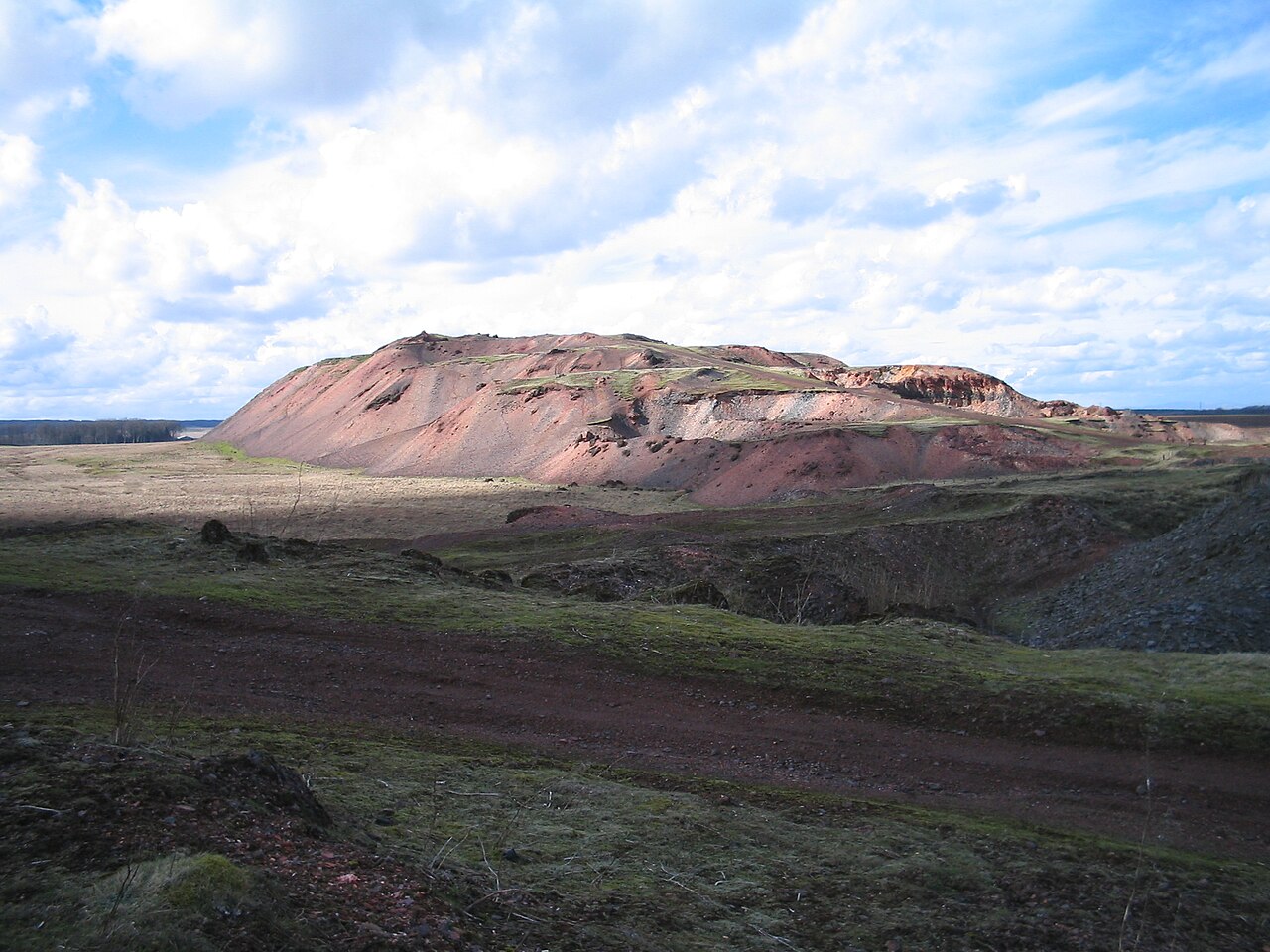
A remote outlying works of Scotland's shale oil industry, whose enormous red waste bing remains visible for miles across the Pentland Hills.
History
A shale oil works was established at Tarbrax, near Auchengray, by 1870, when the site — comprising a bench of 41 retorts with condensers, a pit winding engine, a manager's house and twelve workmen's cottages — was sold at public roup. In 1902, a company decision to cut wages closed the Tarbrax works through strike action, throwing around 500 men out of work. The Tarbrax Oil Company Ltd resumed development of the pit around 1905, and in 1904 the neighbouring No.1 pit at Cobbinshaw, Tarbrax, became the site of the first electric winding gear installed anywhere in Scotland. Fatal accidents at Tarbrax over the years are recorded as resulting from falling shale, runaway hutches, explosions and falls from retort platforms, though no single incident is documented in enough detail to stand as a discrete disaster record. The works closed as the wider Scottish shale oil industry declined through the early 20th century in the face of cheaper imported petroleum.
Geology
Tarbrax worked the southern, outlying end of the West Lothian oil shale field, part of a broad band of workable shale seams running from the Firth of Forth to West Calder and Tarbrax.
Workings
Shale was mined and brought to a bank of 41 retorts on site, where it was heated to drive off crude shale oil for further refining.
Closure
Tarbrax closed as the wider Scottish shale oil industry declined during the early 20th century, unable to compete with cheaper imported petroleum.
What remains
The large red waste bing from the works remains a prominent landscape feature.
A large shale waste bing survives as the most visible remaining feature of the works.
Related mines
- Burngrange Oil Shale Mine — West Lothian shale mines about six kilometres apart, working the same oil shale field.
Nearby mines
- Baads Colliery — 3.6 miles (5.8 km) NW, West Lothian
- Burngrange Oil Shale Mine — 4.1 miles (6.5 km) N, Midlothian
- Wilsontown Ironworks — 4.4 miles (7.0 km) W
- Woodmuir Colliery — 4.6 miles (7.4 km) NW, West Lothian
- Addiewell Oil Works — 4.8 miles (7.7 km) NW, West Lothian
Straight-line distance, within 9 miles (15 km). Show on the map.
What's uncertain
Points where sources disagree or the record could not be settled; both accounts are kept. All open questions in the archive.
- Fatal accidents at Tarbrax over the years are recorded as resulting from falling shale, runaway hutches, explosions and falls from retort platforms, though no single incident is documented in enough detail to stand as its own disaster record. (uncertain) 2
Recorded claims
Individual factual claims, each attached to the source(s) that support it below. Where sources disagree, both are kept.
- A shale oil works at Tarbrax was sold by public roup in 1870, comprising 41 retorts with condensers, a winding engine, a manager's house and twelve workmen's cottages. 1
- A company decision to cut wages closed the Tarbrax works through strike action in 1902, idling around 500 men. 1
- In 1904 the neighbouring No.1 pit at Cobbinshaw, Tarbrax, became the site of the first electric winding gear installed anywhere in Scotland. 1
- Fatal accidents at Tarbrax over the years are recorded as resulting from falling shale, runaway hutches, explosions and falls from retort platforms, though no single incident is documented in enough detail to stand as its own disaster record. (uncertain) 2
Sources
- (primary) Tarbrax Oil Works — Scottish Shale
- (secondary) Shale Mining in West Lothian — Scots Roots
Record created: 21 August 2026 · Last researched: 21 August 2026