 MineArchive
Rothes Colliery
| Location | Thornton, near Glenrothes, Fife — 56.1626, -3.1600 (exact) |
|---|---|
| Commodity | Coal |
| Type | Coal |
| Worked | 1946 (sinking)–May 1962 |
| Operators | Fife Coal Company (1946–1947), National Coal Board (1947–1962) |
Overview
A planned National Coal Board 'superpit' near Thornton in Fife, ambitious enough that the entire new town of Glenrothes was built to house its workforce — and whose geologically disastrous flooding made it, within four years of a royal opening, the most spectacular failure of the NCB era in Scotland.
History
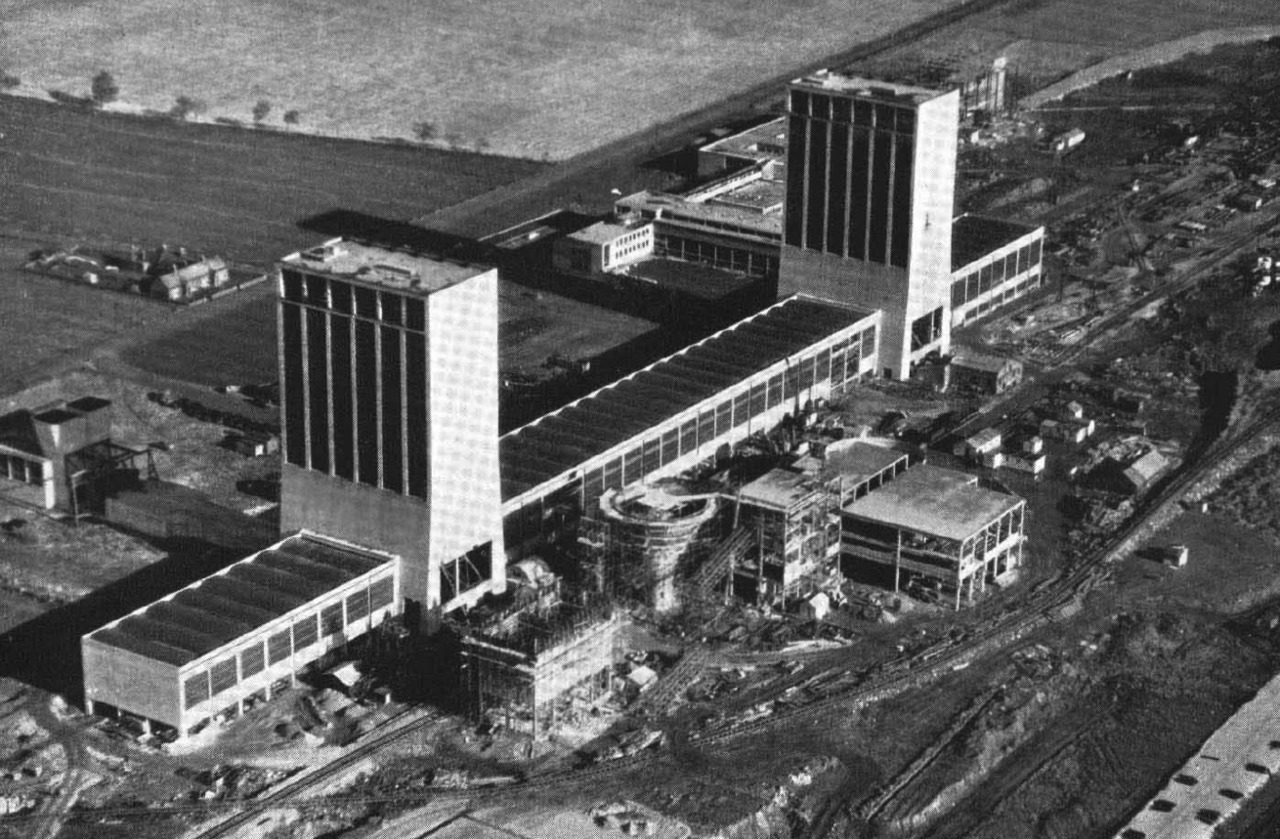
The Fife Coal Company began sinking deep shafts near Thornton in 1946, continued by the National Coal Board after 1947 nationalisation, planning Rothes as one of its 'Superpits' — intended to raise 5,000 tons of coal a day from steeply dipping seams and to work for well over a century. The scheme was judged important enough to central Fife's future that the new town of Glenrothes was built specifically to house its workforce. Architect Egon Riss designed the striking surface layout, its twin 200-foot concrete towers housing Koepe electric winders over each shaft, a technology also being adopted at contemporary English 'superpit' schemes such as Clipstone. Production began in 1957, and on 30 June 1958 Queen Elizabeth II formally opened the colliery, becoming the first British monarch to go down a working coal mine — an event some miners regarded, by old superstition, as an ill omen for a woman to be taken underground.
The omen, if it was one, proved apt. Rothes had been troubled from the start: in July 1951, during sinking, a loaded hoppit fell 1,000 feet down a shaft, trapping 22 men and killing one. Far more damaging was the geology itself — thinning coal seams, faulting and igneous intrusions cut through the workable coal, and water poured in at up to three times the volume expected, at times as much as 1,000 gallons a minute. Employment peaked at 1,235 in 1960, but production never approached its intended capacity, and costs spiralled from an original estimate of £1.65 million to around £20 million. The National Coal Board abandoned the scheme, closing Rothes in May 1962, not yet four years after the Queen's visit — by some accounts the most costly single mining failure of the NCB era in Scotland.
Geology
Rothes worked the Five Feet, Lochgelly Splint and Upper Cardenden Smithy seams, planned as steeply dipping measures capable of very high output; in practice the coal thinned unpredictably and was repeatedly cut by faulting and igneous intrusions, while water entered the workings at up to three times the volume the original survey had predicted.
Workings
Twin shafts were each equipped with 200-foot concrete winding towers, designed by architect Egon Riss and housing Koepe electric winders rather than the conventional cages used at most British collieries of the period. During sinking, in July 1951, a loaded hoppit fell 1,000 feet down one of the shafts, trapping 22 men and killing one — an early sign of the difficult ground conditions that would ultimately defeat the whole scheme.
Closure
The National Coal Board closed Rothes in May 1962, unable to overcome persistent flooding and unstable geology that had already pushed the scheme's cost from an estimated £1.65 million to around £20 million without ever reaching its planned output.
What remains
The colliery's twin winding towers stood as prominent Fife landmarks for over three decades after closure before being demolished on 15 March 1993, their rubble deposited down the shafts and covered over. Some ancillary structures survive. In an unusual afterlife, the sealed shafts were later used to test equipment intended for North Sea oil development.
The twin winding towers were demolished in 1993; some ventilation structures and other ancillary buildings survive.
Nearby mines
- Thornton Colliery — 0.7 miles (1.1 km) E
- Balgonie Colliery — 1.7 miles (2.7 km) NE
- Randolph Colliery — 1.7 miles (2.7 km) SE
- Earlseat Colliery — 2.3 miles (3.7 km) E
- Kinglassie Colliery — 2.7 miles (4.4 km) W
Straight-line distance, within 9 miles (15 km). Show on the map.
Recorded claims
Individual factual claims, each attached to the source(s) that support it below. Where sources disagree, both are kept.
- The Fife Coal Company began sinking Rothes from 1946, continued by the National Coal Board, planning it as a 'Superpit' raising 5,000 tons a day from steeply dipping seams; the new town of Glenrothes was built specifically to house its workforce. 1,2
- Architect Egon Riss designed Rothes's surface layout, its twin 200-foot concrete towers housing Koepe electric winders over each shaft. 2
- Queen Elizabeth II formally opened Rothes Colliery on 30 June 1958, becoming the first British monarch to go down a working coal mine. 1
- In July 1951, during sinking, a loaded hoppit fell 1,000 feet down a shaft, trapping 22 men and killing one. 1
- Water entered the workings at up to three times the expected volume, at times 1,000 gallons a minute, compounded by thinning seams, faulting and igneous intrusions; costs rose from an estimated £1.65 million to around £20 million before the scheme was abandoned. 1,2
- The twin winding towers were demolished on 15 March 1993, with rubble deposited down the shafts; the sealed shafts were later used to test equipment for North Sea oil development. 1,2
Sources
- (secondary) Rothes Colliery: When the ill-fated Fife coal mine was blasted into rubble — The Courier
- (secondary) Rothes Colliery — Northern Mine Research Society
Record created: 27 August 2026 · Last researched: 27 August 2026